
 Back
Back





IN THE HIGH COURT OF KERALA AT ERNAKULAM
Sathish Ninan, P. Krishna Kumar, JJ.
Shaiju – Petitioner
Versus
Manikandan – Respondent
RFA NO. 36 OF 2021 (D)
Decided On : 22-05-2026
| Table of Content |
|---|
| 1. overview of the suit for recovery and the defense of fabrication. (Para 1 , 2 , 3 , 4) |
| 2. inconsistency in pleadings undermines the credibility of the transaction. (Para 8 , 9 , 10 , 11 , 12) |
| 3. failure to discharge the burden of proof regarding execution of a document. (Para 17 , 18 , 19) |
JUDGMENT :
P.Krishna Kumar, J.
The suit for recovery of money based on a demand promissory note was decreed in part by the trial court by the judgment impugned in this appeal. The appeal is preferred by the plaintiff challenging the judgment to the extent the plaint claim was declined.
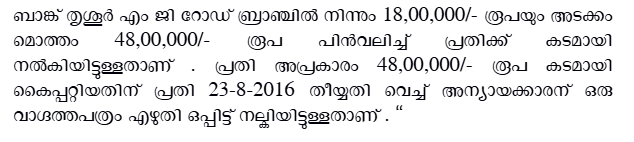
2. For the sake of convenience, the parties are hereinafter referred to as they were arrayed in the suit. The plaintiff contended that, in June 2016, the defendant, who was a close acquaintance, requested a loan of Rs.50,00,000/- for procuring gold for commercial purposes. The plaintiff allegedly lent him Rs.48,00,000/- by withdrawing Rs.13,00,000/- on 27.06.2016, Rs.18,00,000/- on 02.08.2016 and another Rs.17,00,000/- on 19.08.2016. On 23.08.2016, the defendant allegedly executed a promissory note in favour of the plaintiff for Rs.48,00,000/- carrying interest at the rate of 12% per annum. Since the defendant failed to repay the amount as agreed, the plaintiff issued a notice dated 14.08.2017 and thereafter instituted the suit on 16.08.2017.
3. The defendant resisted the suit by vehemently denying the above allegations. According to him, he was not a close acquaintance of the plaintiff, but was only an employee of a gold merchant who was a close friend of the plaintiff. The plaintiff, according to the defendant, was a money lender from whom he had borrowed Rs.5,00,000/- on 09.03.2012 carrying monthly interest at the rate of 5%, and he had been paying Rs.25,000/- per month towards interest till January 2017. According to him, the payments already made by him are sufficient to discharge the principal amount together with reasonable interest. At the time of availing the loan, the plaintiff obtained from him a blank signed paper affixed with a revenue stamp, apart from certain other blank signed documents. The defendant further contended that the alleged promissory note was fabricated using the said blank stamp paper.
4. The evidence in this case consists of the oral testimony of PW1 to PW3 and DW1 and documentary evidence marked as Exts.A1 to A6 and B1 to B11. Upon an evaluation of the oral and documentary evidence, the trial court concluded that the plaintiff failed to prove the execution of Ext.A1 promissory note and, therefore, was not entitled to recover Rs.48,00,000/- from the defendant. However, observing that the defendant failed to prove discharge of the loan transaction admitted by him, the trial court directed the defendant to pay Rs.5,00,000/- with interest to the plaintiff.
5. We have heard Sri.Sreekumar Chelur, the learned counsel appearing for the appellant/plaintiff and Sri.Santhosh P.Poduval, the learned counsel appearing for the respondent/defendant.
6. In view of the rival contentions, the point that arises for consideration is whether the defendant executed Ext.A1 promissory note and whether he is liable to pay the plaint amount.
7. The plaintiff was examined before the court as PW1. In his proof affidavit, the plaintiff reiterated the case pleaded in the plaint. PW2 and PW3 were also examined by the plaintiff in support of his contention regarding the execution of Ext.A1. Both of them deposed that they had witnessed the execution of the promissory note by the defendant. PW3 went further and stated that he had witnessed the defendant receiving Rs.13,00,000/- on 27.06.2016, Rs.18,00,000/- on 02.08.2016 and Rs.17,00,000/- on 19.08.2016 at the office of the plaintiff.
8. Sri. Sreekumar Chelur, the learned counsel appearing for the plaintiff, persuasively argued that, since the defendant admitted his signature in Ext.A1 and PW1 to PW3 consistently deposed before the court that the defendant had affixed his signature and thumb impression on

Mere admission of a signature on a promissory note does not establish its valid execution; the initial burden under Section 118 of the Negotiable Instruments Act, 1881, resides with the plaintiff to ....

The presumption under Section 118 of the Negotiable Instruments Act arises when execution of a promissory note is established, placing the burden on the defendant to disprove the transaction.

The central legal point established in the judgment is the requirement to prove the execution and genuineness of a promissory note under the Negotiable Instruments Act 1881.


The main legal point established in the judgment is the presumption of consideration under Section 118 of the Negotiable Instruments Act and the burden of proof on the defendant to rebut this presump....


The presumption of consideration under Section 118 of the Negotiable Instruments Act applies once execution of the promissory note is established, placing the burden on the Defendant to rebut this pr....



An indispensable Tool for Legal Professionals, Endorsed by Various High Court and Judicial Officers
Please visit our Training & Support
Center or Contact Us for assistance

Scan Me!
India’s Legal research and Law Firm App, Download now!


For Daily Legal Updates, Join us on :



 Back to top


