



1. Petitioner sought discharge in a corruption case, contending that prosecution materials lack any proof of demand or acceptance of illegal gratification by him for alleged criminal conspiracy offences. (Para 1 , 3 , 4 )
 Back
Next 


2026 Supreme(Online)(Ker) 68033
IN THE HIGH COURT OF KERALA AT ERNAKULAM
A. Badharudeen, J
Vincent Joseph Chowalloor – Appellant
Versus
State – Respondent
CRL.REV.PET NO. 522 OF 2024
Important Points
At the discharge stage under Section 239 CrPC, the court determines if a prima facie case or grave suspicion exists. Forensic evidence and witness statements indicating conspiracy and handling of bribe money are sufficient to justify proceeding with trial, without needing the rigorous proof required for conviction.
Subject
Criminal Law - Prevention of Corruption Act
Act Referred
Indian Penal Code: S.120B
Prevention of Corruption Act, 1988: S.7, S.13(1)(d)
Code of Criminal Procedure: S.239, S.161, S.164, S.306(4), S.240, S.209, S.227, S.228
Income Tax Act: S.120
Prevention of Corruption Act, 1988: S.7, S.13(1)(d)
Code of Criminal Procedure: S.239, S.161, S.164, S.306(4), S.240, S.209, S.227, S.228
Income Tax Act: S.120
Headnote
(A) Prevention of Corruption Act, 1988 - Sections 7 and 13(1)(d) read with 13(2) - Indian Penal Code - Section 120B - Code of Criminal Procedure - Section 239 - Discharge - Whether materials disclose sufficient ground for proceeding against the accused - At the stage of considering a discharge petition, the court has the power to sift and weigh evidence for the limited purpose of finding out whether a prima facie case has been made out - Where materials disclose grave suspicion against the accused which has not been properly explained, the court is justified in framing a charge and proceeding with the trial (Paras 11, 12).
(B) Prevention of Corruption Act, 1988 - Demand and acceptance of illegal gratification as sine qua non for offences under Sections 7 and 13 - While demand is an essential ingredient, the proof of such ingredients can be inferred from the evidence in toto (Para 16).
Facts of the case:
The second accused challenged an order dismissing a discharge petition filed under Section 239 of the Code of Criminal Procedure. The prosecution alleged that the first and second accused hatched a conspiracy to demand and accept a bribe. A trap was conducted at the official residence of the second accused. It was alleged that while the first accused made the demand, the second accused participated in the conspiracy, verified the bribe money, and placed it on a shelf. The second accused sought discharge, contending that there was no specific material to prove a personal demand or acceptance.
Findings of Court:
The court found that the positive result of the phenolphthalein test on the hands of the second accused, combined with the statements of the complainant, a witness, and an approver, provided primary evidence of the acceptance of bribe money and supported the allegation of a criminal conspiracy.
Issues: Whether the prosecution materials were insufficient to proceed against the second accused, thereby entitling him to discharge under Section 239 of the Code of Criminal Procedure.
Ratio Decidendi: At the stage of framing charges or considering discharge, the court is not required to perform a roving enquiry or analyze the evidence as if conducting a trial. The court must determine if the facts, taken at face value, disclose the basic ingredients of the alleged offence or create a strong suspicion. In the present case, the cumulative effect of the forensic evidence and witness statements created sufficient suspicion to justify the trial.
Result: Revision petition fails and is dismissed.
Legal Category Hierarchy
Advocates:
For the Appellants/Petitioners: B. Raman Pillai (Sr.), Balakrishnan M., A.L. George, T.K. Vipindas
For the Respondents: Sreelal N Warrier (SC)
For the Appellants/Petitioners: B. Raman Pillai (Sr.), Balakrishnan M., A.L. George, T.K. Vipindas
For the Respondents: Sreelal N Warrier (SC)
Table of Contents
2. Accused argued for discharge due to lack of primary evidence regarding the bribe demand, while prosecution maintained that prima facie evidence including witness statements exists to substantiate the conspiracy. (Para 6 , 7 , 8 , 9 , 10 )
3. Court observed that evidence must be sifted to determine if a prima facie case exists, noting witness statements and test results suggest prima facie involvement in the alleged conspiracy. (Para 13 , 14 , 15 , 16 )
4. At the discharge stage, the court must evaluate if prosecution materials, taken at face value, disclose strong suspicion or ingredients sufficient to presume the accused committed the alleged offence. (Para 11 , 12 )
5. The revision petition is dismissed, and the trial court is directed to expedite remaining trial proceedings within four months. (Para 16 )
6. What is the standard of proof required at the stage of framing charges or considering a discharge petition?
The court must sift evidence for the limited purpose of determining if a prima facie case exists. It need not be convinced beyond a reasonable doubt, but must be satisfied that the material on record creates a strong suspicion that the commission of the offence is possible. (Para 11 )
7. Is the court required to weigh the credibility of witness statements during a discharge proceeding?
No, at the discharge stage, the court should not conduct a roving enquiry into the pros and cons of the evidence or evaluate the credibility of witness statements like a trial court. It must assume the prosecution's allegations to be true for the purpose of framing charges. (Para 10 , 11 )
8. Can an accused be charged with criminal conspiracy and corruption offences even if there is no direct evidence of a bribe demand by that specific person?
Yes, if prosecution materials, including witness statements and forensic results, prima facie indicate that the accused was part of a criminal conspiracy to demand and share illegal gratification, their involvement is sufficient to proceed to trial. (Para 14 , 16 )
ORDER
1.This revision petition has been filed by the second accused in C.C.No.5 of 2014 on the files of the Special Court for CBI, Ernakulam challenging the order in Crl.M.P. No.770/2015 dated 22.11.2019 in the said case.
2. Heard the learned counsel for the revision petitioner/second accused and the learned Special Public Prosecutor appearing for the CBI. Perused the order under challenge and the relevant records, including the written statements submitted on behalf of the revision petitioner.
3. In this case, as part of trap arranged pursuant to the demand of illegal gratification by the first accused, wherein the second accused also has involvement, as part of the conspiracy hatched between them, FIR was registered alleging commission of offences punishable under Section 120B of the Indian Penal Code (hereinafter referred to as ‘IPC’) and under Sections 7 and 13(1)(d) r/w 13(2) of the Prevention of Corruption Act, 1988 (hereinafter referred to as ‘the PC Act’) by the accused persons.
4. After filing final report, the second accused filed discharge petition viz., Crl.M.P.No.770 of 2015 seeking discharge under Section 239 of the Code of Criminal Procedure (hereinafter referred to as ‘Cr.PC’) contending that the prosecution materials are quite insufficient to proceed against him, as prima facie the allegation against him could not be seen from the prosecution records. However, the said plea was negatived by the learned Special Judge.
5. The contentions raised before the Special Court are extracted in paragraph 4 of the impugned order and the same have been reiterated while challenging the impugned order. Argument note has also been tendered by the learned counsel for the revision petitioner.
6. According to the learned counsel, the counter affidavit filed by the CBI on 12.02.2016, (Annexure 1), filed in response to the discharge application before the Trial Court, stated as follows:
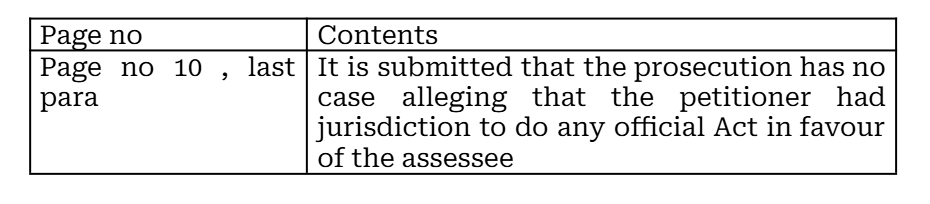
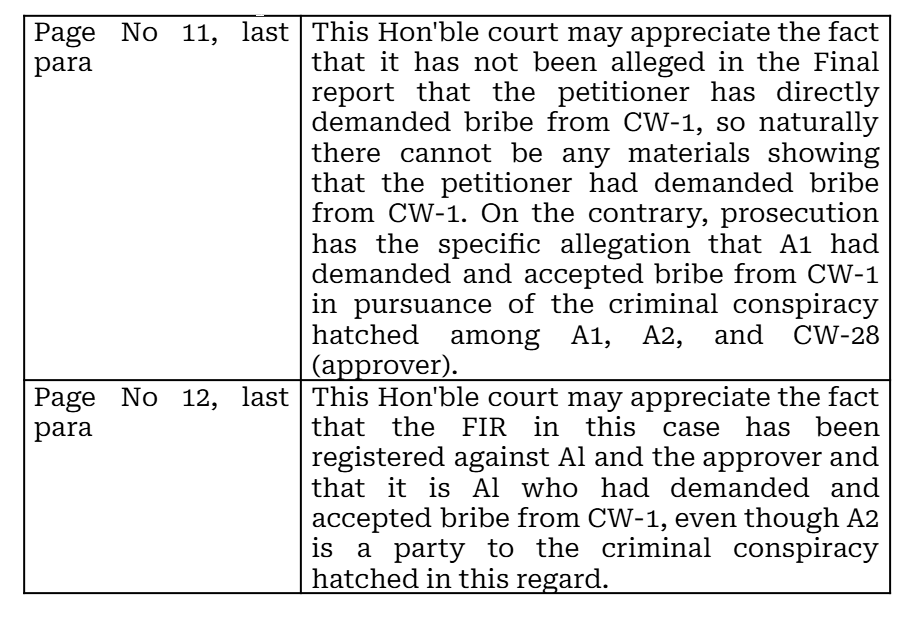
Thus, the allegation as admitted by the prosecution is only conspiracy and therefore, the substantive charges under Section 7 (Charge III) and Section 13(1)(d) r/w 13(2) of PC Act (Charge V) have no legs to stand.
7. The learned counsel has placed reliance on the Apex Court decisions in Banarsi Dass v. State of Haryana ((2010)4 SCC 450:2010 INSC 193) and Ajit Kumar v. State of Jharkhand (2026 INSC 1084) and it is pointed out in the argument note that the demand for illegal gratification is the sine qua non for establishing the offences under Sections 7 and 13 of the PC Act, which has been reiterated in the decision reported in Neeraj Dutta v. State (Government of NCT of Delhi) ((2023) 4 SCC 731.
8. Secondly, it is contended that, even on evaluation of prosecution materials on its face value, nothing could be seen to show demand or acceptance of illegal gratification by the second accused merely on the fact that the trap was at his official residence. It has been contended that the prosecution cannot establish the missing ingredients of demand, knowing acceptance and criminal conspiracy merely by combining circumstances that show the alleged demand by the first accused with the presence of the petitioner at the place of the trap. The prosecution must disclose materials connecting the petitioner individually with the alleged offence. The legal principles reiterated by the Hon'ble Supreme Court in P. Somaraju v. State of Andhara Pradesh, Ajit Kumar v. State of Jharkhand , State of Uttar Pradesh v. A.K. Gaba and M. Sambasiva Rao v. State of Andhra Pradesh, read with the jurisdictional decision of this court in Bharat Raj Meena v. Central Bureau of Investigation, Murukadas @ Murukan vs The state of kerala, directly bear upon that issue.
9. Further, it is contended that the original complaint, FIR or entrustment mahazar do not implicate the petitioner in the alleged demand and the alleged recovery of bribe money is inherently improbable and doubtful. Another point argued is that no independent witness in the form of approver’s evidence is also available in thi










