Back
Back





2024 Supreme(Online)(MAD) 40310
HIGH COURT OF MADRAS
N.SESHASAYEE, J
Vasumathi – Appellant
Versus
R.Vasudevan – Respondent
S.A.No.527 of 2022 and CMP.No.10560 of 2022
Mr.Sharath Chandran, Mr.S.Silambannan, Senior Advocate for Mr.K.Vasanthanayagan
Daughters are entitled to a share in ancestral property as coparceners under amended Section 6 of the Hindu Succession Act, 1956.
Headnote:(A) Hindu Succession Act, 1956 - Section 6 - Partition of ancestral property - Daughters claiming share as coparceners - Trial Court granted preliminary decree for partition, but first appellate court reversed the decision - The court held that the property is ancestral, and daughters are entitled to a share as coparceners under the amended Section 6. (Paras 1, 36)
(B) Estoppel - The first defendant is bound by the recitals in the partition deed regarding the character of the property as ancestral - The burden of proof lies on him to prove otherwise. (Paras 12, 36)
(C) Notional Partition - The court discussed the implications of notional partition under Section 6 and its effect on the character of property, affirming that it does not destroy the coparcenary. (Paras 19.1, 31.1)
Facts of the case:
The plaintiffs, daughters of the first defendant, sought partition of ancestral property, claiming rights as coparceners under the amended Hindu Succession Act. The trial court ruled in their favor, but the first appellate court dismissed their claim.
Findings of Court:
The court found that the property is ancestral and the daughters are entitled to a share, restoring the trial court's decree.
Issues: The main issues were whether the property is ancestral and the implications of the first appellate court's judgment.
Ratio Decidendi: The court ruled that the daughters are coparceners and entitled to a share in the ancestral property, emphasizing the binding nature of the partition deed's recitals.
Result: Appeal allowed, judgment of the first appellate court set aside.
JUDGMENT
1. This second appeal is preferred by the plaintiffs in O.S. No.505 of 2008. The suit is laid for partition of one item of immovable property. Broadly, it is the daughters' suit for partition against their father and brothers claiming a share in the ancestral property as coparceners. They were successful before the trial Court, and obtained a preliminary decree for partition of 1/5 share each in the suit property, whereas before the first Appellate Court in A.S.No.57 of 2021, which the defendants had preferred, the plaintiffs suffered a reversal of fortune and lost their suit. Hence, this appeal. Parties would now be referred to by their rank before the trial Court.
Facts :
2.1 The quintessential facts disclosed in the pleadings are:
a) The first defendant is the father of defendants 2 and 3 and also the plaintiffs. While the plaintiffs are his daughters, the defendants 2 and 3 are the sons of the first defendant.
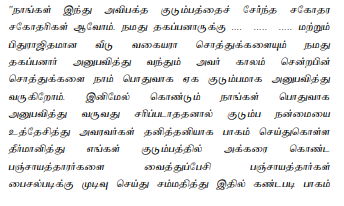
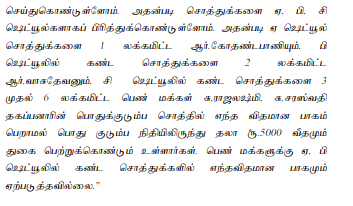
b) The suit property came to be allotted to the share of the first defendant in a partition between him and his brother vide Ext.A1 dated 01.09.1986.
c) Contending that the properties allotted to the first defendant under Ext.A1 partition are ancestral in character, the plaintiffs claim that they are also coparceners along with their father, the first defendant, and their two brothers, defendants 1 and 2, in terms of amendment to Section 6 of Hindu Succession Act vide Central Act 39 of 2005, and demand 1/5 share each in the suit properties.
2.2(a) Defendants 2 and 3 in the present suit (O.S.505 of 2008), on their part had instituted O.S.484 of 2011 against the plaintiffs herein, for restraining the latter with a decree of prohibitory injunction from interfering with their possession. They claimed title based on settlement deeds, dated 22.08.2008 (marked Exts.B1 and B2) executed by the first defendant, barely few days before the institution of O.S.505 of 2008 on 01.09.2008.
2.2(b) This suit for injunction was contested by the present plaintiffs on the ground that the first defendant herein was not the absolute owner of the property, and that these plaintiffs have 1/5th share each in the suit property and that their father (first defendant in O.S.505 of 2008) did not have any right to convey the plaintiffs' share through any settlement deed, and that the said documents themselves have been executed by the first defendant after the plaintiffs had issued their suit notice demanding partition. They are sham as they intended to defeat the right, title and interest of the plaintiffs in the suit property.
3.1 Both the suits were jointly tried, and evidence was recorded in O.S.505 of 2008. During trial, for the plaintiffs, second plaintiff was examined as P.W.1 and she had produced Exts. A1 to A5. For the defendants, the second defendant examined himself as D.W.1 and he had produced Exts.B1 and B2, the separate settlement deeds which the first defendant had executed in favour of defendants 2 and 3.
3.2 On appreciating the facts and evidence before it in the context of amended Sec.6 of the H.S. Act, the trial court proceeded to decree the suit in O.S.505 of 2008 and dismissed O.S.484 of 2011. Aggrieved by the same, the defendants in the partition suit preferred a first appeal in A.S. No.57 of 2021 on the file of the I Additional District Court, Coimbatore. The decree passed in O.S.484 of 2011 was not challenged and it appears to have attained finality. The first appellate court however, reversed the finding of the trial court and dismissed the suit, and hence the plaintiffs are before the Court in this appeal.
4. The appeal is admitted for considering the following substantial questions of law:
1. Whether the judgment of the first appellate Court suffers from grave and manifest perversity as it has misconstrued the effect and terms of the partition deed Ex.A1 to hold that the suit property was not ancestral in character?
2. In the light of the decisions of the Supreme Court in Shyam Narayan Prasad Vs. Krishna Prasad [ (2018) 7 S