
 Back
Back





IN THE HIGH COURT OF JUDICATURE AT MADRAS
K.K.Ramakrishnan, J
K.Ramkumar – Appellant
Versus
Marimuthu – Respondent
C.R.P.(MD).No.2315 of 2016 | A.S.(MD).No.163 of 2016
| Table of Content |
|---|
| 1. overview of the parties and the partition suit. (Para 1 , 2 , 3) |
| 2. arguments presented by both parties regarding their claims. (Para 6 , 7) |
| 3. court's consideration of the submissions and materials. (Para 8 , 9) |
| 4. final decision and orders of the court. (Para 16 , 19) |
COMMON ORDER
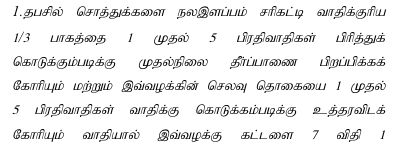
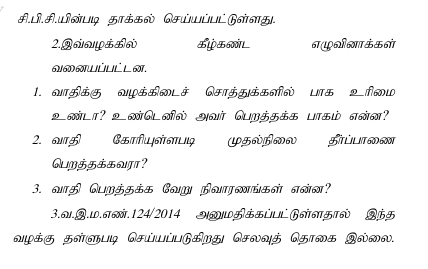
The plaintiff in O.S.No.45 of 2013, on the file of the First Additional District Judge, Tuticorin and the respondent in I.A.No.124 of 2014 in O.S.No.45 of 2013 on the file of the First Additional District Judge, Tuticorin has filed this Appeal Suit in A.S.(MD).No.163 of 2016 and Civil Revision Petition in C.R.P. (MD).No.2315 of 2016 before this Court, challenging the dismissal of the partition Suit filed in O.S.No.45 of 2013 and allowing the claim of the respondents under Section 4 of the Partition Act, 1893 .
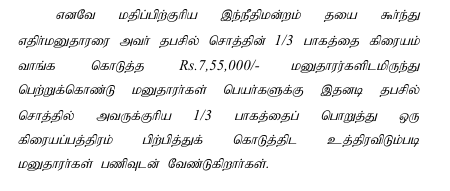
2. For the sake of convenience, the rank of the parties stated in O.S.No.45 of 2013 is herein referred. The appellant is the plaintiff is O.S.No.45 of 2013 and he filed the suit for partition demanding partition of 1/3 share as against the respondents herein. The respondents herein are the defendants in the suit have filed I.A.No.124 of 2014 under Section 4 of the Partition Act, 1893 , praying the learned trial judge to issue a direction to the petitioner/plaintiff to execute the sale deed upon receipt of the sale consideration of Rs.7,55,000/- mentioned in the sale deed purchased for the undivided 1/3 share of the first defendant's brother.
3. Brief fact of the plaintiff case before the Court below:
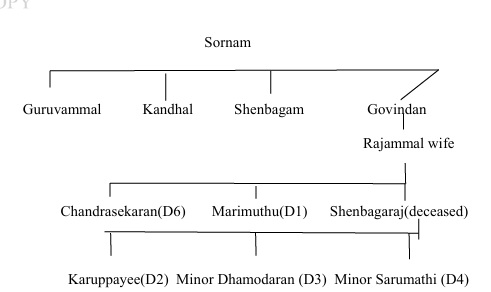
One Sornam was the owner of the suit schedule property. She had executed a registered Will dated 10.10.1978 bequeathing the said property to her three minor grand-sons born through her only son. The three minor grand-sons are Marimuthu, Shenbagaraj, Chandrasekaran. She died on 18.03.1993. After her death, on attaining majority, the three grand-sons had become the absolute owners and had been jointly enjoying the said property. One of the grand-son, namely, Chandrasekar/6th defendant (in the suit), after his majority sold his undivided 1/3 share to the appellant herein on 18.03.2013, upon receipt of the valuable consideration, namely, Rs.7,55,000/- Thereafter, on knowing the same, the respondents herein issued legal notice dated 09.04.2013, to the appellant herein and his vendor and the same was suitably replied by the appellant and the sixth respondent. A police complaint also was made, to the Deputy Superintendent of Police against the appellant. Therefore, the suit in O.S.No.45 of 2013 has been filed to pass a preliminary decree against the defendants/respondent Nos.1 to 5 to divide the suit schedule property by metes and bounds and allot 1/3 share with costs.
4. The brief facts of the case of the defendant Nos.1 to 5
The defendant Nos.1 to 5, have not filed the written statement. But, they have filed I.A.No.124 of 2014 in the said suit under Section 4 of the Partition Act, 1893 , with the following averments:
4.1.They admitted the relationship and execution of the registered “Will” dated 10.10.1978 and the death of Sornam on 18.03.1993. The 6th defendant who had sold the property to the appellant was a drunkard and using the said situation, the appellant had purchased the undivided share. They admitted 1/3 share of the plaintiff. The suit schedule property is undivided dwelling house and hence, allowing the 3rd parties into the undivided dwelling house affected their privacy. Therefore, they filed the application under Section 4 of the Partition Act, 1893 to issue a direction to the appellant to execute the sale deed upon receipt of the sale consideration of Rs.7,55,000/-.
4.2.The said application was contested by the appellant by filing counter and the material portion of the counter is as follows:
4.3.He denied the averment that the sixth defendant was a drunkard and also denied the allegation that he obtained the sale deed by using the said situation. He specifically pleaded that the suit schedule property contains 6 individual houses



An indispensable Tool for Legal Professionals, Endorsed by Various High Court and Judicial Officers
Please visit our Training & Support
Center or Contact Us for assistance

Scan Me!
India’s Legal research and Law Firm App, Download now!


For Daily Legal Updates, Join us on :



 Back to top


