
 Back
Back





BEFORE THE MADURAI BENCH OF MADRAS HIGH COURT
P.T. ASHA, J.
M.Vasanthi – Appellant
Versus
The Revenue Divisional Officer/Sub-Divisional Mag – Respondent
W.P.(MD) Nos.18989, 22793 of 2021 & 282 of 2022 and W.M.P(MD)Nos.15807, 19253 of 2021 & 4318 of 2024
Decided on : 12-11-2025
| Table of Content |
|---|
| 1. jurisdiction to issue writ under article 226. (Para 1 , 2) |
| 2. factual background regarding assets and businesses. (Para 3 , 4 , 5 , 6 , 7 , 8 , 9 , 10) |
| 3. allegations of undue influence and fraud regarding property. (Para 11 , 12) |
| 4. petitioner’s counter-arguments against jurisdiction. (Para 13) |
| 5. submissions and procedural points raised by petitioner. (Para 16) |
| 6. court’s detailed analysis and reasoning on the act’s provisions. (Para 17) |
| 7. court's final ruling and decision on the matter. (Para 18) |
ORDER :
P.T.ASHA, J.
1. The above writ petitions arise out of proceedings initiated under the Maintenance and Welfare of Parents and Senior Citizens Act, 2007 (hereinafter referred as the Act).
2. The original proceeding was initiated by the 3rd respondent in W.P(MD)No.22793 of 2021& 2nd respondent in W.P(MD)No.18989 of 2021 who is none else than the father-in-law of the petitioner in these writ petitions. The 3rd respondent in W.P(MD)No.22793 of 2021 has filed W.P(MD)No.282 of 2022 challenging the very same proceedings. Since the facts and issue involved is common in all these writ petitions, they are dealt with jointly and a common order is being passed. The parties are referred to in the same ranking as in W.P(MD)No.22793 of 2021.
Facts of the case :
3. The 3rd respondent had invoked the provisions of Section 4 of the Act by filing an application before the 2nd respondent. It was his contention that on 01.10.1979 there was a partition between him, his father and brothers and thereafter, he had out of his own earning, started a business in the name and style of “M.Muniyapillai Grocery and Native Medicine Shop” at Big Bazaar Street, Trichy nearly 40 years back. He had also started the Muniyapillai Departmental Store in the year 2001 at Thillai Nagar, Trichy. Out of the income earned from these businesses, he had purchased properties both movable and immovable in his name and in the name of his son, N.Muralidharan.
4. It was his further contention that he had given his son, Muralidharan a good education spending huge sums of money on him. After his son had obtained his MBA degree, he had joined him in his business. However, his son did not evince much interest in the business, but had taken several lakhs of rupees from the 3rd respondent stating that he desired to start a Travel Agency. That apart, he would contend that he had spent huge sums of money to celebrate the wedding of his son with the petitioner herein. Further he had also spent considerable amount on medical expenses as the petitioner had not conceived for over four years after the marriage and even for the delivery, it was he who had borne the expenses.
5. In the year 2001, he and his wife had started the partnership business of M.Muniyapillai Departmental Store. The 3rd respondent would also accuse the petitioner of not taking care of his son properly. He would submit that at the behest of the petitioner, he had given a sum of Rs.10 Lakhs to his son and the petitioner for them to start their Travel business.
6. In the course of carrying on this business at Chennai, in the name and style of Amaze Tours and Travels, the petitioner and her husband had to face some criminal complaints and it was the 3rd respondent who had bailed them out by spending over a sum of Rs.15 Lakhs, at the request of the petitioner.
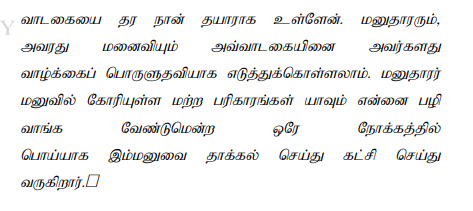
7. Thereafter, his son and his family had shifted to Trichy and requested financial assistance for running their business. Once again the 3rd respondent had given a sum of Rs.30 Lakhs to start their business “Amaze Tours and Travels” at Trichy. The 3rd respondent would further contend that in the year 2006, his wife and he had to travel to America to attend to their daughter who had delivered a baby. The 3rd respondent had to leave the management of his various businesses in the hands of his son Muralidharan and his nephew, Sandeep Kumar. However, within six months, his son and daughter-in-law had managed to accumulate losses in the business. The 3rd respondent h
In interpreting the Maintenance and Welfare of Parents and Senior Citizens Act, 2007, the court ruled that a daughter-in-law does not qualify as 'children' or 'relative,' impacting her obligations fo....

The Senior Citizens Act mandates that children must ensure their parents lead a dignified life, and property transfers can be voided if basic amenities are not provided.
The love and affection between the parent and the child is an implied condition in the Settlement Deed and any violation of this condition would amount to fraud, coercion or undue influence, thus att....


The Senior Citizens Act empowers the Tribunal to issue eviction orders to protect the rights and welfare of senior citizens, emphasizing the obligation of children to maintain their parents, includin....
The authority under the Maintenance and Welfare of Parents and Senior Citizens Act exceeded its jurisdiction by canceling the settlement deed without proper legal grounds, as no maintenance condition....

The court affirmed the authority of the Tribunal under the Senior Citizens Act to order eviction for the protection of senior citizens, rejecting claims of joint ownership and family settlement.

The Maintenance and Welfare of Parents and Senior Citizens Act enables eviction of children from a parent's self-acquired property when there are credible allegations of harassment, emphasizing the p....
The main legal point established in the judgment is the interpretation of Section 23 of the Senior Citizens Act and the applicability of the Indian Contract Act and the Transfer of Property Act to th....



An indispensable Tool for Legal Professionals, Endorsed by Various High Court and Judicial Officers
Please visit our Training & Support
Center or Contact Us for assistance

Scan Me!
India’s Legal research and Law Firm App, Download now!


For Daily Legal Updates, Join us on :



 Back to top


