
 Back
Back





IN THE HIGH COURT OF JUDICATURE AT MADRAS
C. KUMARAPPAN, J
S.Siva – Appellant
Versus
The State of Tamil Nadu – Respondent
WP.Nos.8916|10456|21164|21848|WMP.Nos.10018|11769|11771|23898|24048|24650|24651|24653
| Table of Content |
|---|
| 1. challenges against promotions based on systemic issues (Para 1 , 4 , 5 , 7 , 8) |
| 2. allegations of denying seniority through promotions (Para 9 , 10 , 11) |
| 3. arguments against illegal promotions impacting morale (Para 12 , 14 , 15) |
| 4. legality of government's promotion practices (Para 18 , 19) |
| 5. judicial precedents on seniority and promotion (Para 20 , 21 , 22 , 23 , 26) |
| 6. fundamental rights concerning promotion consideration (Para 27 , 28) |
| 7. government’s duty to follow procedural rules (Para 39 , 46) |
| 8. court's order quashing previous government orders (Para 49 , 50) |
COMMON ORDER
These writ petitions are yet another set of vexed issue of inter se seniority between the direct recruits DSPs' and promotee DSPs'.
2.Since the fact and law involved in all the writ petitions are one and the same, all are taken together for consideration and for common orders.
3.For convenience sake, this Court deems it appropriate to refer the pleading mostly from W.P.No.10456 of 2025.
4.The writ petition in W.P.No.10456 of 2025 has been filed challenging four G.Os, qua G.O.Ms.No.263, dated 30.05.2022, G.O.Ms.No.143, dated 29.03.2023, G.O.Ms.No.214, dated 14.03.2024 and G.O.Ms.No.697 dated 17.12.2024, on the ground that the above GO’s offend Article 14 and 16 of the Constitution of India. Another writ petition in W.P.No.21164 of 2025 is also for the same relief.
5.Apart from the above two writ petitions, the third writ petition W.P.No.8916 of 2025 was filed for Mandamus directing the authority to fill up the Promotional post by drawing a regular panel through the departmental promotion committee.
6.Similarly, the prayer in the Fourth writ petition W.P.No.21848 of 2025 is also for a Writ of Mandamus to draw inter se seniority from the panel year 2012 – 2013 to 2013-2014, and for promotion based upon such panel.
7.The brief facts which are necessary for the disposal of these writ petitions are as follows:
The petitioners are directly recruited Deputy Superintendent of Police. The first and second respondents are the Official respondents. The respondents 3 to 6 are the promotee Deputy Superintendents of Police, who have now been promoted to the cadre of Additional Superintendents of Police. The post of Deputy Superintendent of Police, comes within Class-II, Category-1 of Special Rules for Tamil Nadu Police Service(herein after called 'Special Rules'). According to the Special Rules, the post of Deputy Superintendent of Police has two mode of recruitment namely, direct recruitment and recruitment by transfer from the post of Inspector of police.
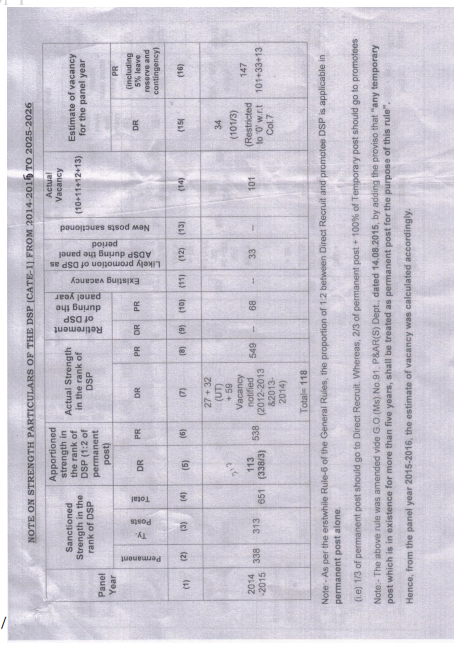
8.According to Class-II Category-1 of Special Rules, the proportion in which “substantive” vacancies of DSPs' has to be filled up is in the ratio of 1 :2 between “Direct Recruitment” and the “Recruitment by Transfer”.
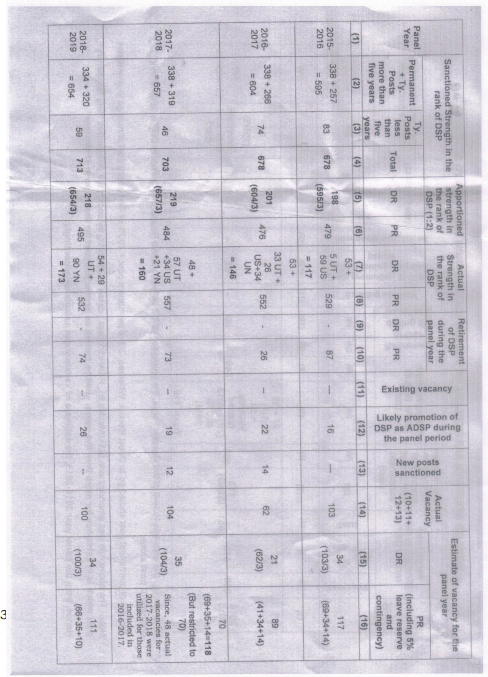
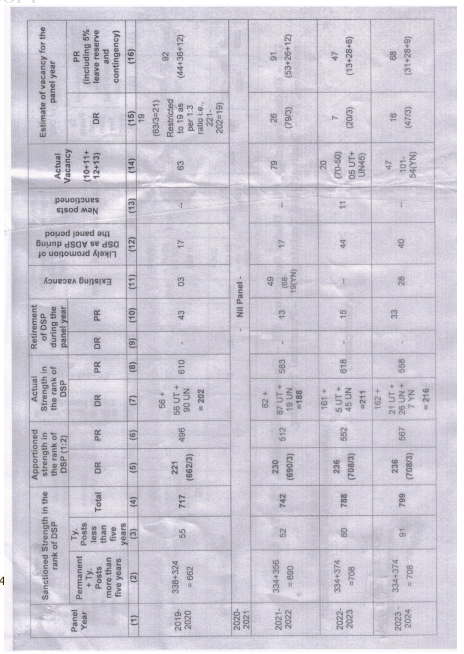
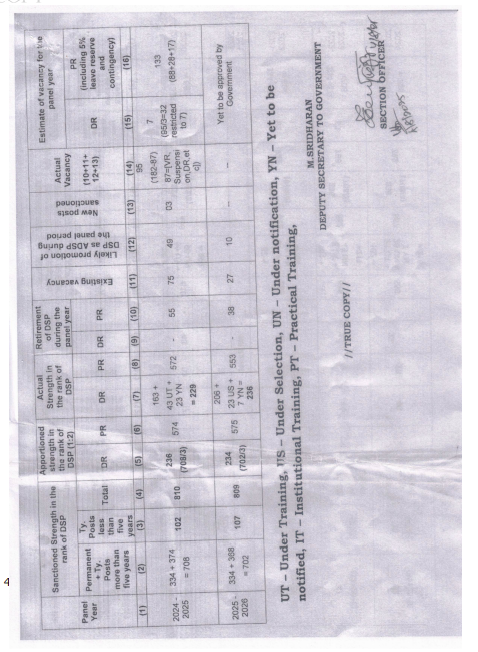
9.The main grievance of the petitioners are that the Official respondents have promoted the Inspectors of police from the Tamil Nadu Subordinate Service, by way of recruitment by transfer to the post of Deputy Superintendents of Police, not only in the substantive post, but also to the temporary post, over and above the permissible ratio of 1:2, thereby denied the legitimate seniority to them. It is their further submission that, by temporary promotion granted under Section 17(1) of the Tamil Nadu Government Service(Conditions of Service)Act, 2016,[hereinafter referred to as 'the Act'], the direct recruit’s legitimate expectation for consideration for promotion is affected.
10.It is the further submission of the petitioners that the respondents 1 and 2 by invoking Section 47 of the Act, have given further promotions to the temporarily promoted DSPs to the post of Additional Superintendents of Police, ignoring the direct recruits who hold the substantive post. For this purpose, the Official respondents invoked Section 58 of the Act, and relaxed the condition stipulated in Section 41(1) of the Act. According to the petitioner, for the past 20 years, further promotions have been given based up



An indispensable Tool for Legal Professionals, Endorsed by Various High Court and Judicial Officers
Please visit our Training & Support
Center or Contact Us for assistance

Scan Me!
India’s Legal research and Law Firm App, Download now!


For Daily Legal Updates, Join us on :



 Back to top


