
 Back
Back





IN THE HIGH COURT OF JUDICATURE AT MADRAS
K.K.RAMAKRISHNAN, J
Seethalakshmi – Appellant
Versus
Ramuthai – Respondent
A.S(MD) Nos.33 of 2006 | S.A.(MD).No.468 of 2007 | C.M.P.(MD).Nos.10927 and 11252 of 2025
| Table of Content |
|---|
| 1. dispute over property division following partition suit. (Para 2 , 3 , 4 , 5) |
| 2. final decree cannot contradict preliminary decree. (Para 10 , 11 , 12) |
COMMON JUDGMENT
The second defendant in O.S.No.23 of 1994, has instituted this appeal challenging the order passed in the final decree application in I.A. No. 25 of 1999, by way of the impugned judgment dated 27.06.2005.
2.The appellant and the first and second respondents are sisters.
Their father, Subbaiah Naicker, owned several properties mentioned in the suit schedule. His wife predeceased him in the year 1982, and he died intestate on 17.03.1985. After the demise of Subbaiah Nayakar, the second respondent/plaintiff filed a suit in O.S. No. 23 of 1994, seeking partition of the ‘A’ and ‘B’ Schedule properties. The ‘A’ Schedule consisted two items, and the ‘B’ Schedule consisted four items of properties. After contest, a preliminary decree was passed by the trial court on 08.08.1995, declaring the second respondent’s entitlement to “the first item of the ‘A’ Schedule property” and the “entire property in the ‘B’ Schedule properties”. Aggrieved by the said decree, the present appellant preferred an appeal before this Court in A.S.No.391 of 1996, which was subsequently dismissed.
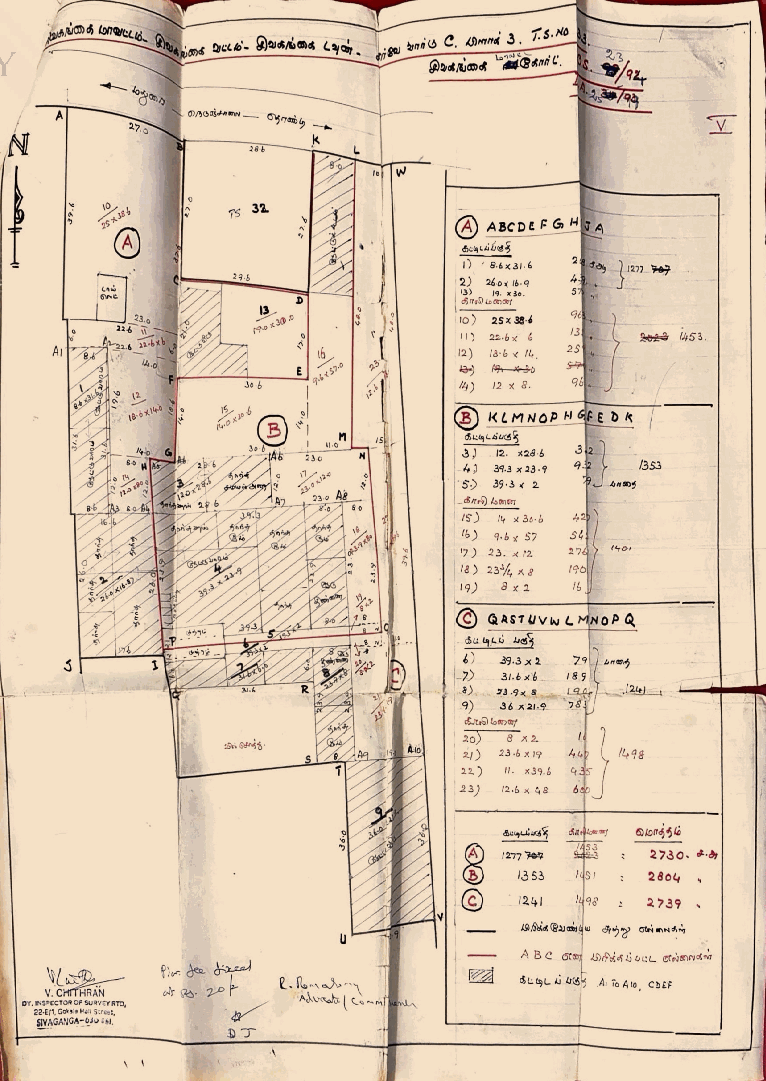
3.Thereafter, the first respondent/first defendant filed a final decree application in I.A.No.25 of 1999, in which an Advocate Commissioner was appointed to effect division of the properties and the learned Judge after considering the pleadings and the Advocate Commissioner's report and the argument of the learned counsel appearing for the parties passed the following final decree in respect of the scheduled property (Item No.1 of the A scheduled property) in O.S.No.23 of 1994 vide impugned judgment dated 08.08.1995:
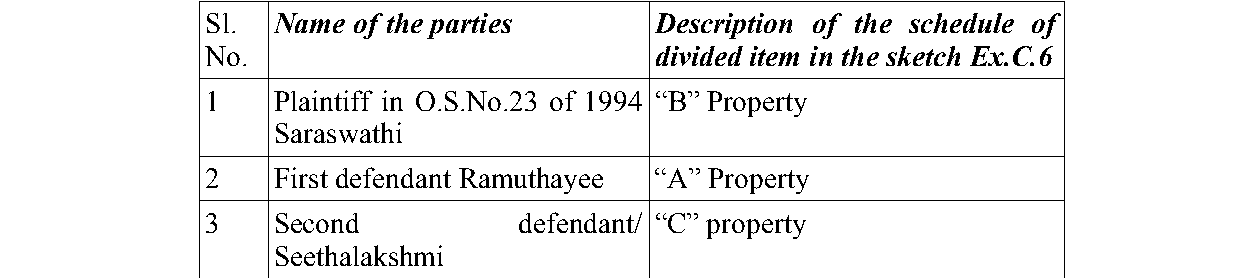
The first defendant in O.S. No. 23 of 1994 has challenged the impugned final decree dated 08.08.19955 in I.A. No. 25 of 1999.
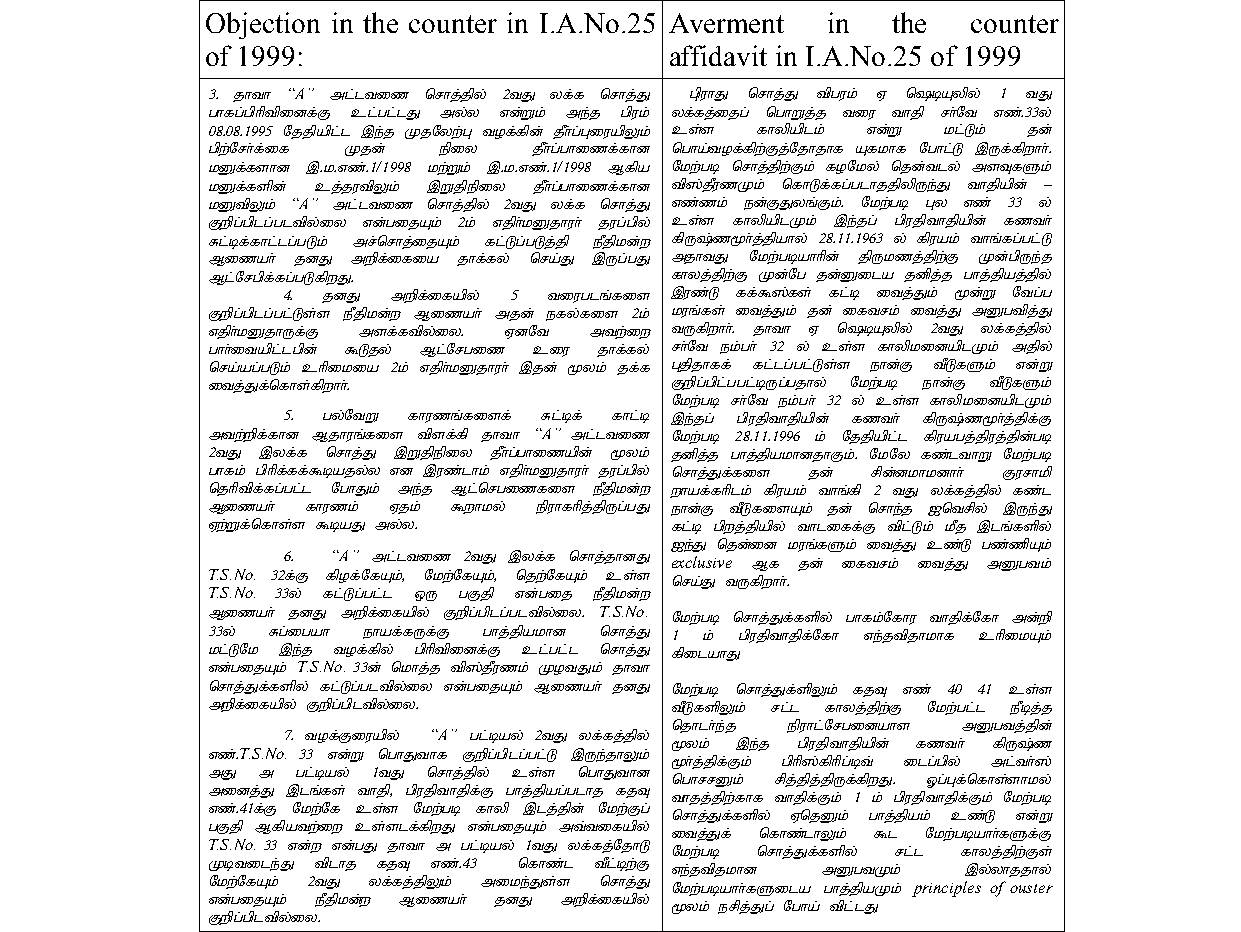
4.The learned counsel for the appellant submitted that the appellant does not dispute the allotment of shares in respect of the ‘B’ Schedule properties. The dispute pertains only to the division and allotment of the first item of the ‘A’ Schedule property, particularly with reference to the separate measurements annexed to the plaint. The learned counsel contended that the Advocate Commissioner failed to take into account that the first item of the suit ‘A’ Schedule property in Survey No.33 forms part of the appellant’s property situated contiguous to Survey No.32, and this aspect was not properly considered. It was specifically contended that the property in question is indivisible, and without adhering to the procedure prescribed under the Partition Act, the Commissioner divided the property, thereby causing grave prejudice to the appellant by diminishing the value and extent of the property and disturbing her long term possession over the suit property. Hence, the appellant seeks to set aside the final decree passed in I.A. No. 25 of 1999 by the impugned judgment.
5.Per contra, the learned counsel for the plaintiff and the first respondent submitted that the appellant’s contention that the ‘A’ Schedule property forms part of the second item of the ‘B’ Schedule property is contrary to the preliminary decree, wherein the division and entitlement of the properties, including Door No. 33, were clearly settled. It was argued that such a contention is impermissible at the stage of final decree proceedings, as the preliminary decree has attained finality. In support of this submission, reliance was placed on the judgment of the Hon’ble Supreme Court. The learned counsel further submitted that the suit was instituted in the year 1995, and the appeal suit was dismissed in 1998. Despite the lapse of considerable time, the respondents are not able to enjoy the fruits of the decree, owing to the appellant’s occupation of the property and her repeated attempts to prolong the proceedings by filing frivolous petitions and raising untenable contentions, which are not p



An indispensable Tool for Legal Professionals, Endorsed by Various High Court and Judicial Officers
Please visit our Training & Support
Center or Contact Us for assistance

Scan Me!
India’s Legal research and Law Firm App, Download now!


For Daily Legal Updates, Join us on :



 Back to top


