
 Back
Back





IN THE HIGH COURT OF JUDICATURE AT MADRAS
C. Kumarappan, J.
Sundar Rao -Petitioner
Versus
Union, Rep. by The Intelligence Officer - Respondent
Crl.O.P.Nos.3329, 4031, 4305, 4349, 2716 and 3430 of 2026
Decided On : 17-03-2026
Key Points: - Non-furnishing of grounds of arrest does not automatically invalidate arrest; prejudice must be shown (!) (!) - Article 22(1) rights and the requirement for informing grounds are satisfied by substantial compliance; written grounds are not mandatory in all cases (!) (!) - For NDPS Act Section 37 bail, harsh criteria require belief of not guilty and not likely to commit offences; procedural lapses are weighed against gravity of offense (!) - Courts distinguish between grounds of arrest and arrest memo; absence of grounds is a procedural lapse with potential prejudice unless demonstrated (!) (!) - Precedent shows the lapse may be ignored where accused had awareness or where no prejudice is shown; recent judgments emphasize prejudice-centric testing (!) (!) - Mihir Rajesh Shah’s case (06.11.2025) prospectively applied; arrests before that date may not benefit from written grounds obligation if no prejudice (!) (!) - Pankaj Bansal (03.10.2023) established grounds of arrest informs defense; subsequent Supreme Court clarifications affect its retroactivity (!) (!) (!) - The court emphasizes that arrests prior to Mihir Rajesh Shah and in flagrante delicto may not gain bail relief solely due to lack of written grounds (!) - Grounds of arrest aim to enable defense, counsel access, and bail challenges; the procedure must balance constitutional safeguards with law enforcement efficiency (!) (!) - Petitions are dismissed for lack of demonstrable prejudice and inability to satisfy Section 37(1)(b)(ii) NDPS criteria (!)
ORDER :
C. Kumarappan, J.
In all these cases, a common contention raised by the petitioners is that, the “grounds of arrest” has not been furnished to them. In this regard, the petitioners relied upon the following judgements of the Hon’ble Supreme Court of India.
(i) Vihaan Kumar Vs. State of Haryana, reported in (2025) 5 SCC 799.
(ii) PrabirPurkayastha Vs. State (NCT of Delhi) reported in 2024 INSC 414.
(iii) KasiredyUpender Reddy Vs. State of Andhrapradesh & Ors reported in 2025 INSC 768.
(iv) Ahmed Mansoor&Ors Vs. The State Rep. By, Assistant Commissioner of Police &Anr (Criminal Appeal No.4505 of 2025 [@ SLP (Crl.] No.198 of 2025 dated 14.10.2025)
(v) Pankaj Bansal Vs. Union of India, reported in (2024) 7 SCC 576.
2. For the purpose of effective adjudication upon the legal defence raised by the petitioners, it is necessary to examine the basic factual aspects of each bail application, namely whether the present application is the first or subsequent one, the date of remand, the fate of the earlier applications and other relevant factors. The said particulars are, therefore, tabulated hereunder:-
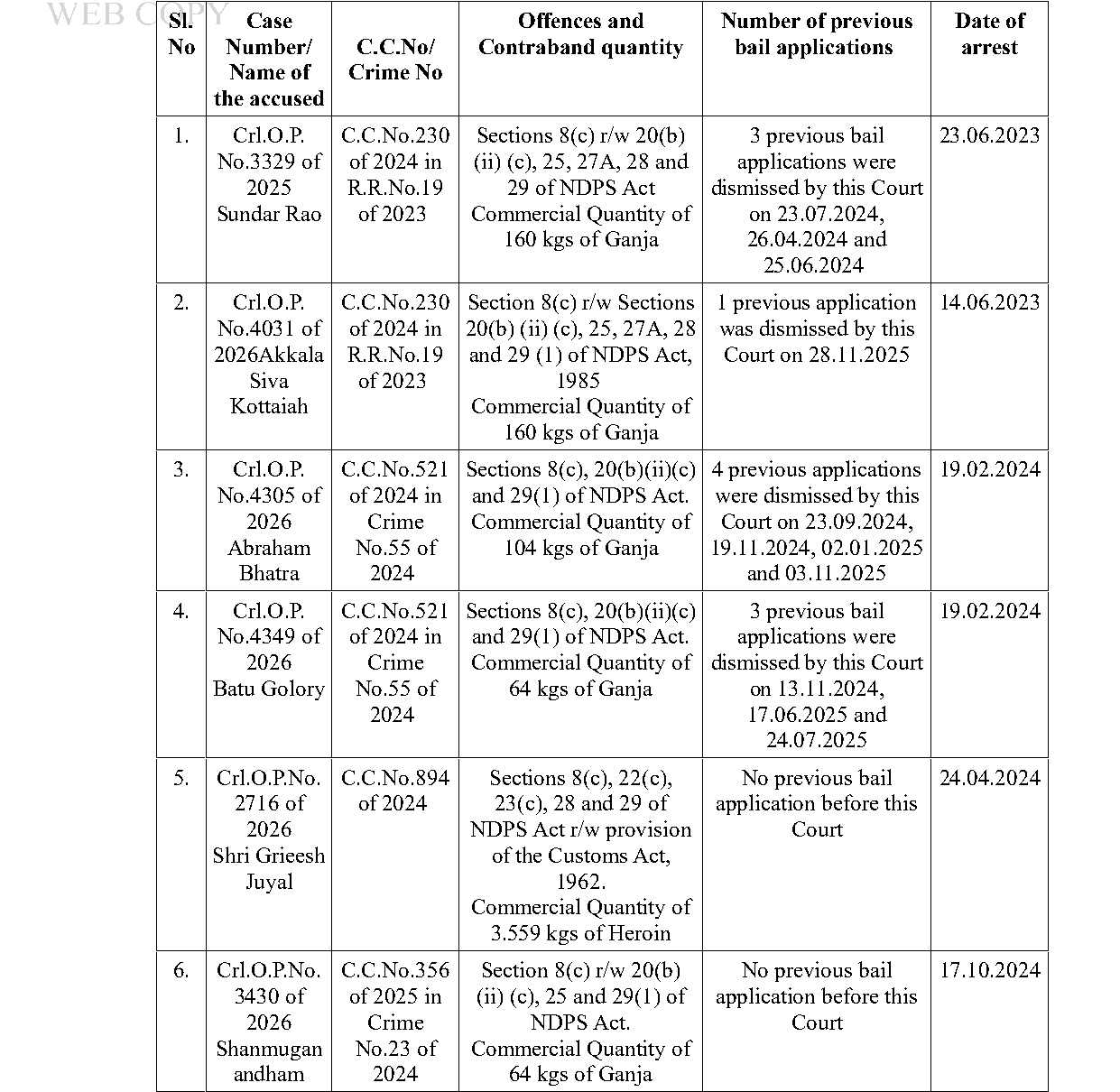
3. On a perusal of the above tabular statement, it is amply clear that the plea regarding non-furnishing of the grounds of arrest was not raised either at the time of arrest or immediately thereafter. According to the said tabular statement, the petitioners raised the said plea only after a considerable lapse of time, ranging from a minimum period of one year to a maximum period of four years. Except Sl.Nos.5 and 6, in other matter the defence of grounds of arrest were not taken in the previous bail applications. It is also seen that the petitioners have undergone incarceration for varying periods. Except, capturing the above fact, this Court is not inclined to go into the veracity of the aforesaid factual aspects, since the same have been referred to only for the limited purpose of indicating the conduct of the parties.
4. Admittedly, in all these cases, “the grounds of arrest” were not furnished to the petitioners and they were served only with the “arrest memo”. The Hon’ble Supreme Court of India in various judgement has clearly distinguished between the “grounds of arrest” and the “arrest memo”, and has held that both cannot be equated. In such circumstances, this Court proceeds to consider the effect of non-furnishing of the grounds of arrest to the case in hand, in the above factual matrix.
5. At this juncture, it is relevant to refer to the judgement of the Hon’ble Division Bench of the Bombay High Court in RajrishiBindawat Vs. State of Maharashtra, reported in 2024 SCC OnLineBom 3660. The said judgement was carried in appeal before the Hon’ble Supreme Court in Mihir Rajesh Shah Vs. State of Maharashtra, reported in (2026) 1 SCC 500. According to the judgement of Bombay High Court in RajrishiBindawat’s case (cited supra), when the grounds of arrest were within the knowledge of the petitioners by their conduct, they cannot be permitted to take advantage of the plea that the “written grounds of arrest” were not given to them. In the above judgement, the Division Bench of the Bombay High Court has observed that an exception can be made in such circumstances. The High Court held that the accused therein were fully aware of their consequences of their gruesome act committed by them against the victims, and therefore, were not entitled to claim the benefit flowing from the judgement of the Hon’ble Supreme Court.
6. The aforesaid finding of the Bombay High Court was carried in appeal in SLP (Crl.) No.17132 of 2024 Mihir Rajesh’s case (cited supra). By the daily order dated 13.12.2024, the Hon’ble Supreme Court observed that, prima facie, it did not find any error in the judgement of the Division Bench. However, the appeal was entertained for the limited purpose of considering the legal position involved in the matter. In order to substantiate the above discussion, it would be appropriate to extract the relevant portion of the judgement of the
Non-furnishing of arrest grounds does not automatically invalidate the arrest unless demonstrable prejudice is proven. The court prioritizes substantial compliance over strict formality in arrest pro....


Absence of written grounds of arrest does not mandate bail absent prejudice; substantial compliance via awareness suffices in serious offences, especially pre-'henceforth' rulings.


The failure to communicate grounds of arrest constitutes a violation of constitutional rights under Articles 21 and 22(1), rendering the arrest illegal and necessitating bail even amidst statutory re....

The constitutional requirement of communicating grounds of arrest is essential, and failure to do so renders the arrest and subsequent remand illegal.



An indispensable Tool for Legal Professionals, Endorsed by Various High Court and Judicial Officers
Please visit our Training & Support
Center or Contact Us for assistance

Scan Me!
India’s Legal research and Law Firm App, Download now!


For Daily Legal Updates, Join us on :



 Back to top


