Back
Back





2026 Supreme(Mad) 1750
IN THE HIGH COURT OF JUDICATURE AT MADRAS
S. SOUNTHAR, J.
Senthil Kumar, (Died) represented by his legal heirs- Lavanya – Appellant
Versus
Koteeswaran, (Died) Rep. by his Legal Heirs.- Hemalatha – Respondent
SA No. 243 of 2026 and CMP Nos.8172 and 8173 of 2026
Decided On : 27-03-2026
For the Appellant : Mr. R. Venkat Raman for M/s TATVA Legal.
Co-owner not party to sale deed need not cancel it to claim partition of undivided share in joint family property.
Headnote:Under Section 100 CPC, second appeal challenges lower courts' decisions on partition suit involving joint family property. Facts: 72 cents joint family land; father sold 22 cents, remaining 50 cents claimed equally by sons; one son sold to third party with false oral partition recital. Court found no proof of oral partition between sons, upheld plaintiff's half share entitlement.
Issues: Proof of oral partition 15 years prior; necessity to cancel sale deed by non-party co-owner. Ratio: Oral partition unproved absent independent evidence or revenue mutation; co-owner not party to sale deed need not seek cancellation, sale valid only to vendor's share; prior decisions distinguished as inapplicable. Second appeal dismissed; first appellate decree confirmed; preliminary partition decree granted to plaintiff for half share.
| Table of Content |
|---|
| 1. summary of suit proceedings and pleadings on partition. (Para 2 , 3 , 4 , 5) |
| 2. oral partition plea unproved by evidence. (Para 6 , 8 , 9 , 10 , 11 , 12 , 13) |
| 3. non-party co-owner need not cancel sale deed. (Para 7 , 14 , 15 , 16 , 17 , 18 , 19) |
| 4. appeal dismissed; partition decree confirmed. (Para 20 , 21) |
JUDGMENT :
S. SOUNTHAR, J.
The legal heirs of the first defendant and the 2nd defendant are the appellants herein.
2. The predecessor in interest of the respondent/deceased sole plaintiff filed a suit in O.S.No.486 of 2008 seeking partition of his half share. The suit was dismissed by the Trial Court. The first appeal filed by the plaintiff in A.S.No.45 of 2018 was allowed by the first appellate court. Aggrieved by the same, the appellants have come before this court. Both the sole plaintiff and the first defendant died pending first appeal and hence, their Legal Representatives were brought on record.
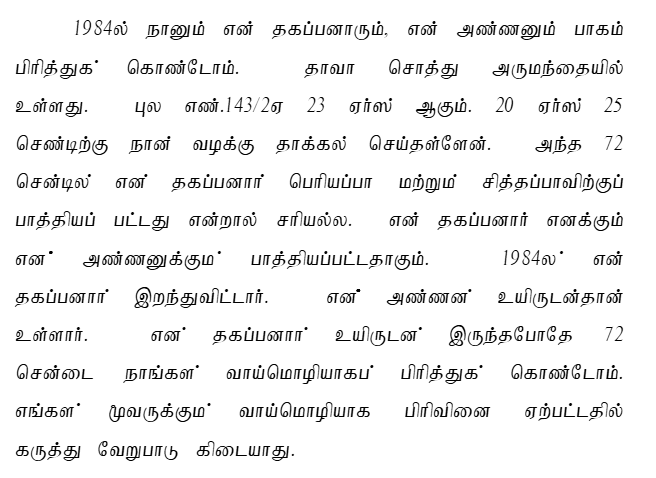
3. According to the plaintiff, 72 cents of lands in S.No.143/2 of Arumandhi Village belonged to joint family consisting of plaintiff’s father Radhakrishnan, plaintiff and his brother Venkatachalam, the 2nd defendant in the suit. The plaintiff’s father Radhakrishnan sold 22 cents of land on the western side of the property in favour of the 1st defendant. Thereafter, it was agreed between the sharers that the 22 cents of land sold by Radhakrishnan should be treated as his share and the remaining 50 cents shall be treated as share of the plaintiff and the 2nd defendant equally. After the death of plaintiff’s father Radhakrishnan, the plaintiff has been in possession and enjoyment of the remaining 50 cents as a co-owner and during November 2007, the first defendant raised some objections regarding enjoyment of the suit property by the plaintiff. On enquiry, the plaintiff came to know that the first defendant purchased the suit property i.e. remaining 50 cents of land in S.No.No143/2 from the 2nd defendant/plaintiff’s brother. Further, in the sale deed executed by the 2nd defendant in favour of the 1st defendant, a false recital was included, as if there was a oral partition between the plaintiff and the 2nd defendant and there under, the suit property was allotted to the share of the 2nd defendant. Denying the said oral partition, the plaintiff contended that the 2nd defendant had no right to sell the entire property to the first defendant and laid the present suit seeking partition of his half share in the suit property. Initially, the said suit was filed only against the first defendant, the purchaser of the suit property and subsequently, on objection by the first defendant regarding non joinder of necessary party, the 2nd defendant was added as party to the suit.
4. The first defendant filed a written statement and contested the suit only on the ground that there was a oral partition between the plaintiff and the 2nd defendant, 15 years back and in the said partition, the suit property, i.e. 50 cents in S.No.143/2 was allotted to the share of the 2nd defendant. It is further stated in the written statement that the first defendant purchased the suit property from the 2nd defendant under a registered sale deed dated 28.01.2008 and it has been in possession and enjoyment of the same. It is also admitted by the first defendant that the suit property jointly stands in the name of the plaintiff, 2nd defendant and their father Radhakrishnan and subsequently, based on the sale deed, the first defendant applied for transfer of patta in his name and since the plaintiff objected for the same, enquiry is still pending. On these pleadings, the first defendant sought for dismissal of the suit.
5. Before the Trial Court, on behalf of the plaintiff, he examined himself as PW1 and 4 documents were marked as Ex.A1 to Ex.A4. On the side of the defendants, the first and 2nd defendants were examined as Dw1 and Dw2 respectively and 4 documents were marked as Ex.B1 to Ex.B4.
6. The Trial Court, on appreciation of evidence available on re