
 Back
Back





BEFORE THE MADURAI BENCH OF MADRAS HIGH COURT
K. Murali Shankar, J.
M.Manthaiyan - Appellant
Versus
C.Savarimuthu - Respondent
S.A.(MD).No.589 of 2019 and C.M.P.(MD)No.11939 of 2019
Decided On : 17-04-2026
| Table of Content |
|---|
| 1. overview of parties and procedural background. (Para 1 , 2 , 3 , 4) |
| 2. assessment of loan transaction defense versus sale agreement. (Para 5 , 6 , 7 , 8 , 9) |
| 3. statutory burden regarding readiness and willingness. (Para 10 , 17) |
| 4. indicators differentiating loan security from valid sale contracts. (Para 11 , 12) |
| 5. evidentiary weight of admitted documents supersedes formal proof. (Para 13 , 14 , 15 , 16 , 18) |
| 6. rejection of perverse findings and dismissal of suit. (Para 19 , 20) |
JUDGMENT :
K. Murali Shankar, J.
The Second Appeal is directed against the judgment and decree made in A.S.No.24 of 2018, dated 22.01.2019, on the file of the Additional District Court (FTC), Theni, confirming the judgment and decree passed in O.S.No.96 of 2013, dated 22.01.2015, on the file of the Subordinate Court, Uthamapalayam.
2. The appellant is the defendant. The respondent/plaintiff filed a suit in O.S.No.96 of 2013 before the Subordinate Court, Uthamapalayam seeking the relief of specific performance of the sale agreement dated 03.06.2011.
3. For the sake of convenience and brevity, the parties will hereinafter be referred as per their status/ranking in their original suit.
4. The case of the plaintiff in brief is as follows:
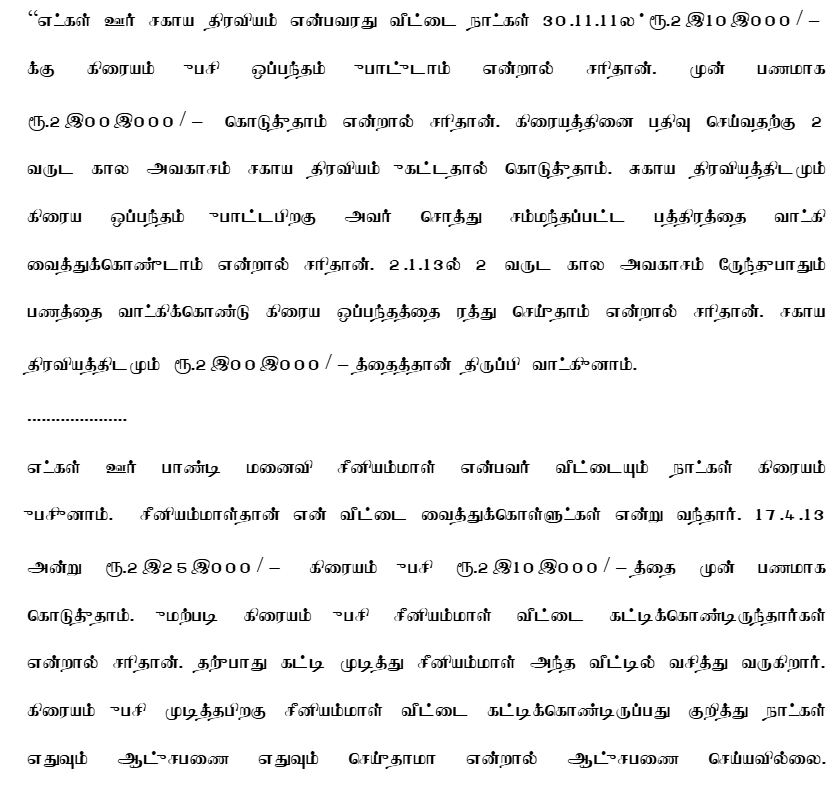
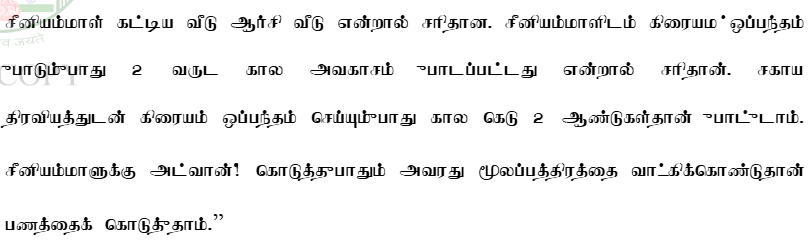
The suit property is owned by the defendant. The defendant offered to sell the suit property and the plaintiff agreed to purchase the same and both of them entered into a sale agreement on 03.06.2011, whereunder they have fixed the sale consideration at Rs.3,10,000/- and the period of performance as two years. The plaintiff paid an advance amount of Rs.3,00,000/- to the defendant and agreed to pay the balance sale price of Rs.10,000/- before 02.06.2013. The defendant has handed over the original sale deed in respect of the suit property to the plaintiff. The plaintiff has always been ready and willing to pay the balance sale price and to get the sale deed executed. But the defendant was postponing the same on some pretext or the other. Hence, the plaintiff sent a legal notice dated 25.05.2013 to the defendant directing him to receive the balance sale price and to execute the sale deed. The defendant having received the notice on 28.05.2013, has neither sent any reply nor complied with the notice demand. Hence, the plaintiff was constrained to file the above suit seeking the relief of specific performance.
5. The defence of the defendant in brief is as follows:
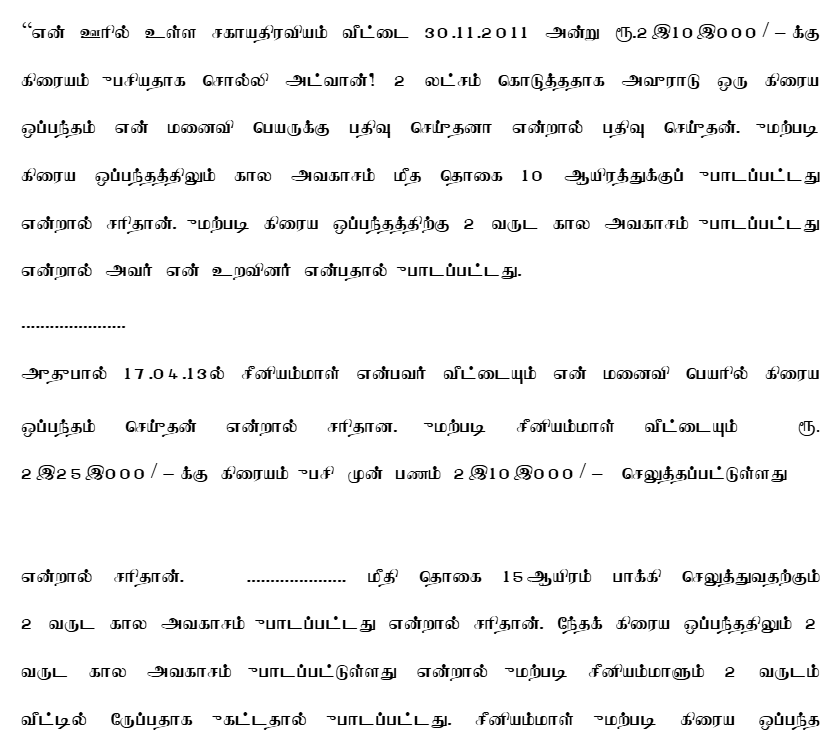
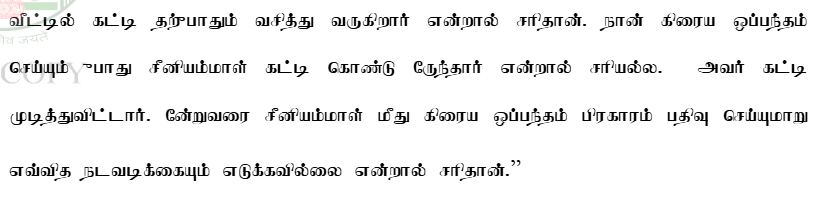
The defendant borrowed a sum of Rs.3,00,000/- from the plaintiff on 03.06.2011 and executed a sale agreement as demanded by the plaintiff and also handed over the original sale deed to the plaintiff. The plaintiff is doing money lending business. The defendant has paid the interest at Rs.9,000/- per month till 03.12.2012. The defendant executed the sale agreement only as a security for the loan transaction. The plaintiff and his wife are in the habit of obtaining sale agreements as security for loan transaction. After the receipt of the legal notice, the defendant met the plaintiff and at that time, the plaintiff informed that it was only a formal notice and the agreement will be cancelled upon the receipt of the loan amount. Believing the words of the plaintiff, the defendant did not send any reply. The defendant is ready to pay the loan amount, but the plaintiff in an attempt to snatch the suit property filed the above suit. Hence, the suit is liable to be dismissed.
6. The learned trial Judge, upon considering the pleadings of both sides, framed the following issues:
(i) Whether the plaintiff is entitled for the relief sought in the plaint?
(ii) Any other relief, the plaintiff is entitled to?
7. During trial, the plaintiff examined himself as P.W.1 and his wife as P.W.2 and exhibited 4 documents as Exs.A.1 to A.4. The defendant examined himself as D.W.1 and exhibited four documents as Exs.B.1 to B.4. The learned trial Judge, upon considering the pleadings and evidence both oral and documentary and on hearing the arguments of both sides, passed the judgment an

AI

Specific performance – Relief of specific performance is equitable remedy – Plaintiff have to necessarily show their readiness and willingness in performing their part of contract from date of agreem....

High Court second appeal under S.100 CPC confined to substantial questions of law; cannot re-appreciate evidence or reverse findings on genuineness, readiness for specific performance.
The court established that an agreement labeled as a sale can be deemed a security for a loan if the evidence supports such a conclusion, and specific performance can be denied if the plaintiff fails....
The court held that a plaintiff must prove readiness and willingness in specific performance claims, and doubts regarding the authenticity of an agreement can lead to dismissal.
A sale agreement must be proven by its written terms, and inconsistencies in evidence can undermine claims for specific performance.
The plaintiff must prove readiness and willingness to perform a contract under Section 16(c) of the Specific Relief Act, and failure to do so negates entitlement to specific performance.

The court ruled that a sale agreement intended as security for a loan does not entitle the plaintiff to specific performance, emphasizing the necessity of proving readiness and willingness to perform....
Sale agreement genuine but specific performance denied due to plaintiff's delay proving lack of readiness and willingness.
The burden of proof lies on the party claiming a different nature of a transaction, and specific performance can be granted if a valid contract exists and the plaintiff is ready and willing to perfor....



An indispensable Tool for Legal Professionals, Endorsed by Various High Court and Judicial Officers
Please visit our Training & Support
Center or Contact Us for assistance

Scan Me!
India’s Legal research and Law Firm App, Download now!


For Daily Legal Updates, Join us on :



 Back to top


