


1. Challenge to externment order under Section 5(b) of M.P. Rajya Suraksha Adhiniyam, 1990. (Para 1 , 2 )

 Back
Back





IN THE HIGH COURT OF MADHYA PRADESH AT JABALPUR
VISHAL MISHRA, J.
Ravi Verma – Petitioner
Versus
The State Of Madhya Pradesh And Others – Respondents
Writ Petition No. 44179 of 2025
Decided On : 24-02-2026
1. Challenge to externment order under Section 5(b) of M.P. Rajya Suraksha Adhiniyam, 1990. (Para 1 , 2 )
2. Petitioner argued conditions not satisfied; State defended order based on habitual criminality and threat. (Para 3 , 4 )
3. Authorities considered old and stale cases lacking close proximity; no material on witness unwillingness. (Para 9 , 11 , 12 , 13 , 14 , 21 )
4. Section 5(b) requires strict compliance: reasonable grounds of offence engagement and witness unwillingness; close proximity essential. (Para 9 , 10 , 15 , 16 , 17 )
5. Externment order and appellate order quashed; petition allowed. (Para 22 , 23 )
Reasonable grounds that the person is engaged or about to be engaged in specified offences, and the District Magistrate's opinion that witnesses are unwilling to depose due to fear. (Para 9 , 10 , 17 )
The offences or their abetment must have close proximity to the date of the proposed externment order; stale cases cannot provide reasonable grounds. (Para 9 , 11 , 12 , 21 )
Concrete material must exist showing witnesses are not coming forward due to fear; mere repetition of statutory language is insufficient. (Para 13 , 14 , 15 )
No; the act must affect public peace or public order; an individual act not impacting society at large does not justify externment. (Para 12 , 21 )
Externment restricts rights under Articles 19 and 21, so conditions must be strictly complied with; slender safeguards must be afforded. (Para 17 )
ORDER :
VISHAL MISHRA, J.
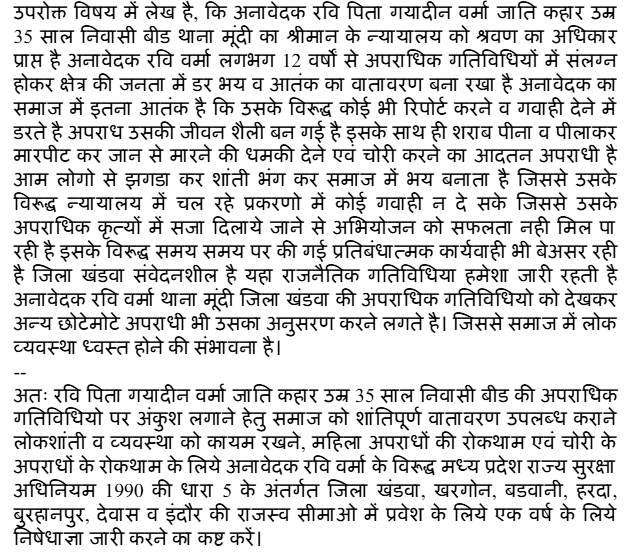
This petition is filed assailing the order dated 17.07.2025 passed by the respondent No.3-Collector/District Magistrate Khandwa (M.P.) whereby the petitioner has been externed from District Khandwa and its neighbouring districts for a period of one year in terms of Section 5 (b) of the M.P. Rajya Suraksha Adhiniyam, 1990 . He is further aggrieved by the order passed by the Commissioner Indore Division dated 31.10.2025 whereby appeal preferred by petitioner was dismissed.
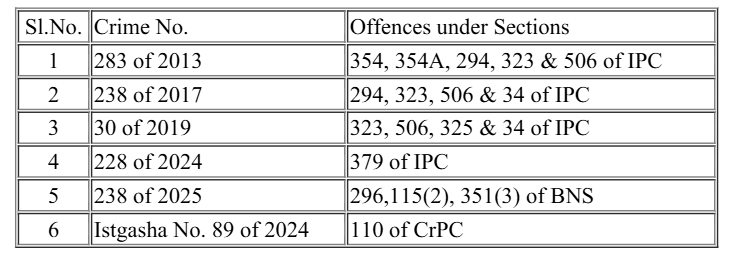
2. It is a case of the petitioner that in all five criminal cases were registered against him and out of which, in three cases, he has already been acquitted. These are (i) Crime No. 283 of 2013; (ii) Crime No. 238 of 2013 and (iii) Crime No. 30 of 2019. The authorities have taken note of the aforesaid criminal cases while preparing the report which was forwarded to the District Magistrate Khandwa. It is argued that the opinion has been found based upon the old cases which are registered against the petitioner. There is only one case which is registered against the petitioner in the year 2025 for the offence under Sections 296 , 115(2), 351(3) of BNS vide Crime No. 238 of 2025 at Police Station Mundi District Khandwa. There is no material placed on record by the respondents-authorities to show that the alleged offences committed by the petitioner are having close proximity enabling the initiation of externment proceedings.
3. Petitioner's counsel has relied upon the order passed by the Division Bench of this Court in the case of Ashok Kumar Patel vs State of M.P. and others reported in (2009) 4 MPLJ 434 and the order passed in the case of Rajesh Nagpure vs State of M.P. and others : WP No. 22524 of 2024 decided on 14.10.2024 in support of his arguments. It is submitted that the recommendations made by the Superintendent of Police in the report that due to threat of the petitioner, none of the witnesses are coming forward to depose against him could not be made out as the names of any of witnesses are not mentioned in the report. It is argued that in terms of Section 5 (b) of the M.P. Rajya Suraksha Adhiniyam, 1990 , two conditions for passing of externment order are required to be satisfied. Since the conditions mentioned in Section 5 (b) are not fulfilled; the externment order against the petitioner could not have been passed. It is further argued that old cases cannot be considered for the purpose of passing externment order because it is to be considered that commission of offence or abetment of such offence by a person must have a very close proximity to the date on which the order is proposed to be passed under Section 5 (b) of the Adhiniyam, 1990. On these grounds, he has prayed for quashment of the impugned order.
4. Counsel appearing for the respondents/State has filed reply to the petition supporting the impugned orders. It is contended that the petitioner was involved in various crimes such as fighting, assault, molestation, use of obscene language, threat to kill etc. and tends to disburse the peace-loving citizens; therefore, the action was required to be taken against him at appropriate time preventing its flare up in the wide area. Looking to the object and reasons of the M.P. Rajya Suraksha Adhiniyam, 1990 , as some effective preventive action was required to be taken by the authorities, the impugned action is taken against the petitioner. The Superintendent of Police District Khandwa made recommendation dated 26.05.2025 to the District Magistrate Khandwa to initiate proceedings for externment against the petitioner in terms of Section 5 of the Adhiniyam, 1990. The District Magistrate issued a show cause notice on 27.05.2025 under Section 8(1) of the Adhiniyam, 1990 asking the petitioner to appear on 05.06.2025. The petitioner appeared and filed reply on 26.06.2025 and thereafter the impugned externment order passed. Full opportunity of hearing was granted to the petitioner prior to passing of the order. The petition
AI



An indispensable Tool for Legal Professionals, Endorsed by Various High Court and Judicial Officers
Please visit our Training & Support
Center or Contact Us for assistance

Scan Me!
India’s Legal research and Law Firm App, Download now!


For Daily Legal Updates, Join us on :



 Back to top