


1. Insurance appeal against award under Motor Vehicles Act — Exoneration from liability — Reduction of compensation. (Para 1 , 2 )

 Back
Back





IN THE HIGH COURT OF MADHYA PRADESH AT GWALIOR
HIRDESH, J.
United India Insurance Co. Ltd. - Appellant
Versus
Deepmala And Others – Respondent
MISC. Appeal No. 4752 of 2024
Decided On : 23-02-2026
1. Insurance appeal against award under Motor Vehicles Act — Exoneration from liability — Reduction of compensation. (Para 1 , 2 )
2. Insurer argued trolley uninsured and income high; claimants supported award. (Para 5 , 6 , 7 )
3. Appeal partly allowed — Insurance liability upheld; compensation reduced to minimum wage calculation. (Para 21 )
Yes, if the insured tractor was the proximate cause. The insurer's liability extends to the accident caused by the tractor despite the uninsured trolley. (Para 10 , 11 , 12 , 13 , 14 )
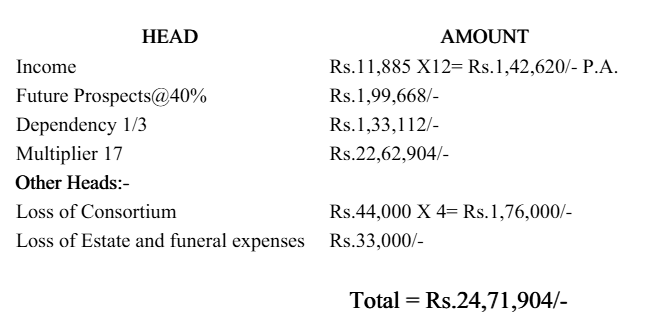
In the absence of documentary evidence, income is assessed based on the Minimum Wages Act for a skilled person, considering the deceased's qualifications and skill level. (Para 16 , 17 )
Following Sarla Verma, 1/3rd is deducted for personal expenses when the deceased has a spouse and other dependents, not 1/4th. (Para 15 , 18 )
ORDER :
HIRDESH, J.
This appeal has been filed by the Insurance Company under Section 173(1) of the Motor Vehicles Act against the award dated 15.03.2024 passed by the Fourth Member, Motor Accident Claims Tribunal, District Guna (M.P.) in Claim Case No. 108/2023, seeking exoneration from its liability as well as reduction of the compensation amount awarded to the claimants.
2. Brief facts of the case are that respondents No. 1 to 5 preferred a claim application under Section 166 of the Motor Vehicles Act, seeking compensation of Rs. 1,00,00,000/- for the death of the deceased, Anil (hereinafter referred to as 'the deceased'). The deceased died in a road traffic accident on 06-05-2023, allegedly involving a tractor bearing registration No. MP 08 AC 3149, which was attached to an uninsured trolley. On the fateful day, the tractor was insured with the appellant Insurance Company. The claimants submitted that the deceased was 29 years old at the time of the accident and was earning Rs. 50,000/- per month as a motor mechanic at a TVS Showroom.
3. Respondent Nos. 6 and 7 filed their written statements, and the appellant insurance company also opposed the claim application on the grounds that no accident occurred involving the vehicle as stated in the claim petition. The earnings and dependency of the claimants were also denied, and other defenses were raised, praying for dismissal of the claim petition.
4. The learned Claims Tribunal framed issues and, after appreciating the facts and the material on record, allowed the claim application, holding the claimants/respondents no. 1 to 5 entitled to a compensation of Rs. 44,93,000/- along with interest.
5. Being aggrieved by the impugned award, the Insurance Company has preferred this appeal, submitting that the award passed by the Claims Tribunal is contrary to the settled provisions of law and inconsistent with the facts, circumstances, and material on record. It is further submitted that the Claims Tribunal erred in not considering the legal aspect that the deceased was struck by the trolley, which was uninsured. It is contended that the Tribunal failed to consider the legal requirement that the trolley must be separately registered and insured. Since the trolley was not insured under the policy, no liability can be fastened on the Insurance Company for an accident involving the uninsured trolley. Moreover, it is argued that when both the tractor and trolley are involved in an accident, both the tractor and the trailer must be insured in order to hold the Insurance Company liable. As such, the Insurance Company should not be held liable for the accident caused by the uninsured trolley, and the impugned award deserves to be set aside, exonerating the appellant Insurance Company. It is also submitted that the Claims Tribunal has assessed the income of the deceased as Rs. 20,000/- per month without any substantial evidence, and that the dependency has been assessed on a higher side. The Insurance Company further contends that, as per the judgment in Sarla Verma & Ors. Vs. Delhi Transport Corporation & Anr. (2009) 6 SCC 121, personal expenses should be deducted at 1/3rd, not 1/4th, as assessed by the Claims Tribunal.
6. In support of their submission, counsel for the Insurance Company has placed reliance on the judgments of the Hon'ble Supreme Court in Dhondubai vs. Hanmantappa Bandappa Gandigude thr. LRs. , 2023 ACJ 1979, and IFFCO TOKIO GEN. INS. CO. LTD vs. Kumar Singh & Ors., SLP No. CC 12585/2012.
7. Per contra, counsel for the claimants supported the impugned award passed by the Claims Tribunal and prayed for dismissal of the instant appeal.
8. Heard the learned counsel for the parties and perused the record of the Claims Tribunal.
9. The first issue to be decided is whether the Insurance Company can be exonerated from liability on the grounds that the trolley attached to the tractor was uninsured.
10. It is undisputed that the tractor bearing Registration No. MP 08 AC 3149 was attached to a
AI



An indispensable Tool for Legal Professionals, Endorsed by Various High Court and Judicial Officers
Please visit our Training & Support
Center or Contact Us for assistance

Scan Me!
India’s Legal research and Law Firm App, Download now!


For Daily Legal Updates, Join us on :



 Back to top