
 Back
Back





PATNA HIGH COURT
RAJEEV RANJAN PRASAD, SOURENDRA PANDEY, JJ
Najra Pravin @ Nazra Praveen – Appellant
Versus
The State of Bihar – Respondent
CRIMINAL APPEAL (DB) No.643 of 2025 | PS. Case No.-609 Year-2023
| Table of Content |
|---|
| 1. victim's right to appeal following acquittal. (Para 2 , 3) |
| 2. interpretation of victim's appeal rights. (Para 4 , 5 , 15 , 18) |
| 3. divergent judicial views on appeal limitation. (Para 6 , 9 , 10 , 25) |
| 4. legislative intent behind appeal rights. (Para 21 , 22 , 23) |
| 5. reference to larger bench for clarity. (Para 54) |
CAV ORDER
(Per: HONOURABLE MR. JUSTICE RAJEEV RANJAN PRASAD)
The instant criminal appeal has been placed before this Court pointing out the Stamp Report defect no. 7. The Office Notes dated 16.10.2015 reads as under:-
“Stamp Report defect no. 7 i.e. Limitation expires on 18.03.2025 and petition filed on 12.05.2025, hence limitation petition wanting for 55 days still stands vide further S.R. dated 04.07.2025 kept at Flag ‘A’.
Submitted U/H “For Orders (On Office Notes)” before Hon’ble D.B. Criminal.”
2. This appeal has been preferred by the informant/victim challenging the judgment of acquittal dated 18.12.2024 by which the learned Special Judge (POCSO), Saharsa has acquitted the respondent nos. 2 and 3 of the charges under Section 376 of the Indian Penal Code (in short ‘IPC’) and Sections 4 and 8 of the Protection of Children from Sexual Offences (POCSO), Act in connection with Saharsa Sadar P.S. Case No. 609 of 2023. The appellant applied for certified copy of the judgment on 19.12.2024 which was delivered to the appellant on 23.12.2024.
3. Mr. Ashhar Mustafa, learned counsel representing the appellant, placed before this Court a Division Bench Judgment of this Court in the case of Parmeshwar Mandal vs. The State of Bihar and Others reported in (2014) 1 PLJR 377. It is submitted that the Hon’ble Division Bench of this Court has held that the right of a victim to prefer an appeal in terms of proviso to Section 372 is an unqualified right and no leave to appeal or special leave is required to be obtained by him/her for the purpose, as required by the State or the complainant for maintaining an appeal in terms of Section 378 of the Code. It has also been held that no limitation of time has been provided by the legislature for exercise of such a right of appeal by the victim in terms of the said proviso. Hence, in the facts and circumstances of each case, the Court has to determine as to whether the appeal is entertainable, or not, on the ground of absence of bona fide explanation for delay by the appellant.
4. Learned Counsel for the appellant submitted that in view of the judgment of the Hon’ble Division Bench of this Court in the case of Parmeshwar Mandal (supra), no application seeking condonation of delay is required to be filed.
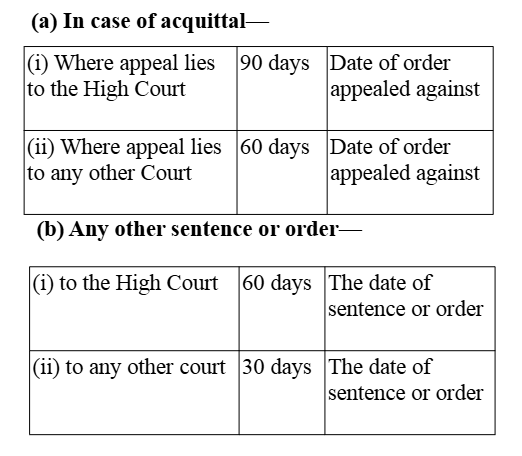
5. On the other hand, learned Additional Public Prosecutor for the State submits that prior to the judgment in the case of Parmeshwar Mandal (supra), a Division Bench of this Court in the case of Raghunath Yadav vs. State of Bihar and Others (Criminal Appeal (DB) No. 933 of 2010) reported in 2010 (4) PLJR 351 had decided that the period of limitation provided under Article 114 (a) of the Schedule to the Limitation Act for filing an appeal under Section 378 (i) & (ii) of the Code of Criminal Procedure (in short ‘CrPC’) would be applicable in case of an appeal under proviso to Section 372 by the victim.
6. It is submitted that even as the judgment of an equal strength of the Bench in case of Raghunath Yadav (supra) was brought to the notice of the Hon’ble Division Bench hearing the case of Parmeshwar Mandal (supra), the latter Division Bench held that the observations of the Division Bench of this Court in case of Raghunath Yadav (supra) is per incuriam the settled principles as emanating from the observations of the Constitution Bench of the Hon’ble Supreme Court in the case of Dadi Jagannadham vs. Jammulu Ramulu and Ors. reported in (2001) 7 SCC 71
7. It is submitted that the Division Bench in case of Parmeshwar Mandal (supra) could not have held a judgment of another Division Bench of this Court per incuriam by applying a principle of interpretation of law. It is submitted that a



An indispensable Tool for Legal Professionals, Endorsed by Various High Court and Judicial Officers
Please visit our Training & Support
Center or Contact Us for assistance

Scan Me!
India’s Legal research and Law Firm App, Download now!


For Daily Legal Updates, Join us on :



 Back to top


