
 Back
Back





PATNA HIGH COURT
HONOURABLE MR. SUNIL DUTTA MISHRA, J
Smt. Savitri Joshi – Appellant
Versus
Rameshwar Yagnik @ Lall Saheb – Respondent
FIRST APPEAL No.131 of 2014|Title Suit No. 72 of 2010|Partition Suit No. 159 of 1949|Title Suit No. 306 of 2010
| Table of Content |
|---|
| 1. factual background of the parties and prior suits (Para 2 , 5 , 6 , 7) |
| 2. arguments regarding the maintainability and legal standing of the suit (Para 9 , 10 , 11 , 22) |
| 3. court's reliance on documentary evidence over oral evidence (Para 18 , 19 , 20) |
| 4. judgment on admissions under order xii rule 6 of cpc (Para 34 , 52) |
| 5. conclusion of appeal with remand instructions to trial court (Para 56 , 57 , 60) |
C.A.V. JUDGMENT
Date : 04-12-2025
1. Heard Learned counsel for both the parties.
2. The instant First Appeal has been preferred by the appellants against the judgment dated 28.04.2014 and decree dated 23.05.2014 passed by the learned Subordinate Judge IV, Bettiah in Title Suit No. 72 of 2010 wherein the learned Trial Court disposed of the suit on admission and decreed in terms of pronouncement of compromise decree of Partition Suit No. 159 of 1949 and permanently restrained the appellants (defendants) to interfere in peaceful possession of respondents (plaintiffs) over the suit land.
3. For the sake of convenience, the parties are being referred to as defendants-appellants or plaintiffs-respondents.
4. To understand the relationship between the parties to the suit is shown in the Genealogical Table (Schedule 1 of plaint) which is given below:
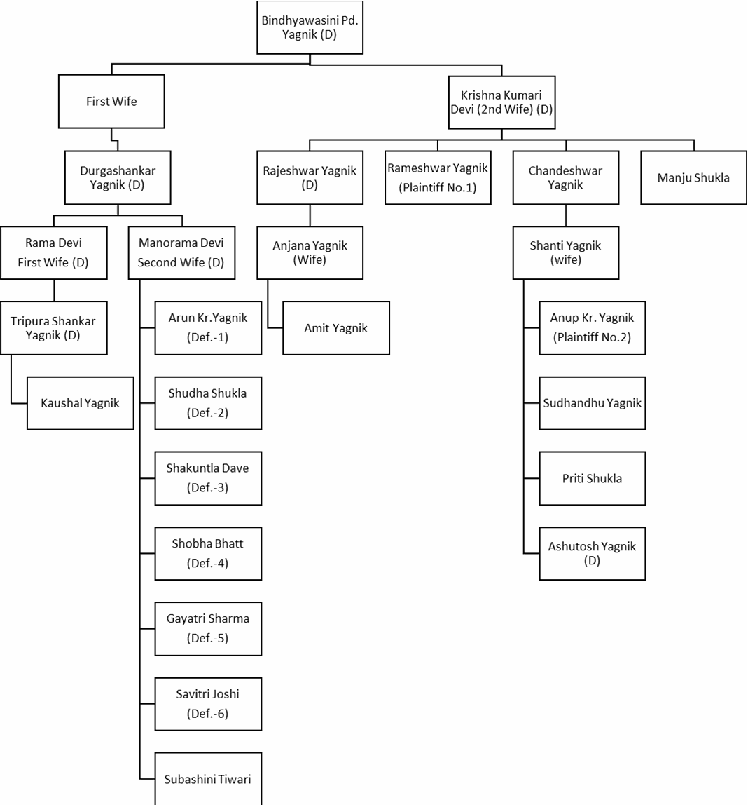
5. As per the plaint, Bindhyawasini Pd. Yagnik (Jani) @ Bacchan Babu was common ancestor who died leaving behind Smt. Krishna Kumari Devi, his second wife from whom three sons and one daughter namely Rajeshwar Pd. Yagnik @ Babu Saheb, Rameshwar Pd. Yagnik @ Lall Sahab (P-1) and Chandeshwar Pd. Yagnik @ Kunwar Saheb and a daughter Manju Yagnik (Shukla) were born. First wife of Bindhyawasini Pd. Yagnik (Jani) pre- deceased and one son namely Durgashankar Yagnik @ Lala Maharaj was born who died leaving behind his son Tripura Shankar Yagnik (born through his first wife Rama Devi), second wife Manorma Devi and his son Arun Kumar Yagnik @ Bachhaji and six daughters namely Sudha Shukla, Shobha Bhatt, Subhashini Tiwari, Shakuntala Dave, Gaytri Sharma and Savitri Joshi. Rajeshwar Pd. Yagnik died leaving behind his widow Anjana Devi and a son namely Amit Yagnik. Chandeshwar Pd. Yagnik @ Kunwar Saheb also died leaving behind his wife Shanti Devi @ Renu Devi and three sons namely Anup Yagnik, Sudhanshu Yagnik and Ashutosh Yagnik (died unmarried) and a daughter Priti (Yagnik) Shukla. Bindhyawasini Pd. Yagnik died in 1974 and his second wife Krishna Kumari died in 1996.
6. The case of the plaintiffs-respondents is that a prior partition suit bearing Partition Suit No. 159 of 1949, between the ancestors of the parties was compromised on 03.01.1951. Under the terms of the compromise, Rameshwar Pd. Yagnik (plaintiff no.1) was allotted the entire land of village Charihani, tauzi no. 799, and Krishna Kumari Devi (mother of plaintiff no.1) was allotted the entire land of village Basantpur, tauzi no. 799. The parties came into possession of their respective shares, and the revenue records were mutated accordingly.
7. The plaintiffs-respondents alleged that during her lifetime, Krishna Kumari Devi, in order to protect her estate, executed a nominal and non-operative gift deed dated 31.01.1962 in favour of her step-granddaughters Sudha and Sakuntala (daughters of Durgashankar Yagnik), however, possession was never delivered, and the deed was later cancelled by a registered deed of cancellation in 1973. Subsequently, Krishna Kumari Devi executed a will dated 08.07.1978, bequeathing her entire share in village Basantpur to her youngest son Chandeshwar Pd. Yagnik (father of plaintiff no.2 Anup Kumar Yagnik), and upon her death in 1996, Chandeshwar Pd. Yagnik came into possession. After death of Chandeshwar Pd. Yagnik, possession continued with his widow wife.
8. It is alleged that defendant no.1 (son of Durgashankar Yagnik) after almost disposing the properties in his share with dishonest intention in collusion with other defendants and some antisocial elements managed to get their names mutated with respect t



An indispensable Tool for Legal Professionals, Endorsed by Various High Court and Judicial Officers
Please visit our Training & Support
Center or Contact Us for assistance

Scan Me!
India’s Legal research and Law Firm App, Download now!


For Daily Legal Updates, Join us on :



 Back to top


