Back
Back





2025 Supreme(Raj) 2188
IN THE HIGH COURT OF JUDICATURE FOR RAJASTHAN, BENCH AT JAIPUR
Inderjeet Singh, Anand Sharma, JJ.
Smt. Munni Kanwar, Wife of Hem Singh - Appellant
Versus
Hem Singh @ Hema Ram - Respondent
D.B. Civil Miscellaneous Appeal No. 633 of 2010
Decided On : 16-05-2025
For the Appellant : Mr. Tanmay Dhand
For the Respondent: Mr. Veyankatesh Garg, through V.C.
Cruelty and desertion are valid grounds for divorce under the Hindu Marriage Act, with evidence of mental and physical cruelty substantiating the claims.
Headnote:(A) Hindu Marriage Act, 1955 - Section 13 - Divorce - Appeal against decree of divorce granted on grounds of cruelty and desertion - The husband alleged cruel behavior and desertion by the wife since 2000, leading to the divorce application filed in 2005 - The court found the husband's claims substantiated by evidence, including suicide attempts by the wife. (Paras 1-10, 15-17)
(B) Cruelty - Definition and scope - The court referenced the Supreme Court's interpretation of cruelty as encompassing both physical and mental aspects, emphasizing that intention is not a necessary element for establishing cruelty. (Paras 10-11)
(C) Desertion - Legal requirements - The court reiterated that desertion must be for a continuous period of not less than two years, with the intention to end cohabitation. (Paras 12-13)
Facts of the case:
The husband filed for divorce citing the wife's cruel behavior and desertion since 2000, with evidence presented regarding her suicide attempts.
Findings of Court:
The court upheld the lower court's decision, confirming that the wife's behavior constituted cruelty and desertion.
Issues: The main issues included whether the lower court properly assessed the evidence and whether the grounds for divorce were substantiated.
Ratio Decidendi: The court ruled that the evidence supported the husband's claims of cruelty and desertion, justifying the divorce decree.
Result: Appeal dismissed.
ORDER :
1. This appeal has been filed by the appellant (hereinafter to be referred as “Wife”) against the respondent (hereinafter to be referred as “Husband) challenging the judgment and decree dated 20.01.2010 passed by the learned District Judge, Sikar, (hereinafter to be referred as “the learned Court below”), whereby the learned Court below allowed the application seeking decree of divorce under Section 13 of the Hindu Marriage Act, 1955 (hereinafter to be referred as ‘Act of 1955’) filed on behalf of the husband.
2. Brief facts of the case are that the husband filed an application seeking decree of divorce under Section 13 of the Act of 1955 against the wife before the learned Court below stating therein that the marriage between the husband and wife was solemnized in the year 1983 and the behaviour of the wife was cruel with the husband. It was further stated in the application that she levelled unnecessary allegations against the husband and his father and on many occasions, she tried to commit suicide and started living separately since the year 2000, therefore, the husband was forced to file the divorce application. Lastly, prayed for granting of decree of divorce.
3. The wife submitted reply to the said application before the learned Court below and denied the allegations levelled by the husband and prayed for dismissal of the divorce application.
4. On the basis of the pleadings of the parties, the learned Court below framed the following issues:-
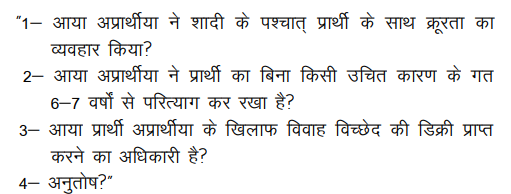
5. The learned Court below after recording the evidence and hearing both the parties allowed the application under Section 13 of the Act of 1955 filed by the husband vide judgment and decree dated 20.01.2010. Being aggrieved by the judgment and decree dated 20.01.2010 passed by the learned Court below, the wife has filed the present appeal before this Court.
6. Learned counsel for the wife submits that learned Court below has decided the application filed on behalf of the husband in a summary manner and the findings have not been recorded on each and every issue by the learned Court below. He further submits that the learned Court below has failed to follow the procedure as prescribed under the Code of Civil Procedure, 1908 and prayed for allowing the appeal.
7. In support of the contentions, learned counsel for the wife relied upon the judgment passed by the Hon’ble Supreme Court in the matter of Income Tax Officer, A Ward, Sitapur Vs. Murlidhar Bhagwan Das reported in 1964 SCC Online 18 and another judgment passed by the Rajasthan High Court in the matter of Shanti Lal Vs. Board of Revenue & Ors. reported in AIR 2011 Raj 72 .
8. Learned counsel appearing on behalf of the husband has opposed the submissions made by the learned counsel for the wife and submits that admittedly, the wife deserted the husband since the year 2000 without any reason, thereafter, the husband filed divorce application in the year 2005, therefore, issue of desertion was found proved against the wife by the learned Court below. He further submits that on many occasions, she tried to commit suicide and the said fact has been proved by leading evidence by the husband before the learned Court below. Lastly, prayed for dismissal of the appeal.
9. Heard learned counsel for the parties and perused the material available on record.
10. The point of cruelty has been considered by the Hon’ble Supreme Court at length in catena of judgments and in a recent judgment delivered in the matter of Rakesh Raman Vs. Kavita reported in 2023 17 SCC 433 , wherein in paras No.17 and 18, it was held as under:-
“17. Cruelty has not been defined under the Act. All the same, the context where it has been used, which is as a ground for dissolution of a marriage would show that it has to be seen as a ‘human conduct’ and ‘behavior” in a matrimonial relationship. While dealing in the case of Samar Ghosh (supra) this Court opined that cruelty can be physical as well as mental:-
“ 46…If it is physical, it is a question of fact and degree.