



1. Auction of residential houses by statutory board — Highest bidders declared and deposits accepted — Cancellation without reasons — Challenge under Articles 14 and 300-A. (Para 1 , 2 , 3 , 4 , 5 , 25 , 26 , 27 )
 Back
Next 





2026 Supreme(Raj) 737
HIGH COURT OF JUDICATURE FOR RAJASTHAN AT JODHPUR
FARJAND ALI, J.
Javari Lal S/o Shri Baldev Ram B/C Jat - Petitioner
Versus
State of Rajasthan through Secretary, Urban and Housing Department, Govt. of Rajasthan – Respondent
S.B. Civil Writ Petitions No. 12881 of 2015, 12588 of 2015, 12883 of 2015, 12884 of 2015, 12885 of 2015, 12886 of 2015, 303 of 2016, 800 of 2016
Decided On : 09-01-2026
Advocates Appeared:
For the Petitioner: Mr. DD Chitlangi, Mr. Khet Singh
For the Respondent: Mr. Amit Tatia
For the Petitioner: Mr. DD Chitlangi, Mr. Khet Singh
For the Respondent: Mr. Amit Tatia
A statutory authority cannot arbitrarily cancel an auction after accepting a winning bid and part payment without assigning cogent reasons. Discretionary powers must be exercised reasonably and transparently; non-speaking orders involving civil consequences violate Article 14 and the principles of natural justice.
Headnote:(A) Constitution of India - Articles 14, 19 and 300-A - Administrative Law - Principles of Natural Justice - Action of statutory authority in cancelling auction proceedings after declaring successful bidders and accepting part payment without assigning reasons - Reasoning constitutes the very soul of a decision and acts as a safeguard against arbitrariness (Paras 10, 11) - Any decision visiting civil consequences must disclose intelligible, transparent reasons capable of judicial scrutiny (Para 10) - Discretionary power is not absolute but regulated, to be exercised within defined parameters and not on whim or caprice (Paras 12, 15, 16) - A general clause reserving the right to reject bids without assigning reasons cannot be used to justify actions that are ex facie arbitrary and non-transparent (Para 34) - Legitimate expectation arises once a bid is declared successful and part consideration is deposited, which cannot be defeated without adherence to the principles of natural justice (Para 36) - Absence of reasons betrays non-application of mind and violates the rule of law (Paras 17, 22, 41).
(B) Public Auction - Scope of Discretion - Power to cancel an auction is conditional upon objective standards of fairness and competitiveness (Paras 12, 13) - If essential conditions of fairness are satisfied, cancellation without specific reasons is legally unsustainable (Para 14) - Cancellation based on internal file notings without communication or hearing is arbitrary and illegal (Paras 32, 38) - Contractual nature of an action does not bar writ jurisdiction when State action is impugned on the touchstone of Articles 14 and 300-A (Para 39).
Facts of the case:
Petitioners participated in public auctions for residential properties, were declared highest bidders, and deposited the requisite earnest money and part bid amounts. Subsequently, the statutory authority cancelled the allotments and/or refunded the deposited amounts through non-speaking letters without assigning any reasons or providing the petitioners an opportunity for a hearing.
Findings of Court:
The cancellation orders were found to be devoid of reasoning, reflecting non-application of mind and an arbitrary exercise of discretion. The authorities failed to demonstrate any procedural illegality, lack of competition, or compelling public interest that justified the cancellations, rendering the actions indefensible under the rule of law.
Issues: Whether a statutory authority can unilaterally cancel auction proceedings and allotment after declaring a bidder successful and accepting part payment, without providing reasons or a hearing, by relying on a general discretionary clause.
Ratio Decidendi: Discretion in administrative law is a structured power hedged by constitutional discipline and fairness, not a license for arbitrariness. A decision involving civil consequences must be supported by transparent reasons. The existence of a discretionary power to reject bids does not immunize the action from judicial review if it violates Article 14 or the principles of natural justice, especially when a legitimate expectation has been created.
Result: Writ petitions allowed; impugned cancellation orders quashed and set aside; restorations of allotments directed.
Legal Category Hierarchy
- constitutional law
- administrative law
-
practice and procedure
-
writ jurisdiction
- maintainability against contractual matters (Para 39)
-
writ jurisdiction
Table of Contents
2. Board justified cancellation under auction clauses; petitioners asserted concluded contracts, legitimate expectation, and absence of reasons or hearing — Violation of natural justice and constitutional rights. (Para 7 , 12 , 28 , 32 , 33 , 34 , 36 )
3. Reasons are the soul of decisions; discretion is regulated, not absolute; cancellation without recorded findings of unfairness or procedural illegality is arbitrary and violates Article 14. (Para 10 , 11 , 13 , 14 , 15 , 16 , 17 , 18 , 19 , 20 , 21 , 22 , 29 , 30 , 31 , 35 , 37 , 38 , 39 , 40 , 41 )
4. Auction cancellation clauses do not confer unfettered discretion; cancellation requires recorded reasons showing unfairness or procedural illegality, and must comply with natural justice. (Para 12 , 13 , 14 , 21 , 34 , 35 , 41 )
5. Writ petitions allowed; impugned cancellation letters quashed; respondents directed to restore allotments and proceed in accordance with law, with consequential benefits. (Para 23 , 24 , 43 )
6. Can a statutory authority cancel a concluded auction without assigning reasons?
No. Cancellation without reasons is arbitrary and violates Article 14; authority must record findings showing the auction was unfair or non-competitive, supported by objective criteria. (Para 11 , 14 , 21 , 22 , 41 )
7. Does a clause reserving power to cancel auctions confer unfettered discretion?
No. Such power is conditional and circumscribed; it must be exercised only on objective grounds like lack of fair competition or procedural irregularity, not at the authority's whim. (Para 12 , 13 , 14 , 21 , 34 )
8. Are principles of natural justice applicable before cancelling an auction after bid acceptance?
Yes. Once a bid is accepted and deposits taken, a legitimate expectation arises; cancellation without notice or hearing violates natural justice and the right to property under Article 300-A. (Para 22 , 30 , 31 , 36 , 38 )
9. Is a writ petition maintainable against unilateral cancellation of an auction despite contractual flavor?
Yes. The challenge is to arbitrary exercise of public power by a State instrumentality, not to contractual terms; writ jurisdiction remains available for violations of Articles 14 and 300-A. (Para 39 )
ORDER :
FARJAND ALI, J.
Grievance and Facts of S.B. Civil Writ Petitions No. 12881/2015, 12588/2015, 12883/2015, 12884/2015, 12885/2015, 12886/2015, 303/2016, 800/2016-
1. By way of filing the instant petitions, the petitioners collectively assail the arbitrary, unexplained and non- speaking rejection letter dated 13.03.2015 issued by the respondent–Rajasthan Housing Board, whereby the concluded auction proceedings were cancelled despite the petitioners having been declared successful bidders, their earnest money and 10% bid amount having been accepted, and a legitimate expectation of allotment having been created in their favour; such action is alleged to be patently illegal, mechanical and unguided, taken without assigning any reasons, in violation of Articles 14 and 300-A of the Constitution of India, the Rajasthan Housing Board (Disposal of Property) Regulations, 1970 and 1973, and the principles of natural justice, causing grave civil consequences to the petitioners , who were at all times ready and willing to perform their obligations.
COMMON FACTS
2. That the factual matrix of all petitions is identical in all material respects, save and except the individual house numbers, area, bid amount and writ petition numbers, which are set out in the comparative table hereinbelow. Table Showing Petition-wise Factual Variations-
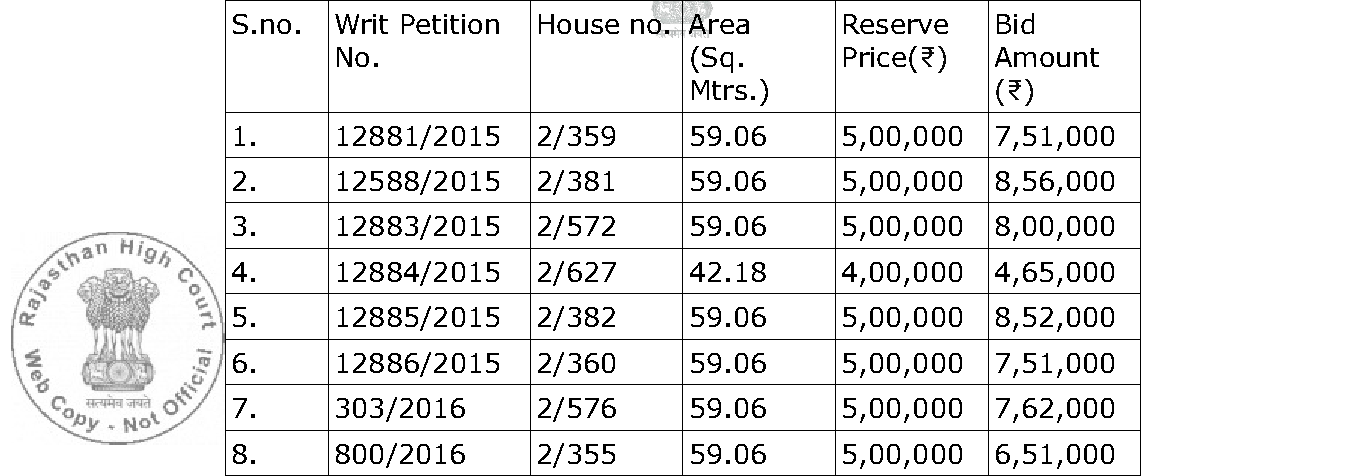
That all the above-captioned writ petitions arise out of a common auction process initiated by the respondent– Rajasthan Housing Board for allotment of constructed residential houses under the Tausar Road Residential Scheme, Nagaur. The respondent Board issued an auction notice inviting sealed bids for allotment of residential houses, shops and residential/commercial plots, stipulating that the residential houses would be allotted to the highest bidders, subject to approval by the competent authority. That pursuant to the said auction notice, each of the petitioners submitted sealed bids for different constructed residential houses under the same scheme, offering amounts substantially higher than the reserve price fixed by the respondent Board, along with the prescribed earnest money.
3. A duly constituted committee of the Rajasthan Housing Board, comprising the representative of the District Collector, Deputy Housing Commissioner (RHB), Bikaner Circle, Assistant Accounts Officer and Resident Engineer, Nagaur Division, scrutinized the bids and, finding the respective petitioners to be the highest bidders, recommended allotment of the concerned residential houses in their favour.
4. That the names of the petitioners were accordingly included in the final list of successful bidders, pursuant whereto each petitioner was directed to deposit 10% of the bid amount within 72 hours, after adjustment of earnest money, which direction was duly complied with by all the petitioners within the stipulated time. As per the auction terms, the remaining bid amount was required to be deposited within 60 days from issuance of a demand letter by the respondent Board.
5. However, despite lapse of considerable time, no demand letters were issued to any of the petitioners. Instead, upon making inquiries and thereafter seeking information under the Right to Information Act, 2005, the petitioners came to know that the proposal for allotment had been rejected by the competent authority vide a common letter dated 13.03.2015, without assigning any reasons, and with an indication that the rejected houses would be put to re-auction.
6. The impugned letter dated 13.03.2015 has thus caused grave prejudice to the petitioners, compelling them to file the present writ petitions.
7. Heard learned counsels present for the parties and gone through the materials available on record.
8. OBSERVATIONS OF THE COURT
9. Upon a careful and anxious consideration of the pleadings, record and rival submissions, this Court finds that the core grievance raised in all the present writ petitions emanates from an identical factual matrix and challenges the same impugned












