1. Dismissal of a fiduciary employee for financial dealings with vendors and failure to disclose conflict of interest under the Industrial Relations Act 1967. (Para 1 , 2 , 15 , 31 )
 Back
Next 





2026 MarsdenLR 446
INDUSTRIAL COURT PENANG
THANGARAJ NARAYANAN – Appellant
Versus
DHL EXPRESS (MALAYSIA) SDN BHD – Respondent
Award No: 412 of 2026 [Case No: 9/4-1475/23]
Important Points
An employee in a fiduciary position who engages in unauthorized financial dealings with vendors and conceals conflicts of interest breaches the duty of fidelity, justifying dismissal. Long service in a position of trust acts as an aggravating factor rather than a mitigating one in cases of integrity breaches.
Subject
Employment Law - Unfair Dismissal
Act Referred
Headnote
(A) Industrial Relations Act 1967 - Section 20(3) - Dismissal - Just cause or excuse - Burden of proof lies with the employer to establish misconduct on a balance of probabilities (Paras 9, 10).
(B) Fiduciary Duty - Employee in a position of trust - Obligation of loyalty and integrity - Prohibition against making profit from trust or placing self in a position where duty and interest conflict (Para 18).
(C) Conflict of Interest - Duty to make full disclosure - Actual loss need not be proved; possible detriment or loss to the employer is sufficient to establish misconduct (Para 30).
(D) Mitigating Factors - Long service for an employee in a position of trust may be an aggravating factor rather than a mitigating one when the employee knowingly abuses the trust reposed in them (Para 37).
Facts of the case:
An employee serving as a customs broker was dismissed for engaging in financial transactions, including borrowing money and betting, with a company vendor and for failing to disclose that his spouse was employed by a major customer. The employee's role involved assigning shipments to vendors, making the position fiduciary in nature. The employee denied the allegations initially but later admitted to the financial dealings during the proceedings.
Findings of Court:
The court found that the employee admitted to the financial dealings and the failure to declare the conflict of interest. Such actions violated the company's code of conduct and breached the duty of fidelity, destroying the trust and confidence essential to the employment relationship.
Issues: Whether the employee was guilty of misconduct and whether the proven misconduct constituted just cause or excuse for the dismissal.
Ratio Decidendi: The court held that an employee in a fiduciary role must act in good faith and avoid conflicts of interest. Engaging in personal financial dealings with vendors creates an unacceptable operational risk of favoritism. In cases involving a breach of integrity, long tenure implies a higher degree of trust, making the breach more severe and the dismissal justified.
Result: Claimant's claim dismissed.
Legal Category Hierarchy
Petitioner Advocates:Sahul Hamid ,Respondent Advocate: Kumarappan Ramasamy
Table of Contents
2. Whether financial dealings with vendors and non-disclosure of spouse's employment constitute misconduct justifying dismissal, or whether such actions were unrelated to work and occurred under duress. (Para 4 , 5 )
3. The employee's fiduciary role required absolute loyalty; borrowing from vendors and concealing conflicts destroyed independence and breached the duty of good faith and the company's code of conduct. (Para 14 , 18 , 23 , 24 , 25 , 26 , 28 , 29 , 31 , 33 , 34 , 35 , 37 )
4. Breach of fiduciary duty through financial conflicts of interest and dishonesty in declarations constitutes grave misconduct justifying summary dismissal, where long service may aggravate the breach. (Para 18 , 28 , 35 , 37 )
5. Claim dismissed; termination found to be with just cause or excuse. (Para 40 , 41 )
6. Who bears the burden of proof in a dismissal case and what is the required standard?
The employer bears the burden of proving that the dismissal was with just cause and excuse, based on the civil standard of balance of probabilities. (Para 9 , 10 )
7. How does a fiduciary relationship affect the assessment of an employee's conduct regarding financial dealings with vendors?
Employees in fiduciary positions owe a duty of loyalty and must not place themselves in positions where personal interests conflict with their duty to the employer, as this destroys their independence. (Para 18 , 25 , 26 , 28 )
8. Does a long record of service typically mitigate the punishment for a breach of fiduciary duty?
In cases involving breaches of fiduciary duty and integrity, long service can be an aggravating factor rather than a mitigating one, as it implies a higher degree of trust. (Para 37 )
9. Does the failure to disclose a spouse's employment with a customer constitute misconduct?
Yes, knowingly concealing such employment in a declaration of interest deprives the employer of the right to assess and mitigate potential conflicts, breaching the duty of good faith. (Para 31 , 34 )
AWARD
Reference
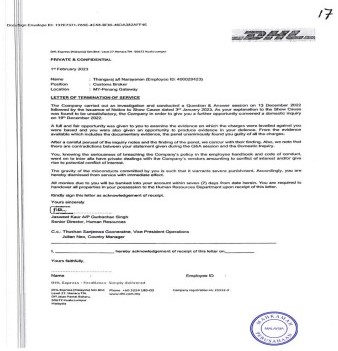
This is a reference dated 25 September 2023 by the Director General of Industrial Relations Malaysia to the Industrial Court of Malaysia under s 20(3) of the Industrial Relations Act 1967 (hereinafter referred to as "the IRA"). This reference is in respect of the dismissal of Thangaraj a/l Narayanan (hereinafter referred to as "the claimant") by his employer, DHL Express (Malaysia) Sdn Bhd (from now on referred to as "the company") effective 1 February 2023.
[1] This Court has considered the following cause papers and documents in handing down this Award, namely:
(a) the claimant's Statement of Case dated 23 November 2023;
(b) the company's Statement in Reply dated 13 February 2024;
(c) the claimant's witness statement (Thangaraj a/l Narayanan) is marked as "CLWS-1";
(d) the company's witness statement (Sukhvinder Singh Rolla Singh) is marked as "COWS-1";
(e) the company's witness statement (Teoh Aik Hong) is marked as "COWS-2";
(f) the company's witness statement (Thushan Sanjeewa Gooneratne) is marked as "COWS-3";
(g) the claimant's Bundle of Documents marked as "CLB-1";
(h) the company's Bundle of Documents marked as "COB-1";
(i) the company's Bundle of Documents marked as "COB-2";
(j) the company's Bundle of Documents marked as "COB-3".
A. Brief Facts Of The Case
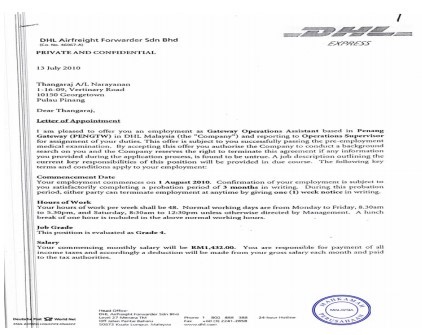
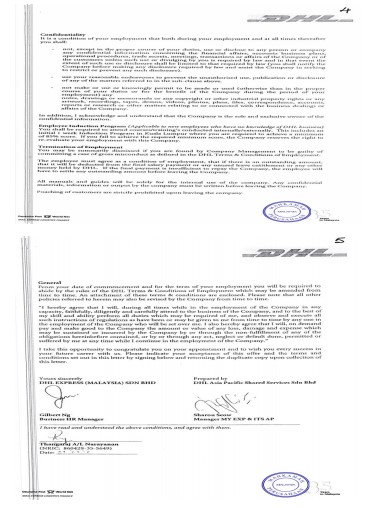
[2] The Claimant commenced his employment with the company as a Gateway Operations Assistant on 13 July 2010. At the time of dismissal, the claimant held the position of Customs Broker, and his last drawn basic salary was RM3,672.00 per month.
[3] The Company is one of the global market leaders in the logistics industry.
B. The Claimant's Case
[4] The Claimant's averments are as follows:
(a) During his tenure of employment for more than twelve (12) years of unblemished record of service, the claimant had carried out his duties in accordance with the company's requirements, rules and regulations without committing any misconduct whatsoever;
(b) The Claimant was instructed to give consent for the company to access his personal bank account and, also instructed him to provide three (3) years' bank statements, checking his handphone, and he was threatened that all the handphone records will be sent for forensics for further investigation and he gave his consent under duress;
(c) By way of the company's letter dated 13 December 2022 and 29 December 2022, respectively, he was issued a letter of suspension and extension of suspension until 15 January 2023 for investigation;
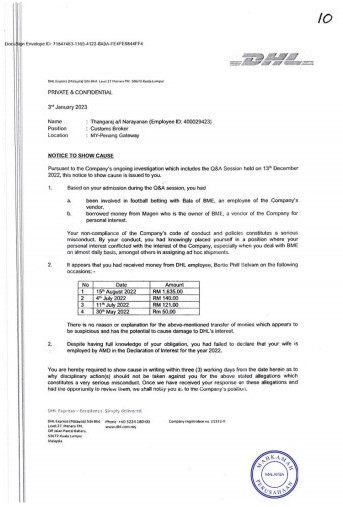
(d) By way of the company's letter dated 3 January 2023, he received a letter of show cause on three (3) allegations levelled against him;
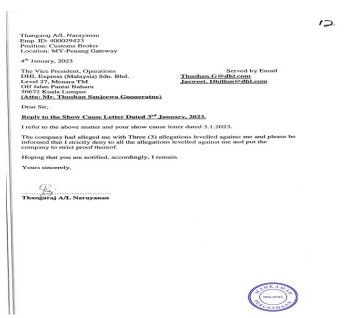
(e) By way of his letter dated 4 January 2023, he had replied to the company's show cause letter and that he had denied all the allegations of wrongdoing levelled against him;
(f) The Company, via a notice of Domestic Inquiry ("DI") dated 12 January 2023, instructed the claimant to attend a DI session on 19 January 2023;
(g) By way of company's letter dated 13 January 2023 and 30 January 2023, respectively, he was informed that his suspension period will be extended until 29 January 2023 and, further until 6 February 2023 with full pay; and
(h) By way of company's letter dated 1 February 2023, he was issued a letter of termination of service with immediate effect from 1 February 2023.
C. The Company's Case
[5] The Company's averments are as follows:
(a) The Claimant is required to manage and to supervise the company's transportation vendors in terms of their service and performance, which includes assigning ad hoc shipments;
(b) The Claimant's position is a fiduciary one where the core obligation is one of loyalty and integrity;
(c) The Claimant's obligations are to serve the company in good faith which includes exclusivity and not to make a profit out of his employment with the company;
(d) The Claimant, by nature of his job, is prohibited from having any private dealings with the company's vendor which includes money dealings;
(e) The Claimant had been involved in