1. Motorcycle collision — Traumatic brain injury — Claim by patient through litigation representative — Consent judgment tendered after trial. (Para 1 , 2 , 5 , 6 , 7 , 8 )
 Back
Next 





2026 MarsdenLR 6130
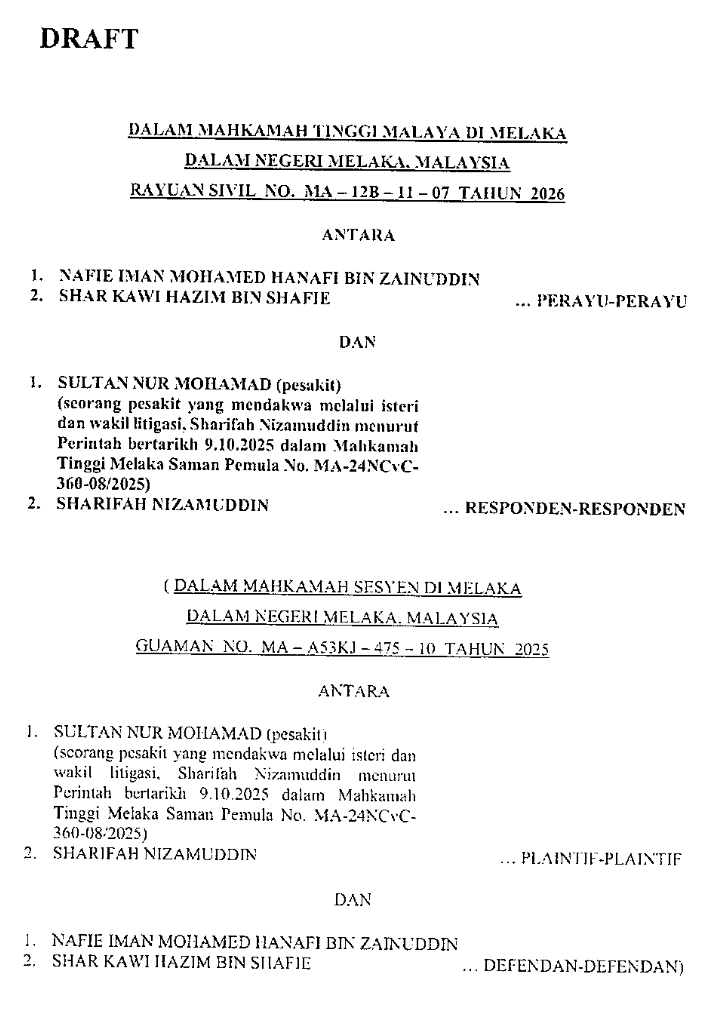
IN THE HIGH COURT OF MALAYA AT MELAKA
RAJA SEGARAN A/L S.KRISHNAN, JC
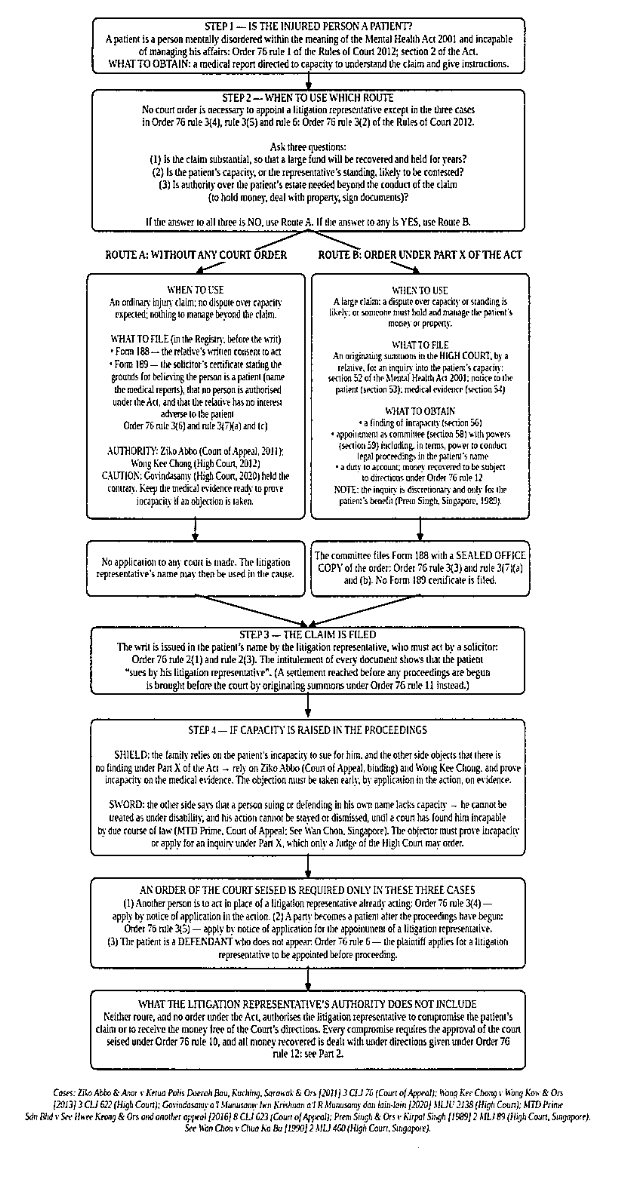
NAFIE IMAN MOHAMED HANAFI BIN ZAINUDDIN – Plaintiff
Versus
SULTAN NUR MOHAMAD – Defendant
APPEAL NO. MA-12B-11-07/2026
Important Points
Compromises for persons under disability are invalid without court approval under Order 76 rule 10, including settlements reached after judgment but pending appeal. Such approval is a substantive judicial act requiring evidence that the compromise is reasonable and serves the patient's best interests.
Subject
Civil Law - Civil Procedure
Act Referred
Rules of Court 2012: O.76 R.1, O.76 R.2(1), O.76 R.3(3), O.59 R.17(4)(a), O.76 R.10, O.76 R.12(1), O.76 R.11(1), O.22B R.7, O.55 R.2, O.55 R.11(3), O.55 R.16(1), O.42 R.6(2), O.42 R.8, O.92 R.3B(1), O.32 R.1, O.32 R.3, O.32 R.10, O.32 R.13(2), O.1A, O.2 R.1(1), O.92 R.4
Mental Health Act 2001: S.2(1), S.51, S.52, S.56, S.58, S.59, S.85
Courts of Judicature Act 1964: S.24
Federal Constitution: Art.8(1)
Headnote
(A) Rules of Court 2012 - Order 76 rules 1, 2, 3, 10, 11, 12 - Mental Health Act 2001 - Settlement and compromise on behalf of a person under disability - Validity of compromise - Requirement for court approval - Any settlement, compromise, or payment involving a person under disability is not valid without the approval of the court (Para [14]) - This requirement serves as an external check on the propriety of the compromise to protect the disabled party from undervaluation or inadequacies in legal advice, ensuring the fund produced is adequate for the patient's needs (Paras [37]-[38]).
(B) Approval of compromise - Temporal reach - The requirement for approval under Order 76 rule 10 extends to compromises reached after judgment while the claim is under appeal - Such approval must be sought from the court currently seised of the appeal (Paras [41]-[44]).
(C) Judicial act vs Ministerial recording - The approval of a compromise is a substantive judicial determination on evidence, which is a condition precedent to the making of any order giving effect to the compromise - It is distinct from the ministerial act of recording a consent order or settling the form of a draft judgment (Para [45]).
Facts of the case:
A patient with a severe traumatic brain injury sued for damages following a vehicle collision through a litigation representative. After the trial court awarded damages, an appeal was filed. The parties subsequently reached a compromise for a sum lower than the adjudicated amount. They sought to record this agreement as a consent judgment via a letter and draft without filing a formal application for the court's approval of the compromise or for directions regarding the settlement moneys.
Findings of Court:
The court found that the proposed compromise required approval under Order 76 rule 10 and that the previous order appointing the litigation representative did not constitute such approval. The court was not in a position to approve the compromise because the parties failed to provide evidence regarding the patient's current condition, the reasons for the agreed discount, or a detailed proposal for the management of the fund. The draft consent judgment was also found to be incomplete in its operative terms and non-compliant with practice directions.
Issues: Whether a compromise reached after judgment but pending appeal requires court approval under Order 76 rule 10 of the Rules of Court 2012, and whether such approval is a distinct judicial act from the recording of a consent judgment.
Ratio Decidendi: The protection extending to persons under disability is the court's responsibility and cannot be waived by the parties. Order 76 rule 10 is a provision that conditions the validity of the compromise itself; therefore, a compromise is not valid unless a considered judicial determination is made on evidence that the settlement is reasonable and in the patient's best interest. A consent order does not, by its mere existence, constitute the required judicial approval.
Result: Request to record the consent judgment declined; litigation representative directed to file a formal application for approval and directions.
Legal Category Hierarchy
Advocates:
Lawyer For Appellant :
Puan Leandra Abigail De Costa
Tetuan Z. Hashim & Co.
Lawyer For Respondent
: Encik Surendran Chelvarajah Tetuan Sekar Gill & C.
Table of Contents
2. Appellants appeal against liability and quantum; respondents seek to record consent judgment compromising the claim pending appeal. (Para 1 , 2 , 9 , 10 )
3. Compromise of patient's claim requires court approval under Order 76 rule 10; neither prior order nor judgment supplies approval. (Para 21 , 22 , 24 , 28 , 29 , 30 , 31 , 32 , 33 , 34 , 35 , 36 , 37 , 38 , 39 , 41 , 42 , 43 , 44 , 45 , 46 , 47 )
4. A compromise of a claim by a person under disability is not valid without court approval under Order 76 rule 10 whenever made. (Para 14 , 21 , 65 )
5. Application for approval required; e-Review not brought forward for recording; directions given for application and hearing. (Para 87 , 88 )
6. Does Order 76 rule 10 require court approval for a compromise reached after judgment and pending appeal?
Yes. The rule applies "whenever entered into or made" and extends to compromises after judgment pending appeal; the court seised of the appeal must approve. (Para 14 , 21 , 22 , 40 , 41 , 42 , 43 , 44 )
7. What does court approval under Order 76 rule 10 require?
A considered judicial determination on evidence that the compromise is proper for the patient; not merely recording parties' agreement in a consent order. (Para 37 , 38 , 39 , 45 , 46 , 47 , 49 , 50 , 51 , 52 , 53 , 54 , 65 )
8. Who applies for court approval and directions under Order 76 rules 10 and 12?
The litigation representative applies by notice in the appeal, seeking approval and directions, supported by her own affidavit addressing the required matters. (Para 67 , 68 , 69 , 70 , 71 , 72 )
9. Does an order authorising a litigation representative to receive compensation supply approval under rule 10?
No. That order identifies who may act for the patient and governs receipt and management of money, not the propriety of a compromise or its amount. (Para 23 , 24 , 25 , 26 , 27 , 28 , 29 )
10. Can a draft consent judgment for a patient be recorded purely on the parties' signatures?
No. Separate court approval under rule10 is required; the draft must also be in proper form and address indefinite terms, payment, and directions. (Para 45 , 77 , 78 , 79 , 80 , 81 , 82 , 83 , 84 , 85 , 86 )
GROUNDS OF JUDGMENT
A. INTRODUCTION
[1] This appeal arises from a running-down action. The First Respondent, who sustained a severe traumatic brain injury in a collision between two motorcycles on 02.03.2024, is a patient within the meaning of Order 76 of the Rules of Court 2012 (P.U.(A) 205/2012) ("the ROC 2012"). He sued in the Sessions Court at Melaka by his wife, the Second Respondent, as his litigation representative. On 30.06.2026 the Sessions Court found the Appellants wholly liable and awarded damages, interest and costs. The Appellants have appealed against the whole of that decision, on liability and on quantum.
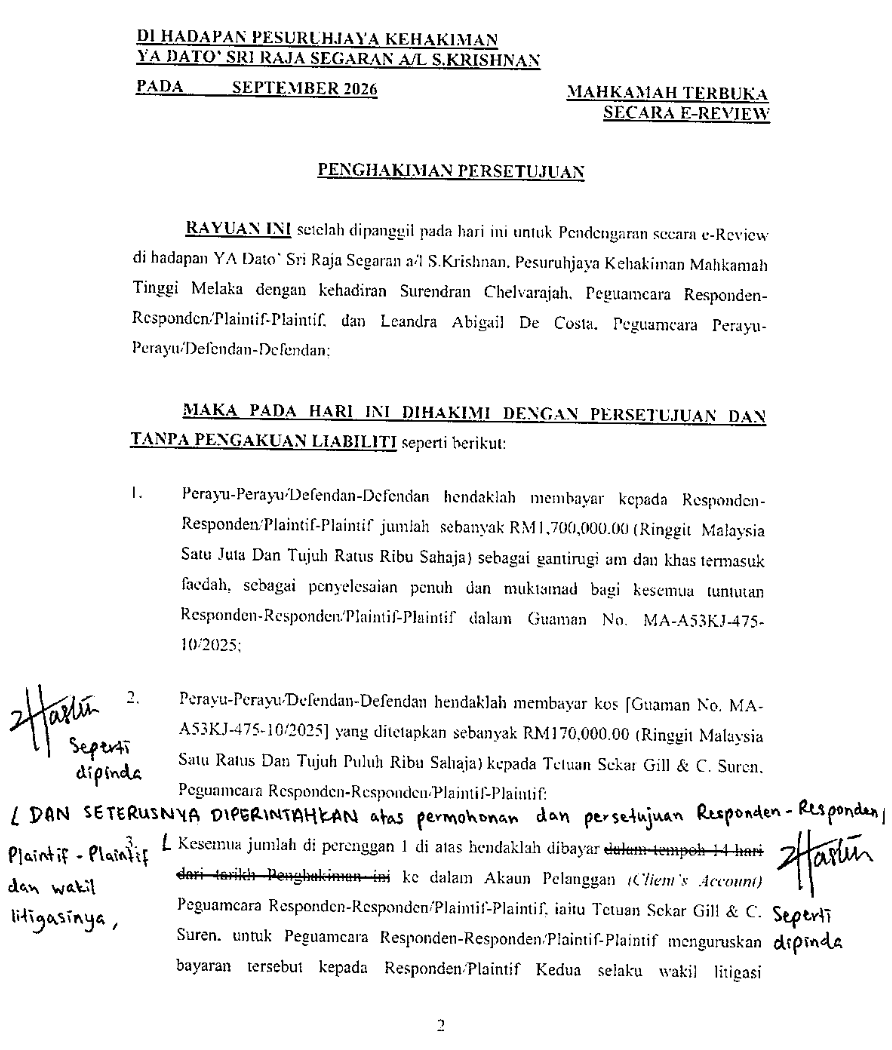
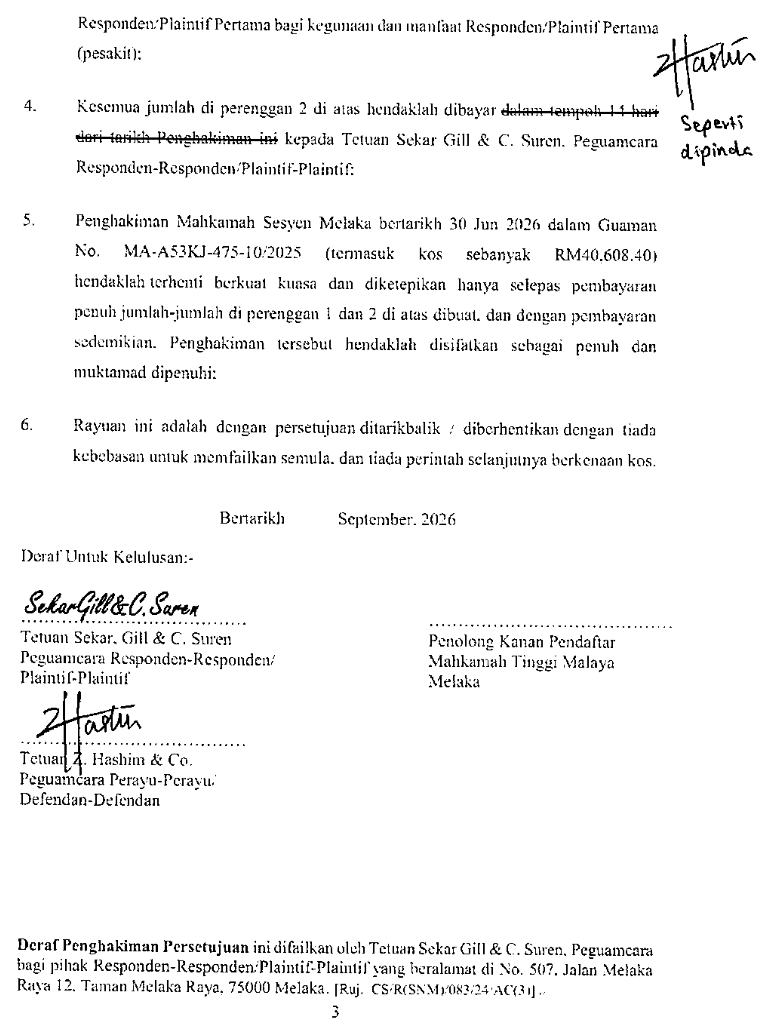
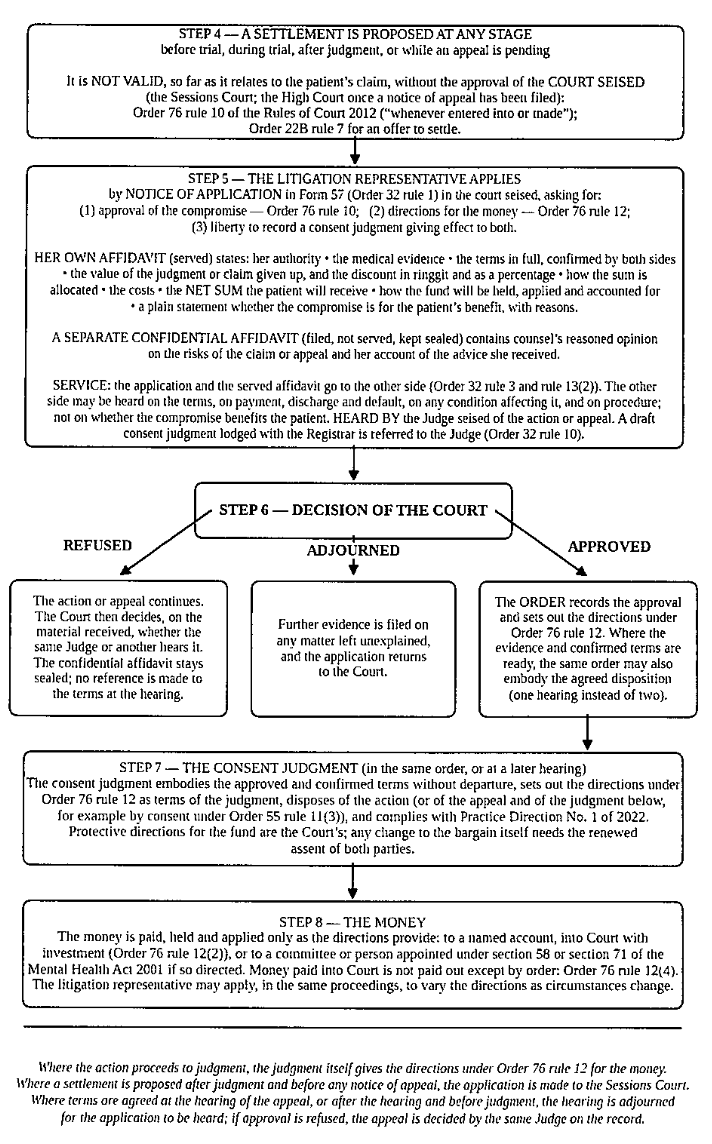
[2] Before the appeal has been heard, the parties have reached terms. By a letter dated 09.09.2026, the Respondents' solicitors asked that the case management by e-Review fixed for 24.09.2026 be brought forward so that a consent judgment could be recorded, and enclosed a draft consent judgment bearing the marks of both firms of solicitors. The proposed terms would substitute, for the adjudicated sums, a payment of RM1,700,000.00 in full and final settlement of the Respondents' claims and a further RM170,000.00 as costs, and would dispose of the appeal.
[3] The request, though modest in form, raises a question of some importance in the administration of civil justice: what is the function of the Court when parties tender for recording a compromise reached on behalf of a person under disability? The answer determines whether the Court may simply record what the parties have agreed, or whether something more is required of it before an order in the proposed terms can be made. These grounds set out the Court's consideration of the letter and the draft, and explain the course it has directed.
[4] Nothing in these grounds is a determination of the appeal, of any ground of appeal, or of the merits of the compromise. The Court has examined the letter and the draft against the record of appeal and the additional record of appeal.
B. MATERIAL FACTS AND PROCEDURAL HISTORY
[5] On 02.03.2024 the First Respondent, riding his motorcycle along Lebuh AMJ, Melaka, was struck by a motorcycle ridden by the First Appellant and registered in the name of the Second Appellant. He suffered a severe traumatic brain injury with right-sided hemiparesis and hemianopia, a major neurocognitive disorder, permanent visual loss and other injuries. The medical evidence records that he is not capable of making decisions on his own, including financial decisions.
[6] On 09.10.2025, on an ex parte originating summons in Originating Summons No. MA-24NCvC-360-08/2025, this Court made an order under the Mental Health Act 2001 (Act 615) ("the Act") and Order 76 of the ROC 2012 permitting the Second Respondent, his wife, to represent him as his litigation representative, to commence a civil action on his behalf arising from the accident, and to receive and manage any compensation obtained in those proceedings for his benefit, and recording that she has no interest adverse to his ("the Order of 09.10.2025").
[7] The writ in Civil Suit No. MA-A53KJ-475-10/2025 was issued in the Sessions Court at Melaka on 30.10.2025 and served on 05.11.2025. The Second Respondent's consent to act in Form 188 and the solicitor's certificate in Form 189, both dated 30.10.2025, were lodged; the certificate certifies that the First Respondent is a patient by virtue of the Order of 09.10.2025, that no other person is authorised to act, and that the Second Respondent has no adverse interest. The Second Respondent also sued in her own right for RM5,000.00, the cost of obtaining the Order.
[8] The Appellants defended on the footing that the First Respondent caused the collision. After a trial on three days between February and May 2026, the Sessions Court gave judgment for the Respondents on 30.06.2026. It found the First Appellant wholly liable and the Second Appellant vicariously liable, and awarded the First Respondent general damages of RM1,466,120.00 and special damages of RM408,120