



1. Commercial transaction for prepaid cards — discovery of counterfeit goods — execution of debt acknowledgment agreement — criminal conviction for forgery under Section 468, Penal Code. (Para 1 , 2 , 3 , 4 , 5 , 6 , 7 , 8 , 9 , 10 )
 Back
Next 


2026 MarsdenLR 114092
IN THE HIGH COURT OF MALAYA AT SHAH ALAM
SHOBA DORAI RAJAH, JC
MOK YAN QUAN – Plaintiff
Versus
CHIN CHEE KEONG – Defendant
CIVIL SUIT NO.: BA-22NCvC-71-02/2026
Important Points
Summary judgment is available for claims not solely based on fraud, including admitted debts. A voluntary criminal guilty plea constitutes a judicial admission admissible in civil proceedings, and bare assertions cannot displace a prima facie case established by written debt acknowledgments.
Subject
Civil Law - Summary Judgment
Act Referred
Rules of Court 2012: O.14, R.1(2)(b), R.3(1)
Companies Act 2016: S.551(3)
Penal Code: S.468
Evidence Act 1950: S.43
Companies Act 2016: S.551(3)
Penal Code: S.468
Evidence Act 1950: S.43
Headnote
(A) Rules of Court 2012 - Order 14 Rule 1(2)(b) and Rule 3(1) - Evidence Act 1950 - Section 43 - Penal Code - Section 468 - Summary judgment - Allegations of fraud - Where a claim is not strictly founded solely upon deceit and fraud, but includes independent alternative causes of action such as unjust enrichment or a breach of a written debt acknowledgment, summary judgment may be granted on those parts of the claim. (Paras 14-15)
(B) Evidence Act 1950 - Section 43 - Criminal plea of guilty - While a criminal conviction does not operate as conclusive proof of civil liability, a voluntary plea of guilty in open court constitutes a judicial admission and is admissible as probative evidence in civil proceedings involving the same factual background. (Paras 20-24)
(C) Summary Judgment - Triable issues - Bare assertions, uncorroborated claims of duress, or afterthoughts lacking documentary evidence are insufficient to disclose a bona fide triable issue to displace a prima facie case based on a written acknowledgment of debt. (Para 28)
Facts of the case:
A party purchased prepaid cards based on representations of authority, only to discover they were counterfeit. The seller had issued invoices under a dissolved company but received payments into a personal account. The seller subsequently executed a written agreement acknowledging a liquidated debt. Additionally, the seller pleaded guilty in a criminal court to forgery for the purpose of cheating regarding the same transaction. The buyer sought summary judgment for the admitted debt.
Findings of Court:
The court found that the claim for restitution and debt recovery stood on an independent footing from the fraud allegations. The guilty plea and the written debt acknowledgment provided conclusive evidence of liability. The defenses raised regarding the return of goods, corporate capacity, and status as a middleman were found to be unsubstantiated.
Issues: Whether allegations of fraud bar summary judgment when alternative causes of action exist; whether a criminal guilty plea is admissible in civil proceedings; and whether the defendant disclosed any bona fide triable issues.
Ratio Decidendi: Summary judgment is permissible under Order 14 Rule 3(1) for parts of a claim not solely dependent on fraud. A voluntary guilty plea in a criminal court serves as a binding judicial admission of the underlying facts in a civil suit. Bare assertions cannot override a written acknowledgment of debt and judicial admissions.
Result: Plaintiff’s application for Summary Judgment is allowed and judgment is entered in favour of the Plaintiff for the liquidated sum claimed and the Counter claim dismissed.
Legal Category Hierarchy
- practice and procedure
- contract law
- tort
- crime and sentencing
Advocates:
Solicitor for the Plaintiff: Alvin Tan Keng Yi [MESSRS DALJIT SINGHPARTNERSHIP]
Solicitor for the Defendant: Lim Jia Qing [MESSRS HENG DAHLIA & CO.]
Solicitor for the Plaintiff: Alvin Tan Keng Yi [MESSRS DALJIT SINGHPARTNERSHIP]
Solicitor for the Defendant: Lim Jia Qing [MESSRS HENG DAHLIA & CO.]
Table of Contents
2. Summary judgment bar due to fraud allegations — inadmissibility of criminal plea under Section 43, Evidence Act — existence of triable issues and harassment counterclaim. (Para 11 )
3. Alternative causes of action for unjust enrichment and admitted debt bypass fraud bars — guilty pleas constitute admissible judicial admissions — defenses lack evidentiary support. (Para 12 , 13 , 14 , 15 , 16 , 17 , 18 , 19 , 20 , 21 , 22 , 23 , 24 , 25 , 26 , 27 , 28 )
4. Summary judgment is permissible for claims not solely based on fraud — voluntary criminal pleas are binding prima facie evidence of civil liability. (Para 15 , 24 )
5. Application for summary judgment allowed for the liquidated sum — counterclaim dismissed. (Para 29 , 30 )
6. Does an allegation of fraud automatically bar a summary judgment application under Order 14 Rule 1(2)(b)?
No. While summary judgment is barred where a claim is strictly founded on fraud, the court may grant it under Order 14 Rule 3 for any part of a claim or alternative cause of action that does not depend on proof of fraud. (Para 13 , 14 , 15 )
7. Is a defendant's guilty plea in a criminal proceeding admissible as evidence in a subsequent civil suit?
Yes. Although a criminal conviction is not conclusive proof of civil liability under Section 43 of the Evidence Act, a voluntary guilty plea in open court constitutes a judicial admission and probative evidence of liability. (Para 19 , 20 , 21 , 22 , 24 )
8. Can an unliquidated claim for tortious damages operate as a legal set-off against a liquidated contractual debt?
No. An unliquidated tort claim cannot extinguish or reduce a clear contractual debt, especially where there is no transactional nexus between the alleged tort and the debt obligation. (Para 28 )
GROUNDS OF JUDGMENT
INTRODUCTION
1. This ground of judgment addresses an application for summary judgment under Order 14 of the Rules of Court 2012 in Enclosure 8, for a liquidated monetary judgment for the sum of RM1,556,613.74. The central issue for determination is whether the Defendant, having executed a formal written agreement expressly acknowledging the debt and having subsequently entered a plea of guilty in the criminal court in respect of the same underlying transactions, may challenge the Plaintiff’s application for summary judgment. The court now has to consider whether the Defendant can now proof any defences disclosing bona fide triable issue sufficient to warrant a trial, displacing the Plaintiff’s prima facie entitlement to judgment under the summary procedure.
BRIEF BACKGROUND
2. The Plaintiff, Mok Yan Quan instituted a civil claim, against the Defendant, Chin Chee Keong arising from a commercial transaction concerning the sale and purchase of prepaid cards which were subsequently discovered by the Plaintiff to be counterfeit. In April 2023, the Defendant represented to the Plaintiff that he was selling official prepaid cards issued or authorized by Omnipay (Malaysia) Sdn Bhd and Omnipay Inc (Philippines, Hong Kong, Indonesia & Canada) specifically Union Pay Omni Genetic Cards and UnionPay Custom Made (Pi Network) Cards.
3. Relying on these representations, the Plaintiff placed several orders between April and June 2023, in which the Defendant had issued four invoices under the name of Magic Partners Sdn Bhd, namely:
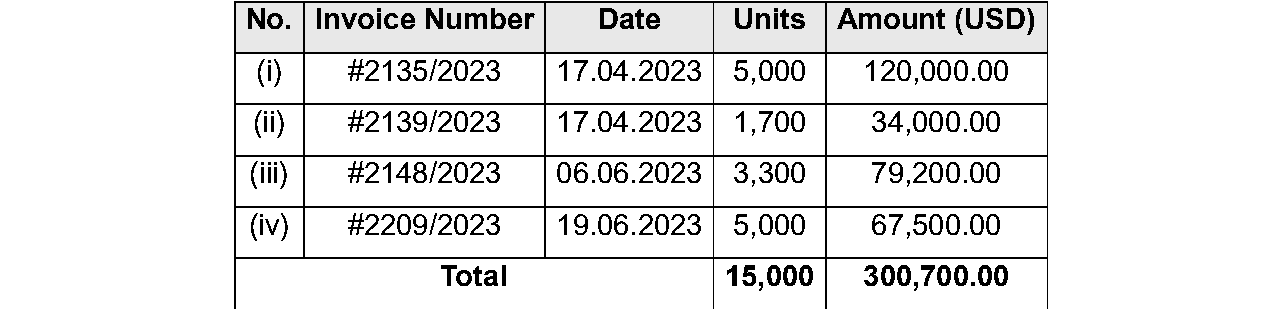
4. At the Defendant’s instruction, the Plaintiff effected payment amounting to USD 424,510, inclusive of deposits and top-up credits, directly into the Defendant’s personal cryptocurrency wallet. However, unknown to the Plaintiff and only until recent discovery, Magic Partners Sdn Bhd had already been dissolved under Section 551(3) of the Companies Act 2016 in 27 December 2018.
5. Subsequently on or about 21 July 2023, the Defendant effected delivery of only 3,000 pieces of the prepaid cards to the Plaintiff, notwithstanding his contractual obligation to supply the full quantity ordered. Thereafter, the Defendant repeatedly gave excuses to defer the balance delivery and in order to procure further indulgence of time, the Defendant entered into a written agreement referred to as the “Confirmation of Debt and Payment Agreement” dated 20 October 2023. This agreement was signed by both parties in the presence of Tan Lai Yee who acted as a witness and an Advocate & Solicitor of the High Court of Malaysia.
6. By the express terms of the Agreement, the Defendant personally and unequivocally acknowledged that a liquidated debt in the sum of USD 333,322.00, equivalent to RM1,556,613.74 as of 21 August 2023, was due and owing to the Plaintiff. Pursuant to the Agreement, the Defendant made two partial payments amounting to RM5,400.00 on 20 September 2023 and 26 September 2023 into the Plaintiff’s Maybank account, but thereafter defaulted and failed to make any further repayment.
7. Moving on to the 23rd of October 2023, Plaintiff had inspected the 3,000 prepaid cards supplied by the Defendant and discovered that they were all counterfeit, wholly unusable and without any legitimate value. Instead of bearing unique QR codes and serial numbers as genuine cards would, all 3,000 pieces carried identical QR codes, evidently printed by the Defendant himself. On the same day, the Plaintiff sought verification from Omnipay (Malaysia) Sdn Bhd. Omnipay confirmed that the Defendant had no official connection, status or authority whatsoever to represent or distribute products on behalf of Omnipay (Malaysia) Sdn Bhd or Omnipay Inc and that he had unlawfully appropriated and misused their corporate name.
8. On 24 October 2023, the Plaintiff lodged a police report against the Defendant and subsequently, on the 1st of November 2023, one Mr. Goh Win Sern, the Director of Omnipay (Malaysia) Sdn Bhd, had also lodged a police report con








