
Act 17 of 1959
Amended by
(Acts 19 of 1963, 17 of 1967, 29 of 1969, 6 of 1972, 7 of 1973, Finance Act 19 of 1983, Finance Act 14 of 1985, Act 14 of 1988, Finance ordinance 9 of 1991, Act 16 of 1991 And Finance Act, 19 of 1994)
An Act to consolidate and amend the law relating to stamps in the State of Kerala
WHEREAS it is expedient to consolidate and amend the law relating to stamps in the State of Kerala;
BE it enacted in the Tenth Year of the Republic of India as follows:-
Read full ActCHAPTER – I
Preliminary
(1) This Act may be called the Kerala Stamp Act, 1959.
(2) It extends to the whole of the State of Kerala.
(3) It shall come into force on such date as the Government may, by notification in the Gazette appoint., [The Act came into force on 1-9-1960 by Notification No. GI-13823/59-1/RD dated 10-8-1960 and Published in Kerala Gazette No. 33 Dated 16-8-1960. For definition “Document” See General Clauses Act, 1897]
In this Act, unless the context otherwise requires:-
(a) “bond” includes:-
(i) any instrument where by a person obliges himself to pay money to another, on condition that the obligation shall be void if a specified Act is performed, or is not performed, as the case may be;
(ii) any instrument attested by a witness and not payable to order or bearer, whereby a person obliges himself to pay money to another; and
(iii) any instrument so attested, whereby a person obliges himself to deliver grain or other agricultural produce to another;
(b) “Chargeable” means, as applied to an instrument executed or first executed after the commencement of this Act, chargeable under this Act, and as applied to any other instrument, chargeable under the law in force in the territories of the State of Kerala when such instrument was executed, or, where several persons executed th
CHAPTER II
Stamp Duties
A. OF THE LIABILITY OF INSTRUMENTS TO DUTY
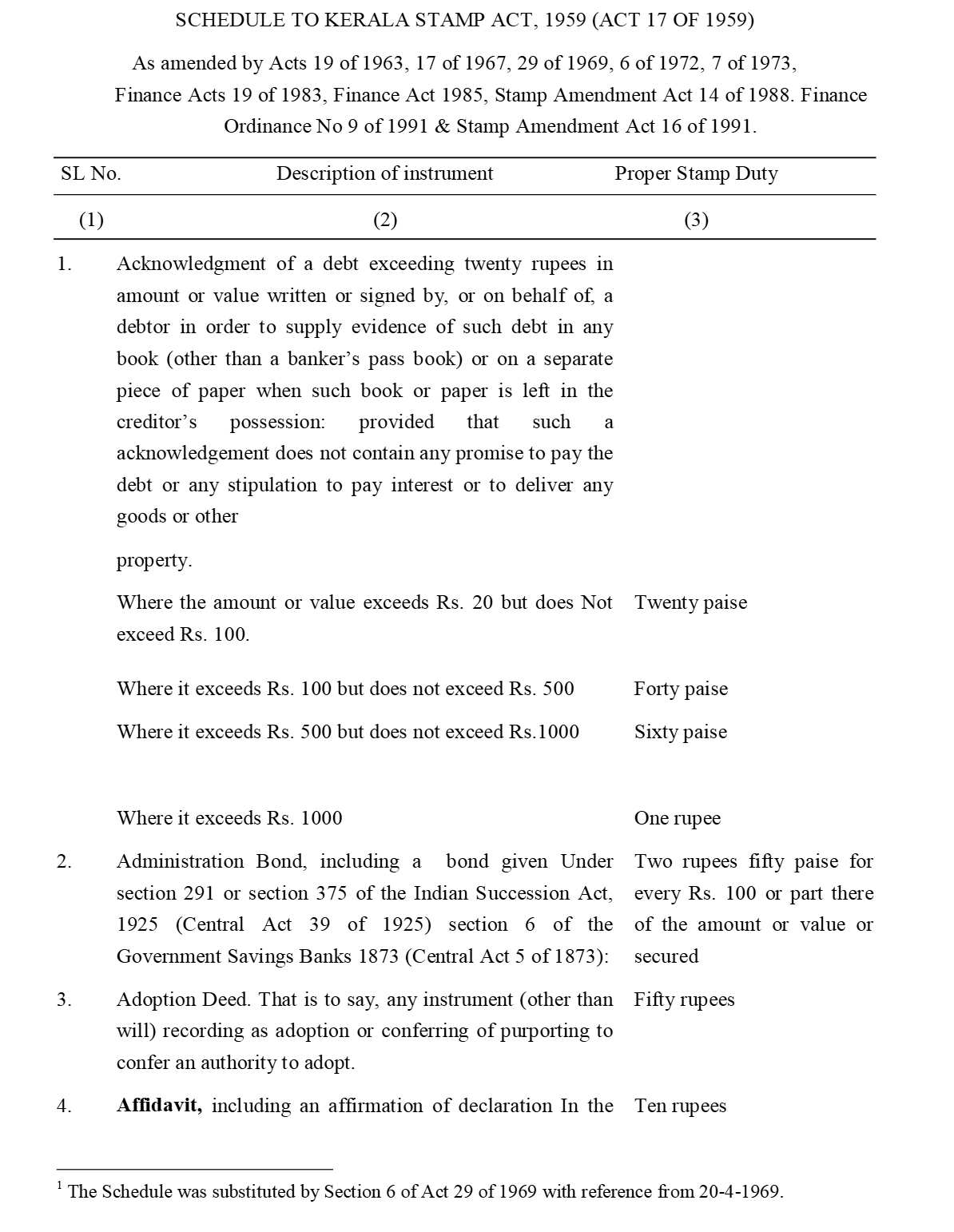
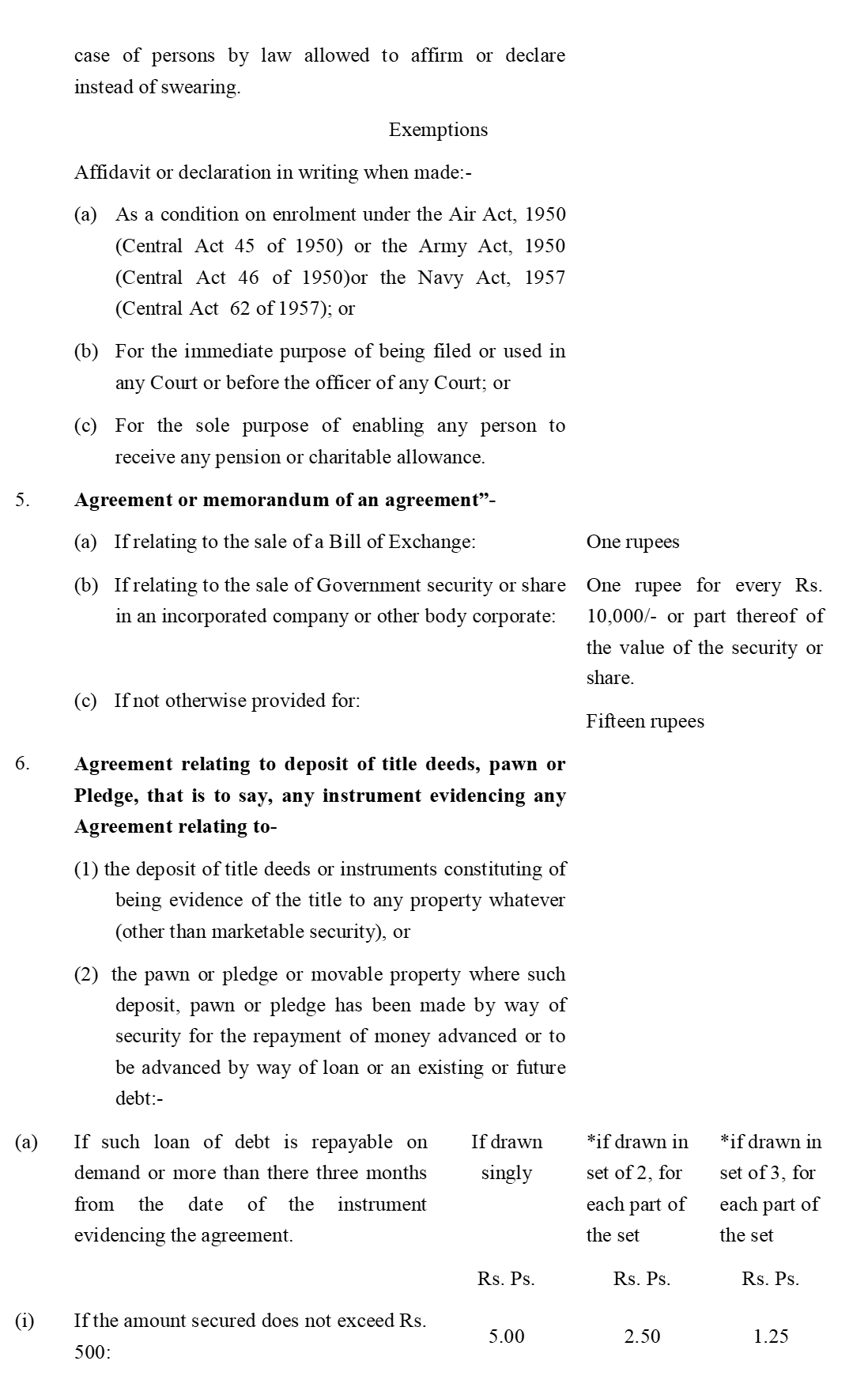
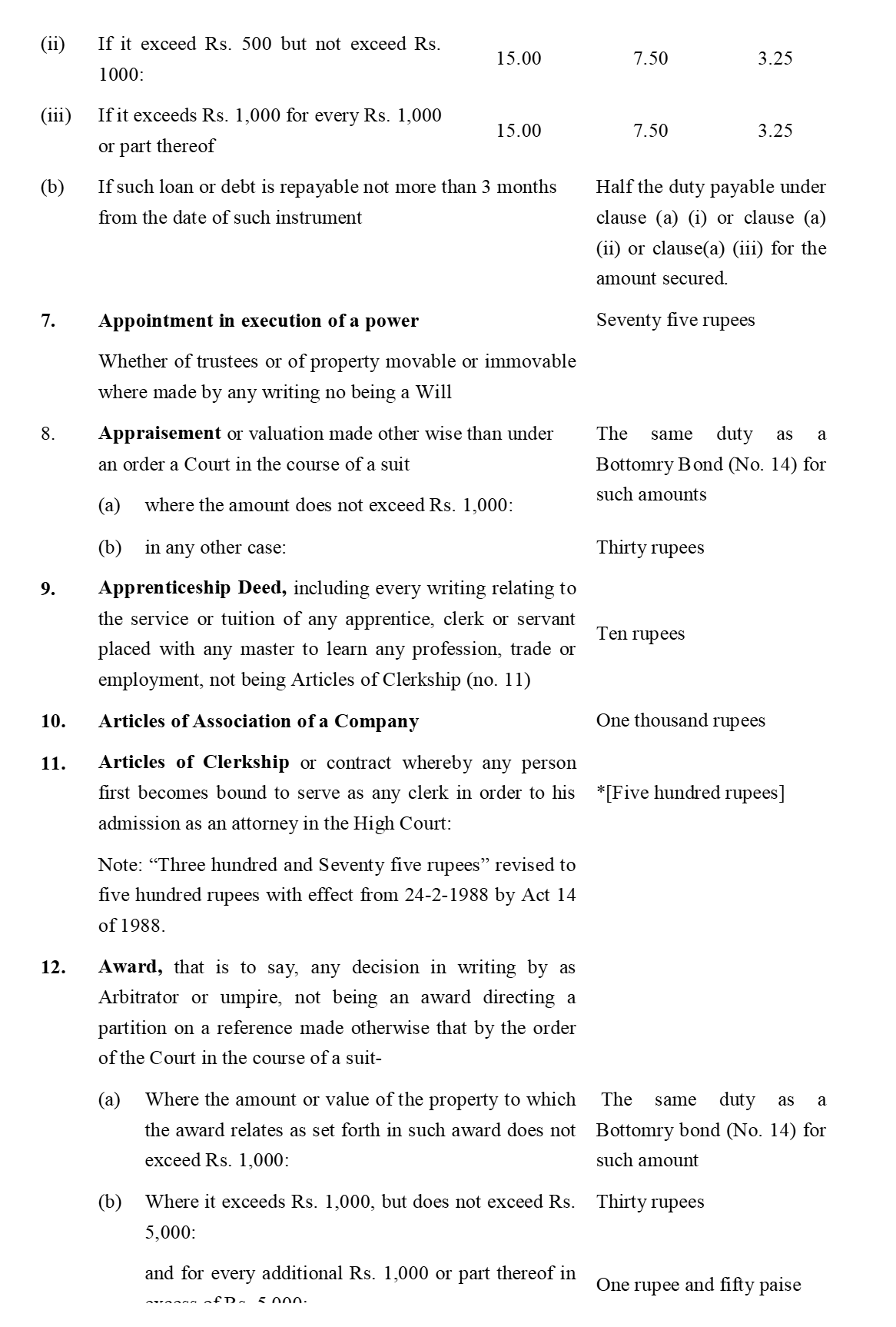
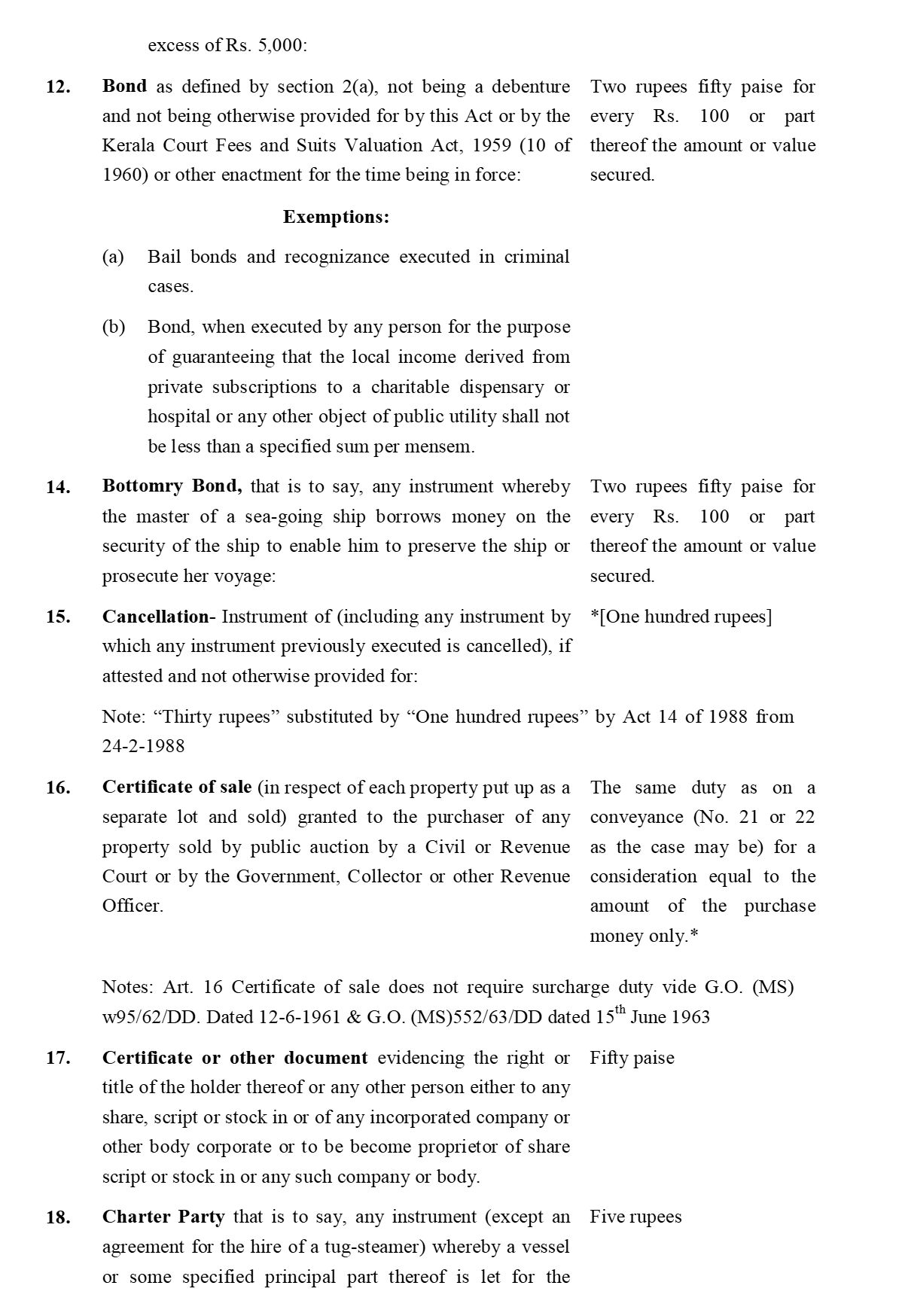
Subject to the provisions of this Act and the exemptions contained in Schedule, the following instruments shall be chargeable with duty of the amount indicated in that Schedule as the proper duty therefore, respectively, that is to say - -
(a) every instrument mentioned in the Schedule which not having been previously executed by any person, is executed in the territories of the State of Kerala on or after commencement of this Act; and
(b) every instrument mentioned in that schedule which, not having been previously executed by any person, is executed out of the State of Kerala on or after that day relates to any property situate, or to any matter or thing done or to be done, in the territories of the State of Kerala and is received in the te
(1) Where in the case of any sale, mortgage or settlement, several instruments are employed for completing the transaction, the principal instrument only shall be chargeable with the duty prescribed in Schedule for the conveyance mortgage, or settlement, and each of the other instruments shall be chargeable with a duty of [Fifteen Rupees], [Two rupees substituted by fifteen Rupees by Act 14 of 1988 with effect from 24-2-1988] instead of the duty, if any, prescribed for it in Schedule.
(2) The parties may determine for themselves which of the instruments so employed shall, for the purpose of sub-section (1), be deemed to be the principal instrument:
Provided that the duty chargeable on the instrument so determined shall be the highest duty which would be chargeable in respect of any of the said instruments employed.
Any instrument comprising or relating to several distinct matters shall be chargeable with the aggregate amount of the duties with which separate instruments, each comprising or relating to one of such matters, would be chargeable under this Act.
Subject to the provisions of the last preceding section, an instrument so framed as to come within two or more of the descriptions in the Schedule shall, where the duties chargeable there under are different, be chargeable only with the highest of such duties:
Provided that nothing contained in this Act shall render chargeable with duty exceeding [Fifteen Rupees], [Five rupees substituted by fifteen Rupees by Act 14 of 1988 with effect from 24-2-1988. Earlier the words “five Rupees” were substituted for the words, “Four Rupees Fifty paise” by Act 29 of 1969, with effect from 20-4-1969.] a counter part or duplicate of any instrument chargeable with duty and in respect of which the proper duty has been paid.
[Explanation * * * *], [Explanation omitted by Act 7 of 1973]
(1) Notwithstanding anything contained in section 4 or 6 on in any other enactment, unless it is proved the duty chargeable under this Act has been paid:
(a) on the principal or original instrument, as the case may be, or
(b) in accordance with the provisions of this section, the duty chargeable on an instrument of sale, mortgage or settlement, other than a principal instrument or on a counterpart, duplicate or copy of any instrument shall, if the principal or original instrument would, when received in the State, have been chargeable under this Act with a higher rate of duty, be the duty with which the principal or original instrument would have been chargeable under section 19.
(2) Notwithstanding anything contained in any enactment for the time being in force, no instrument, counterpart, duplicate or copy chargeable with duty under this section shall be received in evidence unless the duty chargeable under this secti
(1) Notwithstanding any thing contained in this Act, any local authority raising a loan under the provisions of any law for the time being in force, by the issue of bonds or, other securities other than debentures shall in respect of such loan, be chargeable with a duty of one per centum on the total amount of the bonds, or other securities issued by it, and such bonds or other securities need not be stamped and shall not be chargeable with any further duty on renewal, consolidation, subdivision or otherwise.
(2) The provisions of sub-section (1) exempting certain bonds, or other securities from being stamped and from being chargeable with certain further duty shall apply to the bonds or other securities other than debentures of all outstanding loans of the kind mentioned thereon, and all such bonds or other securities shall be valid, whether the same are stamped or not.
(3) In the case of willful neglect to pay the duty required by this section the local aut
(1) The Government may, by order published in the Gazette:-
(a) reduce or remit, whether prospectively, or retrospectively in the whole or any part of the State of Kerala, if in the opinion to if the Government it is necessary in public interest so to do, the duties with which any particular class of instruments, or any of the instruments belonging to such class, or any instruments when executed by or in favour of any particular class of persons, or by or in favour of any members of such class, are chargeable; and
(b) Provided for the composition or consolidation of duties in the case of issues by any incorporated company or other body corporate of bonds or other marketable securities other than debentures.
(2) Every rule or order published under clause (a) of sub-section (1) shall be laid as soon as may be after it is published, before the Legislative Assembly.
B. OF STAMPS AND THE MODE OF USING THEM
(1) Exempt as otherwise expressly provided in this Act, all duties with which any instruments are chargeable shall be paid, and such payment shall be indicated on such instruments, by means of stamps:-
(a) according to the provisions herein contained; or
(b) when no such provision is applicable thereto, as the Government may by rules direct.
(2) The rules made under sub-section (1) may, among other matters, regulate:-
(a) in the case of each kind of instrument – the description of stamps which may be used;
(b) in the case of instruments stamped with impressed stamps – the number of stamps which may be used.
The following instruments may be stamped with adhesive stamps:-
(a) instruments chargeable with the duty of [Twenty Paise], [Substituted by Act 29 of 1969] and less;
(b) [Certificate of enrolment in the roll of advocates maintained in the State Bar Council], [Endorsement on Mortgage documents are exempted from stamp duty vide this provision.]
(c) Notarial Acts;
(d) Instruments as the Government may, by notification in the Gazette, specify.
(1) (a) Whoever affixes any adhesive stamp to any instrument chargeable with duty which has been executed by any person shall, when affixing such stamp, cancel the same so that it cannot be used again; and
(b) Whoever executes any instrument on any paper bearing an adhesive stamp shall, at the time of execution unless such stamp has been already cancelled in manner aforesaid, cancel the same so that it cannot be used again.
(2) Any instrument bearing an adhesive stamp which has not been cancelled so that it cannot be used again shall, so far as such stamp is concerned, be deemed to be unstamped.
(3) The person required by sub-section (1) to cancel an adhesive stamp may cancel it by writing on or across the stamp his name or initials or the name or initials or his firm with the true date of his so writing or in any other effectual manner.
Every instrument written upon paper stamped with an impressed stamp shall be written in such manner that the stamp may appear on the face of the instrument and cannot be used for or applied to any other instrument.
No second instrument chargeable with duty shall be written upon a piece of stamped paper upon which an instrument chargeable with duty has already been written:
Provided that nothing in this section shall prevent any endorsement which is duly stamped or is not chargeable with duty being made upon any instrument for the purpose of transferring any right created or evidenced thereby, or of acknowledging the receipt of any money or goods the payment or delivery of which is secured thereby., [Endorsement on Mortgage documents are exempted from stamp duty vide this provision.]
Every instrument written in contravention of section 13 or section 14 shall be deemed to be unstamped.
Where the duty with which an instrument is chargeable, or its exemption from duty, depends in any manner upon the duty actually paid in respect of another instrument, the payment of such last mentioned duty shall be denoted upon such first mentioned instrument by:, [Substituted by Act 17 of 1967 with effect from 15-9-1967]
(i) The Collector, if application is made in writing for the purpose and on production of both the instruments: or
(ii) By the Registering Officer on production of both the instruments, by endorsement under the hand of the Collector or the Registering Officer, as the case may be, or in such other manner as Government may by rules prescribe]
C. OF THE TIME OF STAMPING INSTRUMENTS
All instruments chargeable with duty and executed by any person in the State of Kerala shall be stamped before or at the time of execution.
(1) Every instrument chargeable with duty executed only out of India may be stamped within three months after it has been first received in the State of Kerala.
(2) Where any such instrument cannot, with reference to the description of stamp prescribed thereof, be duly stamped by a private person, it may be taken within the said period of three months to the Collector who shall stamp the same, in such manner as the Government may by rules prescribe, with a stamp of such value as the person so taking such instrument may require and pay for.
Where any instrument of the nature described in any article in the Schedule and relating to any property situate or to any matter or thing done or to be done in the State of Kerala is executed out of the said State and subsequently received in the said State:-
(a) the amount of duty chargeable on such instrument shall be the amount of duty chargeable under the Schedule on a document of the like description executed in the State of Kerala less the amount of duty, if any, already paid on such instrument, in any other State in India.
(b) and in addition to the stamps, if any, already affixed thereto such instrument shall be stamped with the stamps necessary for the payment of the duty chargeable on it under clause (a) of this section, in the same manner and at the same time and by the same parsons as though such instrument were as instrument received in the State of Kerala for the first time at the time when it became chargeable
D. OF VALUATION FOR DUTY
(1) Where an instrument is chargeable with ad valorem respect of any money expressed in any currency other that of India, such duty shall be calculated on the value of such money in the currency of India according to the current rate of exchange on the day of date of the instrument.
(2) The rate of exchange prescribed by the Central Government under sub-section (2) of section 20 of the Indian Stamp Act, 1889 (Central Act II of 1889) shall be deemed to be the current rate of exchange for the conversion of any foreign currency for the purpose of calculating the duty under sub-section (1)
Where an instrument is chargeable with ad valorem in respect of any stock or of any marketable or other security, such duty shall be calculated on the value of such stock or security according to the average price or the value thereof on the day of date of the instrument.
When an instrument contains a statement of current rate of exchange, or average price, as the case may require, and is stamped in accordance with such statement, it shall, so far as regards the subject matter of such statement, be presumed, until the contrary is proved, to be duly stamped.
Where interest is expressly made payable by the terms of an instrument, such instrument shall not be chargeable with duty higher than that with which it would have been chargeable had no mention of interest been made therein.
(1) Where an instrument:-
(a) is given upon the occasion of the deposit of any marketable security by way of security for money advanced or to be advanced by way of loan, or for an existing or future debt; or
(b) makes redeemable or qualifies a duty stamped transfer intended as a security, of any marketable security;
it shall be chargeable with duty as if it were an agreement or memorandum of an agreement chargeable with duty under Article 5 of the Schedule.
(2) A release or discharge of any such instrument shall be chargeable with the like duty.
Where any property is transferred to any person in consideration, wholly or in part of any debt due to him or subject either certainly or contingently to the payment or transfer of any money or stock, whether being or constituting a charge or encumbrance upon the property or not such debt, money, or stock is to be deemed the whole or part, as the case may be, of the consideration in respect whereof is chargeable with ad valorem duty:
Provided that nothing in this section shall apply to any such certificate of sale as is mentioned in Article 16 of the Schedule.
Explanation:- In the case of a sale property subject to a mortgage or other encumbrance any unpaid mortgage money or money charged, together with the interest, if any, due on the same, shall be deemed to be part of the consideration for the sale:
Provided that, where property subject to a mortgage is transferred to the mortgagee, he shall be entitled to deduct from the duty payable on the transfer
Where an instrument is executed to secure the payment of annuity or other sum payable periodically, or where the consideration for a conveyance is an annuity or other sum payable periodically, the amount secured by such instrument or the consideration for such conveyance, as the case may be, shall, for the purposes of this Act, be deemed to be:-
(a) Where the sum payable for a definite period so that the total amount to be paid can be previously ascertained such total amount;
(b) Where the sum is payable in perpetuity or for an indefinite time not terminable with any life in being at the date of such instrument or conveyance – the total amount which according to the terms of such instrument or conveyance will or may be payable during the period of twenty yeas calculated from the date on which the first payment becomes due; and
(c) Where the sum is payable for an indefinite time terminable with any life
Where the amount or value of the subject matter of any instrument chargeable with ad valorem duty cannot be or could not have been, ascertained at the date of its execution, or first execution, nothing shall be claimable under such instrument more than the highest amount or value for which, if stated in an instrument of the same description, the stamp actually used would, at the date of such execution have been sufficient:
Provided that, in the case of the lease of mine in which royalty or a share of the produce is received as the rent or the part of the rent it shall be sufficient to have estimated such royalty or the value of such share, for purpose of stamp duty:-
(a) When the lease has been granted by or on behalf of the Government, at such amount or value as Collector may, having regard to all the circumstances of the case, have estimated as likely to be payable by way of royalty or share to the Government under the lease; or
The consideration, if any, and all other facts and circumstances affecting the chargeability of any instrument with duty, or the amount of the duty with which it is chargeable, shall be fully and truly set forth therein.
[“28.A. Fixation of fair value of land:-, [
28A section was inserted by Act 14 of 1988 and was deleted by Act 16 of 1991. The following is the section 28A. Fixation of minimum value of land:
(1) The Collector shall subject to such rules as may be prescribed by Government, fix the minimum value of lands situate within the area of his jurisdiction, for the purpose of determining the duty chargeable at the time of registration of instruments involving lands.
(2) The Collector shall in fixing the minimum value of land under subsection (1), have regard ‘inter alia’ to the following matters, namely:
(a) development of area such as t
(1) Where any property has been contracted to be sold for one consideration for the whole, and is conveyed to the purchaser in separate parts by different instruments, the consideration shall be apportioned in such manner as the parties think fit, provided that a distinct consideration for each separate part is set forth in the conveyance relating thereto and such conveyance shall be chargeable with ad valorem duty in respect of such distinct consideration.
(2) Where property contracted to be purchased for one consideration for the whole, by two or more persons jointly, or by any person for himself and others, or wholly for others, is conveyed on parts by separate instruments to the persons by or for whom the same was purchased for distinct parts of the consideration, the conveyance of each separate part shall be chargeable with ad valorem duty in respect of the distinct part of the consideration therein specified.
(3) Where a person, having contracted for th
E. DUTY BY WHOM PAYABLE
In the absence of an agreement to the contrary, the expense of providing the proper stamp shall be borne.
(a) in the case of any instrument described in any of the following articles of the Schedule, namely.—
No. 2 (Administration Board)
No. 6 (Agreement relating to deposit to title deeds, pawn or pledge),
No. 13 (Bond),
No. 14 (Bottomry Bond),
No. [25], [Substituted by Act 29 of 1969.] (Customs Bond or Central Excise Bond, [Substituted by Act 17 of 1967 with effect from 15-9-1967]),
No. [30], [Substituted by Act 29 of 1969.] (Further Charge),
No. [32], [Substituted by Act 29 of 1969.] (Indemnity Bond),
No. [37], [Substituted by Act 29 of 1969.] (Mortgage Deed),
No.
CHAPTER III
Adjudication as to Stamps
(1) When any instrument, whether executed or not and previously stamped or not is brought to the Collector, and the person bringing it applies to have the opinion of that officers as to duty, if any, with which it is chargeable, and pays a fee of such amount not exceeding ten rupees and not less than one rupees) as the Collector may in each case direct, the Collector shall determine the duty, if any, with which, in his judgment, the instrument is chargeable.
(2) For this purpose the Collector may require to be furnished with an abstract of the instrument, and also with such affidavit or other evidence as he may deem necessary to prove that all the facts and circumstances affecting the chargeability of the instrument with duly, or the amount of the duly with which it is chargeable, are fully and truly set forth therein, and may
(1) When an instrument brought to the Collector under section 31, is in his opinion, one of a description chargeable with duly, and
(a) the Collector determines that it already fully stamped, or
(b) the duty determined by the Collector under section 31, or such a sum as, with duty already paid in respect of the instrument is equal to the duty so determined, has been paid, the Collector shall certify by endorsement on such instrument that the full duty (stating the amount) with which it is chargeable has been paid.
(2) When such instrument is, in his opinion, not chargeable with duty, the Collector shall certify in manner aforesaid that such instrument is not so chargeable.
(3) Any instrument upon which an endorsement has been made under this section shall be deemed to be duly stamped or not chargeable with duty as the case may be; and, if chargeable with duty, shall be receivable in evidence or otherwise, and may
(1) Every person having by law or consent of parties authority to receive evidence, and every person in charge of a public office, except an Officer of Police, before whom any instrument, chargeable in his opinion, with duty, is produced or comes in this performance of his functions, shall, if it appears to him that such instrument in no duly stamped, impound the same.
(2) For that purpose every such person shall examine every instrument so chargeable and so produced or coming before him, in order to ascertain whether it is stamped with a stamp of the value and description required by the law in force in the State when such instrument was executed or first executed:
Provided that
(a) nothing herein contained shall be deemed to require any Magistrate or Judge of a Criminal Court to examine or impound, if he does not think fit to do, any instrument coming before him in the course of any proceeding other than proceeding under Chapter XII o
No instrument chargeable with duty shall be admitted in evidence for any purpose by any person having by law or consent of parties authority to receive evidence or shall be acted upon, registered or authentication by any such person or by any public officer, unless such instrument is duly stamped.
Provided that
(a) any such instrument not being an instrument chargeable with a duty of [twenty paise] or less than [twenty paise] shall, subject to all just exceptions, be admitted in evidence on payment of the duty with which the same is chargeable, or, in the case of an instrument insufficiently stamped, of the amount required to make up such duty, together with a penalty to five rupees or, when ten times the amount of the proper duty or deficient portion thereof exceeds five rupees, of sum equal to ten times such duty or portion;
(b) any such instrument, when presented to a Registering Officer for registration, shall be re
When an instrument has been admitted in evidence such admission shall not except as provision in Section 59, be called in question at any stage of the same suit or proceeding on the ground that the instrument has not been duly stamped.
The Government may make rules providing that, where as instrument bears a stamp of sufficient amount but of improper description, it may, on payment of the duty with which the same is chargeable, be certified to duly stamped, and any instrument so certified shall then be deemed to have been duly stamped as from the date of its execution.
(1) When the person impounding as instrument under section 33 has by law or consent of parties authority to receive evidence and admits such instrument in evidence or when he is a Registering Officer to register such instrument upon payment of a penalty as provided by section 34 or of duty as provided by section 36, he shall send to the Collector an authenticated copy of such instrument, together with a certificate in writing, stating the amount of duty and penalty levied in respect thereof, and shall send such amount to the Collector or to such person as he may appoint in this behalf.
(2) in every other case, the person so impounding an instrument shall send it in original to the Collector.
(1) When a copy of an instrument is sent to the Collector under sub-section (1) of section 37, he may, if he thinks fit, refund the whole or any portion of the penalty in excess of ten rupees which has been paid in respect of such instrument.
(2) When such instrument has been impounded only because it has been written in contravention of section 13 or section 14, Collector may refund the whole penalty so paid.
(1) When the Collector impounds any instrument under section 33, or receives any instrument sent to him under sub-section (2) of section 37, not being an instrument chargeable with a duty of, [The words “twenty paise” were submitted for the words “twelve paise” by Act 1969 of 1969 with effect
from 2004196] [twenty paise] or less, he shall adopt the following procedure:-
(a) if he is of opinion that such instrument is duly stamped or is not chargeable with duty, he shall certify by endorsement thereon that it is duly stamped or that it is not so chargeable as the case may be;
(b) if he is so opinion that such instrument is chargeable with duty and is not duly stamped he shall require the payment of the proper duty or the amount required to make up the same, together with a penalty of five rupees; or of he thinks fit, an amount no exceeding ten times the amount of the proper duty or of the deficient portion thereof whet
If any instrument chargeable with duty and not duly stamped, not being an instrument chargeable with a duty of [twenty paise] or less is produced by any person of his own motion before the Collector within on year from the date of its execution or first execution and such person brings to the notice of the Collector the fact that such instrument is not duly stamped and offers to pay to the Collector the amount of the proper duty, or the amount required to make up the same and the Collector is satisfied that the omission to duly stamped such instrument has been occasioned by accident, mistake or urgent necessity, he may, instead of proceedings under section 33 and 39, receive such amount and proceed as next hereinafter prescribed.
(1) When the duty and penalty, if any leviable in respect of any instrument have been paid under section 34, section 39 or section 40, the person admitting such instrument in evidence or the Collector, as the case may be, shall certify by endorsement thereon that the proper duty or, as the case may be proper duty and penalty (stating the amount of each) have been levied in respect thereof and the name and residence of the person paying them.
(2) Every instrument so endorsed shall thereupon be admissible in evidence, and may be registered and acted upon and authenticated as if it had been duly stamped, and shall be delivered on this application in this behalf to the person from whose possession it came into the hands of the officer impounding it, or as such person may direct.
(a) no instrument which has been admitted in evidence upon payment of duty and a penalty under section 34 shall be so delivered before the expiration of one month from th
The taking of proceedings or the payment of a penalty under this Chapter in respect of any instrument shall not bar the prosecution of any person who appears to have committed an offence the law relating to stamps in respect of such instrument:
(1) When any duty or penalty has been paid under section 34, section 36, section 39 or section 40, by any person in respect of an instrument, and by agreement or under the provisions of section 30 or any other enactment in force at the time such instrument was executed, some other person was bound to bear the expense of providing the proper stamp for such instrument, the first-mentioned person shall be entitled to recover from such other person the amount of the duty or penalty so paid.
(2) For the purpose of such recovery any certificate granted in respect of such instrument under this Act shall be conclusive evidence of the matters therein certified.
(3) Such amount may, of the Court thinks fit, be included in any order as to costs in any suit or proceeding to which such persons are parties and in which such instrument has been tendered in evidence. If the Court does not include the amount in such order, no further proceedings for the recovery of the amount
(1) Where any penalty is paid under section 34 or section 39, the Government or such other authority as may be specified by Government in this behalf may, upon application in writing made within one year from the date of the payment, refund such penalty wholly or in part.
(2) Where, in the opinion of the Government or such Government or such other authority specified under sub-section (1), stamp duty in excess of that which is legally chargeable has been charged and paid under section 34 or section 39, the Government or such authority may upon, application in writing made within three months of the order charging the same, refund the excess.
(1) If any instrument sent to the Collector under sub-section (2) of section 37 is lost, destroyed or damaged during transmission, the person sending the same shall not be liable for such loss, destruction or damage.
(2) When any instrument is about to be sent, the person from whose possession in came into the hands of the person impounding the same, may require a copy thereof to be made at the expense of such first-mentioned person and authenticated by the person impounding such instrument.
“[45A. [Section 45A of the Principal Act is renumbered as 45B by Act 14 of 1988, 45A was inserted by Act 14 of 1988 which is detailed below and has been deleted from 11-1-1991 by Act 16 of 1991. 45A Instrument not bearing stamp of sufficient amount as per minimum value of land how to be dealt
with:
(1) Notwithstanding anything contained in this Act, the Registering Officer shall, while registering Officer shall, while registering i
CHAPTER V
Allowances for stamps in certain cases
Subject to such rules as may be made by the Government as to the evidence to be required, or the enquiry to be made, the Collector may, on application made, within the period prescribed in section 48, and if he is satisfied as to the facts, make allowance for impressed stamps spoiled in the cases hereinafter mentioned, namely:-
(a) the stamp on any paper inadvertently and undersigned spoiled, obliterated or by error in writing or any other means rendered unfit for the purpose intended before any instrument written thereon is executed by any person;
(b) the stamp on any document which is written out wholly or in part, but which is not signed or executed by any party thereto;
(c) the stamp used for an instrument executed by any party thereto which-
The application for relief under section 47 shall be made within the following periods, that is to say-
(1) in the cases mentioned in clause (c) (5) within two months of the date of the instrument.
(2) in the case of a stamp paper on which no instrument has been executed by any of the parties thereto, within six months after the stamp has been spoiled;
(3) in the case of a stamped paper in which an instrument has been executed by any of the parties thereto, within six months after the date of the instrument or if it not dated, within six months after execution thereof by the person by whom it was first or alone executed.
Provided that
(a) when the spoiled instrument has been for sufficient reasons sent out of the State, the application may be made within six months after it has been received back in the State.
(b) When, from u
The Government or such other authority as be specified in this behalf by Government may, without limit of time, make allowance for stamped papers used for printed forms of instruments by any banker or by any incorporated company or other body corporate, if for any sufficient reason such forms have ceased to be required by the said banker, company or, body corporate:
Provided that the Government or such authority is satisfied that the duty in respect of such stamped papers has been duly paid.
(a) When any person has inadvertently used for an instrument chargeable with duty, a stamp of a description other than that prescribed for such instrument by the rules made under this Act, or stamp of greater value than was necessary or has inadvertently used any stamp for an instrument having been written in contravention of the provisions of section 13;
The Collector may, on application made within six months after the date of the instrument, or if it is not dated, within six months after the execution thereof by the person by whom it was first or alone executed, and upon the instrument, if chargeable with duty, being restamped with the proper duty, cancel and allow as spoiled that stamp so misused or rendered useless.
In any case in which allowance is made for spoiled or misused stamps, the Collector may give in lieu thereof-
(a) other stamp of the same description and value; or
(b) if required and he thinks fit, stamps of any other description to the same amount in value; or.
(c) at this description, the same value in money deducting six paise for each rupees or fraction of a rupee.
When any person is possessed of a stamp or stamps which have not been spoiled or rendered unfit or useless for the purpose intended, but for which he has no immediate use, the Collector shall repay to such person the value of such stamp or stamps in money, deducting six paise for each rupee or portion of a rupee, upon such person delivering up the same to be cancelled, and proving to the Collector’s satisfaction:-
(a) that such stamp or stamps were purchased by such person with bona fide intention to use them; and
(b) that he has paid the full price thereof; and
(c) that they were so purchased within the period of six months next preceding the date of which they were so delivered:
Notwithstanding anything contained in section 52, when any person is possessed of a stamp or stamps in any denominations other that in denominations of annas four or multiples thereof and such stamp or stamps has or have not been spoiled, the Collector shall repay to such person the value of such stamp or stamps in money calculated in accordance with the provisions of sub-section (2) of section 14 of the Indian Coinage Act, 1906 (3 of 1906), upon such person delivering up, within six months from the commencement of this Act, such stamp or stamps to the Collector.
CHAPTER VI
Reference and Revision
(1) The powers exercisable by a Collector under Chapter IV and Chapter V and under clause (a) of the first proviso to section 27 shall in all cases be subject to the control of the Government or such other authority as may be specified by Government in this behalf.
(2) If any Collector acting under section 31, section 39 or section 40, feels doubt as to the amount of duty with which any instrument is chargeable, he may draw up a statement of the case and refer it with his own opinion thereon, for decision of the Government or such other authority as may be specified by Government in this behalf.
(3) The Government or such authority shall consider the case and send a copy of its decision to the Collector, who shall proceed to assess and charge the duty, if any, conformity with such decision.
(1) The Government or such authority as may be specified by Government in this behalf may state case referred to it under sub-section (2) of section 54 or otherwise coming to its notice, and refer such case, with its own opinion thereon, to the High Court.
(2) Every such case shall be decided by not less than three Judges of the High Court, and in case of difference, the opinion of the majority shall prevail.
If the High Court is not satisfied that the statements contained in the case are sufficient to enable it to determine the questions raised thereby, the Court may refer the case back to the authority by which it was stated, to make such addition thereto or alterations therein as the Court may direct in that behalf.
(1) The High Court, upon the hearing of any such case, shall decide the questions raised thereby, and shall deliver its judgment thereon containing the grounds on which such decision is founded.
(2) The Court shall send to the authority by which the case was stated, a copy of such judgment under the seal of the Court and the signature of the Registrar; and the authority shall, on receiving such copy, dispose of case the conformably to such judgment.
(1) If any Court, other than the High Court, feels doubt as to the amount of duty to be paid in respect of any instrument under proviso (a) to section 34, the Judge may draw up a statement of the case and refer it, with his own opinion thereon, for the decision of the High Court.
(2) The High Court shall deal with the case as if it had been referred under section 55 and send a copy of its judgment under the seal of the Court and the signature of the Registrar to the Government or such other authority specified in this behalf and another like copy to the Judge making the reference, who shall be on receiving such copy, dispose of the case conformably to such judgment.
(3) Reference made under sub-section (1), when made by a Court subordinate to a District Court, shall be made through the District Court, and when made by any subordinate Revenue Court, shall be made through the Court immediately superior.
(1) When any Court in the exercise of its Civil or Revenue jurisdiction or any Criminal Court in any proceedings under Chapter XII or Chapter XXXVI of the Code of Criminal Procedure, 1898, makes any order admitting any instrument in evidence as duly stamped or as not requiring a stamp, or upon payment of duty and a penalty under section 34, the Court to which appeals lie from, or references are made by, such first mentioned Court may, of its own motion or on the application of the Collector, take such order into consideration.
(2) If such Court, after such consideration, is of opinion that such instrument should not have been admitted in evidence without the payment of duty and penalty under section 34, or without the payment of a higher duty and penalty that those paid, it may record a declaration to that effect, and determine the amount of duty with which such instrument is chargeable, and may require any person in whose possession or power such instrument then i
CHAPTER VII
Criminal Offences and Procedure
(1) Any person executing or signing otherwise that as a witness any instrument chargeable with duty, without the same being duly stamped shall for every such offence be punishable with fine which may extend to five hundred rupees.
Provided that when any penalty has been paid in respect on any instrument under section 34, section 39 or section 59, the amount of such penalty shall be allowed in reduction of the fine, if any, subsequently imposed under this section in respect of the same instrument upon the person who paid such penalty.
(2) If a share warrant is issued without being duly stamped, the Company issuing the same, and also every person who, at the time it is issued, is the Managing Director or Secretary or other principal officer of the Company, shall be punishable with fine which may extend to five hundred
Any person required by section 12 to cancel an adhesive stamp, and failing to cancel such stamp in manner prescribed by that section, shall be punishable with fine which may extend to one hundred rupees.
Any person who intend to defraud the Government.
(a) executes any instrument in which all the facts and circumstances required by section 28 to be set forth in such instrument are not fully and truly set forth; or
(b) being employed or concerned on or about the preparation of any instrument, neglects or omits fully and truly to set forth therein all such facts and circumstances; or,
(c) does any other fact calculated to deprive the Government of any duty or penalty under this Act,
shall be punishable with fine which extend to five thousand rupees.
Any person who with intend to defraud the Government of duty, practices or is concerned in any act, contrivance or device not specially punishable under this Act or any other law for the time being in force shall be punishable with fine which may extend to one thousand rupees.
(a) any person appointed who sell stamps who disobeys any rule mad under section 69, and
(b) any person not so appointed who sells or offers for sale any stamp other than a stamp of the value of [twenty paise] of less, shall be punishable with imprisonment for a term which may extend to six months, or with fine which may extend to five hundred rupees, or with both.
(1) No prosecution in respect of any offence punishable under this Act or any enactment hereby repealed, shall be instituted without the sanction of the Collector or such other officer as the Government generally, or the Collector specially authorized in that behalf.
(2) The Government, or any officer generally or specially authorized by it in this behalf, may stay any such prosecution or compound any such offense,
(3) The amount of any such composition shall be recoverable in the manner provided by section 46.
No Magistrate other than a Magistrate whose powers are not less than those of a Magistrate of the First Class, shall try any offence under this Act.
Every such offence committed in respect of any instrument may be tried in any district in which such instrument is found, as well as in any district in which offence might be tried under the Code of Criminal Procedure, 1898.
Every public officer having in his custody any registers, books, records, papers, documents or proceedings, the inspection whereof may tend to secure any duty, or to prove or lead to the discovery of any fraud or omission in relation to any duty, shall at all reasonable times permit any person authorized in writing by the Collector to inspect for such purpose the registers, books, papers, documents and proceedings, and to take such notes and extracts as he may deem necessary, without fee or charge.
(1) The Government may, by notification in the Gazette make rules to carry out generally the purposes of this Act.
(2) In particulars and without prejudice to the generally of the foregoing power such rules may be for regulating-
(a) the supply and the sale of stamps and stamped papers,
(b) the persons by whom alone such sale is to be conducted,
(c) the duties and remuneration of such persons, and
(d) the fines which shall in no case exceed five hundred rupees to be incurred on breach of any rule:
Provided that such rules shall not restrict the sale of adhesive stamp of the value of [twenty paise] of less.
(3) All rules made under this Act shall be laid as soon as may be, after they are made, before the Legislative Assembly while it is in session for a total period of not less than 14 days which may be comprised in one session or in two or more
Nothing contained in this Act shall be deemed to affect the duties chargeable under any enactment for the time being in force relating to Court fees.
All stamps in denominations of annas four or multiple thereof shall be deemed to be stamps of the value of twenty five paise, or as the case may be, multiples thereof and shall, accordingly, be valid for all the purpose of this Act.
The Indian Stamp Act 1899, (Central Act 2 of 1899) as in force in the Malabar District referred to in section 5(2) of the State Re-organisation Act, 1956 (Central Act 37 of 1956) in so far as it relates to the matter specified in Entry 44 of List III of Seventh Schedule to the Constitution in respect of documents specified in Entry 91 of List I of the said Schedule shall notwithstanding anything contained in any law, extend to the whole of the State Kerala.
The Indian Stamp Act, 1899 (Central Act 2 of 1899) in its application to the Malabar District referred to in section 5(2) of the State Re-organisation Act, 1956 (Central Act 37 of 1956) in so far as it relates to the matter specified in Entry 44 of List III of Seventh Schedule to the Constitution in respect of documents falling under Entry 63 of List II in the said Schedule and the Travancore-Cochin Stamp Act, 1125 (Act 1 of 1125) are hereby repealed.
Provided that such repeal shall not affect:-
(a) the previous operation of the said enactments or anything duly done or suffered there under.
(b) any right, privilege, obligation or liability acquired, accrued, or incurred under the said enactment;
(c) any penalty, forfeiture or punishment incurred in respect of any offence committed against the said enactment; or
(d) any investigation, legal proceeding or remedy in respect of

Elevate your legal practice with advanced AI-driven research and drafting solutions. Experience unmatched efficiency, precision, and security, tailored exclusively for legal professionals.


An indispensable Tool for Legal Professionals, Endorsed by Various High Court and Judicial Officers
Please visit our Training & Support
Center or Contact Us for assistance

Scan Me!
India’s Legal research and Law Firm App, Download now!


For Daily Legal Updates, Join us on :



 Back to top


 AI Assistant





