
Kerala State Electricity Regulatory Commission (Conduct of Business) Regulations, 2003
(1) These Regulations may be called the Kerala State Electricity Regulatory Commission (Conduct of Business) Regulations, 2003.
(2) They shall come into force at once.
(1) The headquarters of the Commission will be at Thiruvananthapuram.
1[(2) Unless otherwise directed, the headquarters and other offices of the Commission shall be open daily except on Saturdays, Sundays and holidays notified by the Government of Kerala. The headquarters and other offices of the Commission shall be open at such times as the Commission may direct. The working hours of the Commission shall be from 9.30 hours to 17.30 hours. The lunch break shall be from 13 hours to 13.30 hours.]
(3) Where the last day for doing of any act falls on a day on which the office of the Commission is closed and by reasons thereof the act cannot be done on that day, it may be done on the next day on which the office is open.
(4) The Commission may hold sittings for hearing matters at the headquarters or any other place on days and time to be specified by the Commission.
(1) Unless otherwise permitted by an order of the Commission, the proceedings of the Commission shall be conducted either in Malayalam or English. All petitions shall be submitted in Malayalam or English.
(2) Any petition, docu material in any language other than Malayalam or English may be accepted by the Commission, only if the same is accompanied by a translation thereof in Malayalam or English.
(3) Any translation which is agreed to, by the parties to the proceedings, or which any of the parties may furnish with an authenticity certificate of the person who had translated the same in Malayalam or English, may be accepted by the Commission as a true translation.
(4) The Commission may in appropriate cases direct translation of the petitions, pleadings, documents and other material to Malayalam or English by an officer or person designated by the Commission for the purpose.
(1) There shall be a separate seal indicating that it is the official seal of the Commission.
(2) Every order or communication made, notice issued or copy granted by the Commission shall be stamped with the seal of the Commission and shall be authenticated by an officer designated for the purpose.
(1) The Commission shall have the power to appoint Secretary, officers and other employees for discharging various duties.
(2) The Secretary shall be the Principal Officer of the Commission and shall assist the Commission in the discharge of its functions under the Act. The Secretary shall exercise his/her powers and perform his/her duties under the control of the Chairperson.
(3) In particular and without prejudice to the generality of the above provisions, the Secretary shall have the following powers and perform the following duties, namely:--
(a) to have custody of the records and the seal of the Commission;
(b) to receive or cause to receive all petitions, applications or references pertaining to the Commission;
(c) to prepare or cause to be prepared briefs and summaries of all pleadings presented by various parties in each case before the Commission in the discharge of its functions in this regard;
(d) to assist the Commission in the p
(1) The Commission may delegate to its officers such functions including functions that may be required by these Regulations to be exercised by the Secretary on terms and conditions the Commission may specify for the purpose.
(2) In the absence of the Secretary, such other officer of the Commission, as may be designated by the Chairperson, may exercise all the functions of the Secretary.
(3) The Commission shall, at all times have the authority, either on an application made by any interested or affected party or suo motu, to review, revoke, revise, modify, amend, alter or otherwise change any order made or action taken by the Secretary or other officers of the Commission.
In the conduct of its business and in the discharge of its functions under the Act, the Commission may adopt one or more of the following methods:--
(a) By circulation amongst Chairperson and Members or such other officer(s) or person(s) to whom the powers and functions may be delegated as per procedure which shall be laid down for the purpose.
(b) By discussion in the internal meetings of the Commission under Chapter II.
(c) By holding proceedings under Chapter III.
The Commission shall meet ordinarily twice in a month and in any case shall hold minimum one meeting in a month for transaction of business. The gap between two meetings shall not exceed thirty days.
The Chairperson may if he/she considers expedient, obtain the views of the Member(s) on any matter by circulation of the matter to the Members.
The Chairperson at his/her discretion, may call for special meeting either on his/her own or on receipt of a requisition in writing from any Member specifying the subject for consideration at the meeting.
All meetings of the Commission shall ordinarily be held in Thiruvananthapuram at the office of the Commission.
(1) For every meeting of the Commission, a notice, in writing, of three clear days shall be sent by the Secretary with the approval of the Chairperson to all the Members.
(2) A special meeting can be called by the Chairperson, in which case the notice for this meeting may be of less than three days.
(3) Non-receipt of a notice of a meeting by any Member shall not invalidate the proceedings or any resolution passed or decision taken at such meeting.
The Secretary shall normally send the agenda for the meeting together with notes, statements and reports, if any, along with the notice of the meeting.
(1) The Chairperson shall preside over the meetings and conduct the business. If the Chairperson is unable to attend a meeting of the Commission, any other member nominated by the Chairperson in this behalf and, in the absence of such nomination or where there is no Chairperson, any member chosen by the members present amongst themselves, shall preside over the meeting.
(2) The rulings given by the Chairperson or the Member presiding over the meeting on any point of procedure shall be final and binding.
The quorum for the meeting shall be two with the Chairperson present in person or a Member duly nominated by him/her to chair the meeting. If there is no quorum, the meeting shall stand adjourned.
In addition to matters included in the agenda, any other matter proposed by any Member may be discussed with the permission of the Chairperson or the presiding Member.
The decision of the Commission shall be taken on the basis of majority of Members present including the Chairperson. In case the votes in favour of or against any proposal are equal, the Chairperson, or the Member presiding over the meeting, shall have a casting vote.
The Secretary and such persons as have been invited by the Chairperson to attend any meeting may participate in the discussions with the approval of the Chairperson or the presiding Member, but will not be eligible to vote.
(1) The Secretary or in his/her absence, an officer of the Commission designated by the Chairperson shall record the minutes of the meetings and maintain a book which will amongst other things, contain the names and designation of Members and invitees present in the meeting, proceedings and notes of dissent, if any. The draft minutes shall, as soon as practicable, be sent to the Chairperson and the attending Member(s). Comments on the minutes shall be sent so as to reach the Secretary within a period of 3 days from the date of issue of the draft minutes. The comments so received shall be submitted to the Chairperson for approval. If no comments are received within 3 days, it shall be presumed that the Member has no comments to offer.
(2) The decision taken in a meeting of the Commission shall be recorded in the minutes in clear and concise manner to facilitate implementation.
(3) he minutes of the previous meeting shall be confirmed in the next meeting subject to the c
he Commission may, from time to time, hold such proceedings as it considers appropriate, for the discharge of its functions under the Act, provided that all matters, which the Commission is required, under the Act, to undertake and discharge through hearing of the affected parties shall be done only through proceedings.
Proceedings may be initiated under these Regulations in one of the following manners:--
(a) Suo motu by the Commission;
(b) Upon a petition filed by the Board or a licensee;
(c) Upon a petition filed by the Government of Kerala;
(d) Upon a petition filed by an affected party:
Provided that the Commission shall have the right to decide or order that any party is not an affected party for the purpose of these Regulations.
Provided further that the proceedings under (a), (b), (c) and (d) above shall pertain to matters relating to the powers and functions of the Commission as assigned to it under Section 86 and other provisions of the Act.
(1) When the Commission initiates the proceedings suo motu, it shall be by a notice of inquiry (hereinafter referred to as the "Notice of Inquiry") issued by the Office of the Commission.
(2) While issuing the Notice of Inquiry, the Commission may pass such orders and directions as may be deemed necessary for service of notices to the affected or interested parties and for the filing of replies and rejoinders in support or in opposition of the case in such form as the Commission may direct.
(3) The Commission may, if it considers appropriate, issue orders for publication of the Notice of Inquiry inviting comments from the public or any class of persons on the issue involved in the proceedings in such form as the Commission may direct in such order.
(4) While issuing the Notice of Inquiry, the Commission may, in suo motu proceedings and other appropriate cases, designate an officer of the Commission or any other person whom the commission considers appropriate to
(1) All petitions shall be filed in 6 (six) copies together with sufficient number of copies for service on the respondent, if any, and all such copies shall be complete in all respects. Such fees as may be prescribed by the Commission shall be payable along with the petition.
(2) All petitions to be filed before the Commission shall be type written, cyclostyled or printed neatly and legibly on one side of white paper and every page shall be consecutively numbered. The contents of the petition shall be divided appropriately into separate paragraphs, which shall be numbered serially. Notwithstanding the aforesaid, the Commission may, at its discretion allow a petition to be presented in an electronic form, such as in a floppy, disc or through e-mail, subject to such conditions, as the Commission may prescribe by way of directions to the petitioner.
(3) The general heading in all petitions before the Commission and in all notices issued or published in that connection, s
(1) Petitions may either be presented by the petitioner in person or through an authorised representative, or sent by registered post to the headquarters of the Commission or such other filing centre as may be designated and notified by the Commission from time to time.
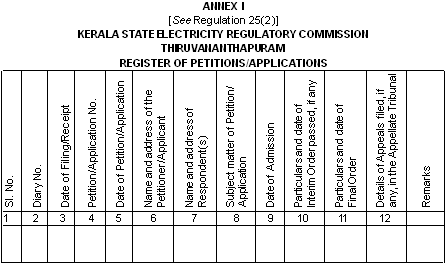
(2) The Receiving Officer shall affix the receipt stamp with the seal of the Commission on the front page of all the copies of the petition and put his/her initials on the stamp. The Receiving Officer shall also enter the date of receipt of the petition and also such other details as required in the Register prescribed, as per Annex-I to these Regulations. The Receiving Officer shall also issue an acknowledgment with stamp and date to the person filing the petition. In case the petition is received by registered post, the date on which the petition is actually received at the office of the Commission shall be taken as the date of presentation of the petition. The Receiving Officer may decline to accept any pet
(1) The petition after receipt will be placed before the Commission. If the Commission finds the petition in order, it may straight away admit the petition. If the petition is found to be defective in pleading, the Commission may issue such directions as are necessary for removing the defects in the petition. Once the petition is set right to the satisfaction of the Commission, the Commission may admit the petition without requiring the attendance of the party filing the petition. The Commission shall not pass an order refusing admission without giving the party concerned an opportunity of being heard. The Commission may, if it is considered appropriate, issue notice to such person or persons as may be considered necessary to hear the petition for admission. If the defects are not removed after notice, the Commission may reject the petition without any further proceedings.
2[(2) If the commission admits the petition, it may give such orders and directions as may be
(1) Any notice or process issued by the Commission may be in any one or more of the following modes as may be directed by the Commission:--
(a) by hand delivery or courier;
(b) under certificate of posting;
(c) by registered post, with acknowledgment due;
(d) by facsimile transmission or electronic mail (e-mail);
(e) by publication in newspaper in cases where the Commission is satisfied that it is not reasonably practicable to serve the notices, processes, etc.; on any person in the manner mentioned above;
(f) in any other manner as may be considered appropriate by the Commission.
(2) The Commission shall be entitled to decide in each case the person or persons who shall bear the cost of such service and publications.
(3) Every notice or process required to be served on or delivered to any person may be sent to that person or his agent empowered to accept service at the address furnished by him for service or at the place where
(1) Each respondent intending to contest the Notice of Inquiry or the petition filed against him shall file his/her reply to the Notice of Inquiry or the Petition in 6 (six) sets along with the documents relied upon by him/her, within such period, not exceeding 21 (twenty one) days from the date of service of petition upon the respondent, as may be fixed by the Commission.
(2) The Commission may, if so satisfied, allow filing of the reply after the expiry of the prescribed period.
(3) In the reply filed under sub-regulation (1) above, the respondent shall specifically admit, deny or explain the facts stated in the notice of inquiry or the petition and may also state such additional facts as he/she considers necessary for a just decision of the case. The reply shall be verified, signed and supported by affidavit in the same manner as in the case of a petition. The respondent shall also indicate in the reply whether he/she wishes to participate in the proceedings and be
(1) Every person who intends to file objections or comments in regard to a matter pending before the Commission, pursuant to the publication issued for the purpose (other than the persons to whom notices, processes, etc., have been issued calling for reply) shall deliver to the Receiving Officer, the statement of objections or comments in triplicate along with evidence in support thereof within the time fixed for the purpose.
(2) The Commission may permit such person or persons, as it may consider appropriate, to participate in the proceedings before the Commission, if on the report received from the Receiving Officer, the Commission considers that the participation of such person or persons will facilitate the proceedings and the decision in the matter.
(3) Unless permitted by the Commission, the person filing objections or comments shall not be entitled to participate in the proceedings. However, the Commission shall be at liberty to take into account the objections
(1) A party to any proceedings under this Chapter may be represented before the Commission in one of the following manners, namely:--
(a) In person;
(b) Through an authorised employee; or
(c) Through an authorised professional who may be an Advocate or a Chartered Accountant, or a Cost and Works Accountant or a Company Secretary or a Graduate/Chartered Engineer, holding a certificate of practice:
Provided that an Advocate (legal practitioner) appearing and acting in the proceedings on behalf of any person before the Commission shall file a vakalatnama duly executed by the person for whom he/she appears, if not already filed on the record of the case. A person other than a legal practitioner representing a party shall file a Memorandum of Appearance in the Form 4 attached hereto, duly signed by him/her.
(2) The representation of a party at the proceedings shall include the right to act and plead on his/her behalf, subject to such terms and con
(1) The Commission may permit any association/forum or other body corporate or any group of electricity consumers to participate in any proceedings before the Commission.
(2) The Commission may, for the sake of timely completion of proceedings, direct grouping of electricity consumers forum who have a common interest so that they can make collective pleadings.
(3) The Commission may appoint any officer or any other person to represent the interest of the electricity consumers in general or any class or classes of consumers, as the Commission may consider appropriate. If any person not being an officer is appointed as above, the Commission may direct payment to such person of such fee, cost and expenses by such of the parties to the proceedings, as the Commission may consider appropriate.
(4) The Commission may, in appropriate cases, permit any individual with specialised knowledge of the issues concerned to participate in any proceedings before the Commission.
(1) The Commission may determine the manner, the place, the date and the time of the hearing of the matter.
(2) The Commission may decide the matter on the pleadings of the parties or may at its sole discretion call for the parties to produce evidence by way of affidavit or lead oral evidence.
(3) If the Commission directs evidence of a party to be led by way of affidavit, the Commission may as and when considers it to be necessary, grant an opportunity to the other party to cross-examine the deponent of the affidavit.
(3) The Commission may, if considered necessary or expedient, direct that the evidence of any of the parties be recorded by an officer or person designated for the purpose by the Commission.
(4) The Commission may direct the parties to file written notes of arguments or submissions in the matter.
(1) The Commission may, at any time before passing orders on the matter, require the parties or any one or more of them or any other person whom the Commission considers appropriate, to produce such documentary or other evidence, as the Commission may consider necessary for the purpose of enabling it to pass orders, within such time as may be prescribed by the Commission.
(2) The Commission may direct the summoning of the witnesses, discovery and production of any document or other material objects producible in evidence, requisitioning any public record from an office, examination by an officer of the books, accounts or other documents or information in the custody or control of any person, which the Commission considers relevant for the matter.
(1) At any stage of the proceedings, the Commission shall be entitled to refer such issue or issues in the matter, as it considers appropriate, to persons including, but not limited to, the officers and consultants of the Commission, whom the Commission considers as qualified to give expert or specialised advice or opinion on such issue or issues.
(2) The Commission may nominate from time to time any person, including but not limited to the officers and consultants, to visit any place or places for inspection and report on the existence or status of the place or any facilities therein.
(3) The Commission, if it deems fit, may direct the parties to appear before the persons designated in sub-regulation (1) or (2) above to present their respective views on the issues or matters referred to.
(4) The report or the opinion received from such person shall form a part of the record of the case and parties shall be given the copies of the report or opinion given by the
(1) When, on the date fixed for hearing of the petition or on any other date to which such hearing may be adjourned, any party or his authorised representative does not appear when the matter is called for hearing, the Commission may, in its discretion, either dismiss the petition for default when the petitioner or the person who moves the Commission for hearing is absent or proceed to hear and decide the petition ex parte.
(2) Where a petition is dismissed in default or decided ex parte, the person aggrieved may file an application within 30 days from the date of receipt of the order of such dismissal or proceeding held ex parte, as the case may be, for recall of the order passed, and the Commission may recall the order on such terms as it deems fit, if the Commission is satisfied that there was sufficient cause for the non-appearance when the petition was called for hearing.
(1) No Member shall exercise his/her vote on a decision unless he/she was present during all substantial hearings of the Commission on the matter.
(2) The Commission shall pass orders on the petition in writing and the Chairperson and Members of the Commission who heard the matter and voted on the decisions will sign the orders.
(3) The reasons given by the Commission in support of the orders, including those by a dissenting Member, if any, shall form part of the order and shall be available for inspection and supply of copies in accordance with these Regulations.
(4) All orders and decisions issued or communicated by the Commission shall be authenticated by the signature of an officer empowered in this behalf by the Chairperson and shall bear the seal of the Commission.
(5) Copy of every interim order granting or refusing or modifying interim relief and every final order passed on any petition or notice of enquiry shall be communicated to the petitioner
(1) Records of every proceedings, except those parts which for reasons specified by the Commission in terms of Section 65(1) of these Regulations are confidential, shall be open to inspection by any person subject to such person complying with such terms as the Commission may direct, by order from time to time, including in regard to time, place and manner of inspection and payment of fees.
(2) Any person shall be entitled to obtain authenticated copies of the orders, decisions, directions and reasons in support thereof given by the Commission as well as the pleadings and papers and other parts of the records of the Commission to which he is entitled, subject to payment of fees and compliance with such other terms as the Commission may direct.
(1) Where, in any proceedings, any of the parties to the proceedings dies or is adjudicated as an insolvent or in the case of a Company if it is under liquidation/winding up, the proceedings shall continue with the successors-in-interest, the executor, administrator, receiver, liquidator or other legal representative of the party concerned.
(2) The Commission may, for reasons to be recorded, treat the proceedings as abated in case the Commission so directs and dispense with the need to bring the successors-in-interest to come on record.
(3) In case any person wishes to bring on record the successors in-interest, etc.; the application for the purpose shall be filed within 90 days from the event requiring the successors-in-interest to come on record.
The proceedings before the Commission shall ordinarily be open to the public. However, admission to the hearing room during proceedings shall be subject to the availability of sitting accommodation, provided that the Commission may, if it deems fit, and for reasons to be recorded in writing, order at any stage of the proceedings of any particular case that the public generally or any particular person or group of persons shall not have access to or remain in the room or building used by the Commission.
(1) Where any application, petition, or other matter is required to be published under the Act or these Regulations or as per the directions of the Commission, it shall unless the Commission otherwise orders or the Act or Regulations otherwise provide, be published not less than 15 days before the date fixed for hearing.
(2) Except as otherwise provided, such publication shall give a heading describing the subject matter in brief.
(3) Such publication shall be approved by the officer of the Commission designated for the purpose.
(1) Subject to such conditions and limitations as may be directed by the Commission, the cost of all proceedings shall be awarded at the discretion of the Commission and the Commission shall have full power to determine by whom or out of what funds and to what extent such costs are to be paid and shall give all necessary directions for the aforesaid purpose.
(2) The costs shall be paid within 30 days from the date of the order or within such time as the Commission may by order, direct. The order of the Commission awarding costs shall be executed in the same manner as the decree/order of a Civil Court.
(1) The Commission may make such order or orders as it may consider appropriate in terms of Section 96 of the Act for collection of information, inquiry and investigation, entry, search and seizure, without prejudice to the generality of its powers in regard to the following:--
(a) The Commission may at any time, direct the Secretary or any one or more officers or consultants or any other person, as the Commission considers appropriate to study, investigate or furnish information with respect to any matter within the purview of the Commission under the Act.
(b) The Commission may for the above purpose give such other directions as it may deem fit and specify the time within which the report is to be submitted or information furnished.
(c) The Commission may issue or authorise the Secretary or an officer to issue directions to any person to produce before it and allow to be examined and kept by an officer of the Commission specified in this behalf, the books, acc
(1) The Commission may, at any time, take the assistance of any institution, consultant, experts, engineers, chartered accountants, advocates, surveyors and such other technical and professional persons, as it may consider necessary and ask them to study, investigate, inquire into any matter or issue and submit report or reports or furnish any information. The Commission may determine the terms and conditions for engagements of such professionals.
(2) If the report or information obtained in terms of the above or any part thereof is proposed to be relied upon by the Commission in forming its opinion or view in any matter, the parties concerned with the matter shall be given a reasonable opportunity for filing objections and making submission on such report or information.
(1) No Generating company supplying electricity in the State, other than that owned or controlled by the Central Government and other than that has entered into a contract for or otherwise has a composite scheme of generation and sale of electricity in more than one State, shall charge the Board or distribution licensees any tariff for supply of electricity without the approval of such tariff by the Commission.
(2) The Board or licensees for intra-State transmission, wheeling and supply of electricity in the State, shall not charge any tariff without the approval of the Commission:
Provided that the existing tariff being charged by the Generating Companies, the Board and licensees shall continue to be in vogue after the date of effect of these Regulations for such period as may be specified by a notification without prejudice to the powers of the Commission to take up any matter relating to tariff falling within the scope of Sections 62 and 86 of the Act.
(1) Any Generating company, other than that owned or controlled by the Central Government, proposing to enter into contract(s) for supply of electricity exclusively within the State with the Board or any distribution licensee, shall get the approval of the Commission on the power/energy supply contract(s) including the tariff(s) for supply before entering into such contract(s).
(2) Board or any distribution licensee proposing to enter into contract(s) for buying electricity from any source other than a Generating company or generating station shall get the approval of the Commission on the power/energy purchase contract(s) including the tariff(s) for purchase before entering into such contract(s).
Without prejudice to the generality of the powers of the Commission in determining the tariff for generation, transmission, wheeling and supply of electricity, the Commission may keep in view, while determining the tariff, factors such as:
(a) the need to link tariff adjustments to increases in the productivity of capital employed and improvements in efficiency so as to safeguard the interests of the consumers;
(b) the need to rationalise tariffs to progressively reflect the cost of generation, transmission and distribution;
(c) the need to 4[reduce] cross-subsidies in a phased manner;
(d) the need to transparently provide for appropriate incentives in a non-discriminatory manner, for a continuous enhancement in the efficiency of generation, transmission and distribution and upgradation in the levels of service;
(e) the need to transparently provide for appropriate incentives in a non-discriminatory manner to the consumers operating at h
(1) The Commission may frame separate Regulations, through notifications, for Expected Revenue from Permissible Charges (ERC) and Tariff Filing in accordance with the provisions of Sections 62 and 64 of the Act.
(2) The Commission may work out appropriate incentive schemes for improved performance in generation, transmission and distribution, which shall be notified from time to time.
(3) The Commission shall regulate the charges payable to the Board and licensees for transmission and distribution losses stipulating a progressive reduction of the same in a time bound manner to achieve acceptable standards.
(4) The Commission may approve differential tariff linked to factors like Time Of Day Metering (TOD) and payment terms with built-in incentives for timely payment of bills.
(5) The Commission may approve the system of prepaid meters linked to incentives for advance payment.
(1) The Board and licensees shall submit proposals for tariff formulation/revision in the form of petition based on the terms and conditions provided in these Regulations and in conformity with the requirements as prescribed in Chapter III.
(2) The Commission shall invite objections/suggestions on the tariff proposals from the interested stakeholders and this shall be followed by grant of public hearings as may be deemed fit.
(3) The Commission may get the books and records of the Board or licensees concerned, examined by the officers or by consultants, as and when necessary. The report of the officers or consultants shall be made available to the parties concerned and they shall be given opportunity to react on the report in the manner as prescribed in Section 34(4) of these Regulations.
(4) The Commission may require the Board or licensees concerned, to furnish other information, particulars and documents as considered appropriate to enable the Commission to a
The Board or licensees concerned shall publish the tariff as decided by the Commission, in the manner as may be provided in the order.
The Board or licensees shall submit periodic returns, as may be prescribed, containing operational and cost data to enable the Commission to monitor the implementation of its order and reassess the basis on which tariff was approved.
(1) In accordance with Section 87 of the Act, the Commission shall, by notification, constitute with effect from such date as it may specify in such notification, a Committee known as State Advisory Committee.
(2) The Committee shall consist of such number of persons being not less than 12 and not more than 21 as the Commission may appoint to represent the interests mentioned in the sub-section (2) of Section 87 of the Act.
(3)The Committee shall include representatives from the following:--
(a) Energy /Power Department, Government of Kerala;
(b) Generating Companies, the Board and licensees operating within the State;
5[(c) Domestic consumers;]
(d) Commerce;
(e) Industry;
(f) Agriculture;
(g) transport;
(h) Labour employed in the Electricity Supply Industry;
(i) Non-Governmental bodies in energy sector;
(j) Academic and Research Bodies in Energy Sector; and
(k) Legal profession.
The functions of the Committee shall be as follows:--
(a) to advise the Commission on major question of policy relating to the electricity supply industry in the State;
(b) to advise the Commission on matters relating to quality, continuity and extent of service provided by the licensees and compliance by them with the conditions and requirement of service to be provided by them;
(c) to advise the Commission on matters regarding protection of consumer interests;
(d) to advise the Commission on overall standards of performance to be maintained by the licensees regarding electricity supply; and
(e) to advise the Commission on the norms and standards for efficient use of electricity by the consumers which in the opinion of the Advisory Committee are economic and ought to be achieved by the licensees.
The Committee shall meet at least once in every three months for transaction of business.
All meetings of the Committee shall ordinarily be held in Thiruvananthapuram 6[xxxx]
(1) Meetings of the Committee shall be called by notice in writing, giving Committee members thereof not less than fourteen days notice of the date, time and place of the proposed meeting.
(2) A special meeting can be called by the Chairperson, in which case the notice for this meeting may be less than fourteen days but not less than five days.
(3) Non-receipt of a notice by a Committee member shall not invalidate the proceedings or any resolution passed or decision taken at the meeting.
(4) A notice shall be deemed duly issued, if it is sent, by post or by a messenger, within the prescribed time to the registered address of the Committee member.
The Secretary, with the approval of the Chairperson, shall normally send the agenda for the meeting together with notes, statements and reports, if any, along with the notice of meeting.
(1) The quorum for the meeting shall be one-third of the total strength of the Committee. If there is no quorum, the meeting shall stand adjourned. No quorum is necessary for the adjourned meeting. If at any time after the meeting is commenced a quorum ceases to exist, the meeting shall not be dissolved but shall continue.
(2) No matter shall be considered at an adjourned meeting other than the matters remaining from the meeting at which the adjournment took place, provided that, with or without notice, the Chairperson shall bring in or direct to be brought before an adjourned meeting of the Committee, any new matter which in his/her opinion is urgent.
(3) No proceeding of the committee shall be invalid by reason solely of the vacancies existing in the committee, or by reason of non-receipt of the notice or agenda paper, provided the notice and agenda were duly issued.
(1) The Chairperson shall preside over the meetings and conduct the business. If Chairperson is unable to be present in any meeting for any reason, a Member of the Commission nominated by the Chairperson for the purpose shall preside over the meeting and perform the duties of the Chairperson.
(2) The rulings given by the Chairperson or the Member presiding over the meeting on any points of procedure shall be final and binding.
In addition to matter included in the Agenda, any other matter proposed by any Committee member may be discussed only with the permission of the Chairperson or the presiding Member.
The Secretary and such persons as have been invited by the Chairperson to attend the meeting may participate in the discussions with the approval of the Chairperson or the presiding Member.
(1) The Secretary or in his/her absence an officer of the Commission designated by the Chairperson, shall record the minutes of the meetings and maintain a book, which will, amongst other things, contain the names and designation of the Committee members and invitees present in the meeting and proceedings thereof. The minutes of the meeting shall be signed by the person presiding over the meeting.
(2) The minutes of the meeting shall be confirmed in the next meeting.
(1) A Committee member shall not be entitled to any remuneration other than that provided in these Regulations.
(2) A sitting fee prescribed by the Commission shall be payable to the Committee members except those who are employees of the Government or a Public Sector Undertaking. Committee Members 24 other than those who are employees of the Government or Public Sector Undertakings shall be entitled to receive Travelling Allowance and Daily Allowance at the rate applicable to Class I (Group-A) Officers of the Government of Kerala.
(3) A Committee member who is a Government Servant or an employee of any Public Sector Undertaking shall draw Travelling Allowance and Daily Allowance on the scale admissible to him/her from his/her parent organisation.
(1) A Committee member who fails to attend three consecutive meetings of the Committee without prior intimation to the Commission and without valid reasons for his absence shall forthwith cease to be a Committee member.
(2) Any Committee member may, by writing under his hand, addressed to the Secretary of the Commission, resign his office as a Committee member.
(3) The Commission will take appropriate action to nominate a Committee member to fill up the vacancy thus caused.
(1) Every petition, application or complaint made to the Commission shall be made by payment of the appropriate fees prescribed in the schedule of fees as per Annex II to these Regulations.
Provided that the petition/application shall be accompanied by a fee of Rs.10,000/- only and the balance fee payable, if any, shall be paid within two weeks of the admission of the petition/application.
(2) The fees payable under these Regulations shall be paid by means of bank draft or pay order, drawn in favour of the Secretary, Kerala State Electricity Regulatory Commission, payable at Thiruvananthapuram.
(3)The fee received shall be entered in a register prescribed for the purpose as per Annex III to these Regulations.
(4) The fees received by the Secretary of the Commission under these Regulations shall be remitted to the State Electricity Regulatory Commission Fund.
(1) The Commission may, by order, direct that any information, documents and other papers and materials produced before the Commission or any of its officers, consultants, representatives or otherwise which may be in, or come into, their possession or custody, shall be confidential or privileged and shall not be available for inspection or supply of copies, and the Commission may also direct that such document, papers, or materials shall not be used in any manner except as specifically authorised by the Commission.
(2) Records of the Commission, except those parts which for reasons specified by the Commission are confidential or privileged, shall be open to inspection by all, subject to the payment of prescribed fee and complying with the terms, as the Commission may direct.
(3) The application for inspection of documents shall be in Form-5 attached hereto and shall be accompanied by a fee of Rs.100/- for each inspection for one day in the form of Demand Draft/Pay Orde
(1) The Commission may, on such terms and conditions as the Commission considers appropriate, provide for the supply of the authenticated copy of the documents and papers available with the Commission to any person.
(2) Any person desirous of obtaining an authenticated copy of any order of the Commission or any document forming part of the records of proceedings before the Commission shall submit an application as per Form 6 attached hereto, accompanied by a fee of Rs.50/- in the form of Demand Draft/Pay Order in favour of the Secretary, Kerala State Electricity Regulatory Commission payable at Thiruvananthapuram.
(3) A Register of Applications for authenticated copy shall be maintained by the Commission in the format as per Annex V to these Regulations.
(4) As far as practicable, the authenticated copy shall be prepared in the order in which the applications are entered in the Register of Copy Applications.
(5) The copies shall be prepared by photocopyin
(1) The Commission may, either on its own motion or on an application made by any interested or affected party, within 90 days of the making or issuing of any decision, direction, order, notice or other document or the taking of any action in pursuance of these Regulations, review, revoke, revise, modify, amend, alter or otherwise change such decision, direction, order, notice or other document issued or action taken by the Commission or any of its Officers.
(2) An application under sub-regulation (1) shall be filed in the same manner as a petition under Chapter III of these Regulations.
Subject to the provisions of the Act and these Regulations, the Commission may from time to time, issue orders and practice directions in regard to the implementation of the Regulations and procedure to be followed on various matters which the Commission has been empowered by these Regulations to specify or direct.
(1) Nothing in these Regulations shall be deemed to limit or otherwise affect the inherent power of the Commission to make such orders as may be necessary for meeting the ends of justice or to prevent the abuse of the process of the Commission.
(2) Nothing in these Regulations shall bar the commission from adopting a procedure which is at variance with any of the provisions of these Regulations, if the Commission, in view of the special circumstances of a matter or class of matters and for reasons to be recorded in writing, deems it necessary or expedient for dealing with such a matter or class of matters.
(3) Nothing in these Regulations shall, expressly or impliedly, bar the Commission from dealing with any matter or exercising any power under the Act for which no Regulations have been framed, and the Commission may deal with such matters, powers and functions in a manner it deems fit.
(4) In the exercise of its powers under the Act and in the discharge of its
If any difficulty arise in giving effect to any of the provisions of these Regulations, the Commission may, by general or special order, do anything, not being inconsistent with the provisions of the Act, which appears to it to be necessary or expedient for the purpose of removing the difficulties.
The Commission shall have the power for reasons to be recorded in writing and with notice to the affected parties, dispense with the requirements of any of the Regulations in specific cases subject to such terms and conditions as may be specified.
The Commission shall be entitled from time to time to add, amend, alter or vary these Regulations and the amount of fees prescribed, by a notification to be made by the Commission.
Subject to the provisions of the Act, the time prescribed by these Regulations or by order of the Commission for doing any act may be extended (whether it has already expired or not) or abridged, for sufficient reason, by order of the Commission.
Failure to comply with any requirement of these Regulations shall not invalidate any proceeding or order passed by the Commission, merely by reason of such failure unless the Commission is of the view that such failure has resulted in miscarriage of justice.
The Secretary shall ensure execution of the orders passed by the Commission, by the persons concerned in accordance with the provisions of the Act and Regulations and if necessary, may seek the orders of the Commission for directions.
| FORM 1 [See Regulation 24(3)] General Heading for petitions BEFORE THE KERALA STATE ELECTRICITY REGULATORY COMMISSION Petition No. | |
| (To be filled by the Office, if number has not earlier been assigned) | |
| IN THE MATTER OF: | |
| (Gist of the purpose of the petition or application) | |
| NAME(S) AND FULL ADDRESS(ES) OF PETITIONER(S)/APPLICANT(S) NAME(S) AND FULL ADDRESS(ES) OF RESPONDENT(S) | |
| 1[Annex II | ||||
| [See Regulation 64(1)] | ||||
| KERALA STATE ELECTRICITY REGULATORY COMMISSION | ||||
| | ||||
| Sl. No. | Nature of petition/Application | Fee | ||
(1) In these Regulations, unless the context otherwise requires,--
(a) "Act" means the Electricity Act, 2003 (Central Act No. 36 of 2003);
(b) "Agenda" means the gist of business proposed to be transacted at a meeting;
(c) "Board" means the Kerala State Electricity Board;
(d) "Chairperson" means the Chairperson of the Kerala State Electricity Regulatory Commission;
(e) "Commission" means the Kerala State Electricity Regulatory Commission constituted under the Act;
(f) "Licensee" means a person who has been granted a licence under Section 14 of the Act;
(g) "Member" means a Member of the Kerala State Electricity Regulatory Commission;
(h) "Officer" means an officer of the Commission;
(h) "Petition" shall mean and include all petitions, applications, complaints, appeals, replies, rejoinders, supplemental pleadings, other papers and documents filed before the Commission;
(j) "Proceedings" shall mean and include proce

Elevate your legal practice with advanced AI-driven research and drafting solutions. Experience unmatched efficiency, precision, and security, tailored exclusively for legal professionals.


An indispensable Tool for Legal Professionals, Endorsed by Various High Court and Judicial Officers
Please visit our Training & Support
Center or Contact Us for assistance

Scan Me!
India’s Legal research and Law Firm App, Download now!


For Daily Legal Updates, Join us on :



 Back to top


 AI Assistant





