
Use our app for the best experience
Available for Android & iOS

Odisha Forest Act, 1972.
An Act to consolidate and amend the laws relating to the protection and management of forests in the State.
Be it enacted by the legislature of the State of Odisha in the Twentythird year of the republic of India as follows :
1Statement of Objects and Reasons : There are now to Forest Acts in application in the State of Odisha, i.e. the Indian Forest Act, 1927 and the Madras Forest Act, 1882. Except for the Districts of Koraput, Ganjam and part of Phulbani districts (Baliguda and G. Udayagiri Taluks) where the Madras Forest Act, 1882 is in force, the rest of the area is covered by the Indian Forest Act, 1927. The existence of two Acts quite often creates confusion and also administrative difficulty. The existence of the two Acts imposed an extra strain on the Government machinery with no commensurate advantage and this could be avoided by one unified Act. The necessity for a unified Forest Act was felt quite early
Read full Act(1) This Act may be called the Odisha Forest Act, 1972.
(2) It extends to the whole of the State of Odisha.
(3) It shall come into force at once.
In this Act, unless the context otherwise requires—
The State Government may constitute any land which is the property of Government or over which the Government have proprietary rights of a reserved forest in the manner hereinafter provided.
(1) Whenever it is proposed to constitute any land a reserved forest, the State Government shall issue a notification in the Official Gazette:
Explanation :- For the purpose of Clause (b), it shall be sufficient to describe the limits of the forest by roads, rivers, bridges or other well known or readily intelligible boundaries.
(2) The Officer appointed under Clause (c) of Sub-Sec. (1) shall ordinarily be a person not holding any for
(1) After the issue of a notification under Section 4, no right shall be acquired in or over the land comprised in such notification, except by succession or under a grant or contract in writing made or entered into by or on behalf of the State Government or some person in whom such right was vested when the notification was issued; and no fresh clearing or breaking of land for cultivation or for any other purpose or construction of shed or other structures shall be made in such land except in accordance with such rules as may be made by the State Government in that behalf.
(2) Save as otherwise provided in this Act, no Civil Court shall, between the date of publication of the notification under Section 4 and of the notification to be issued under Section 21, entertain any suit to establish any right in or over any land included in the notification published under Section 4.
When a notification has been issued under Section 4 the Forest Settlement Officer, in the prescribed manner, publish in Oriya in every town and village in the neighbourhood of the land comprised therein, a proclamation :
(1) The Forest Settlement Officer shall take down in writing all statements made under Section 6 and shall at some convenient place in the locality, inquire into all claims duly preferred under that Section, and existence of any rights mentioned in Section 4 or 5 and not claimed under Section 6 so far as the same may be ascertainable from the records of Government and the evidence of any person likely to be acquainted with the same.
(2) The Forest Settlement Officer shall also record any representation which the Forest Officer, if any, representing the Forest Department under Sub-Section (3) of Section 4 or the Divisional Forest Officer may in respect of any such objection or claim.
For the purpose of such enquiry, the Forest Settlement Officer may exercise the following powers, that is to say—
Rights in respect of which no claim has been preferred under Section 6 and of the existence of which no knowledge has been acquired by inquiry under Section 7, shall be extinguished, unless before the publication of the notification under Section 21, the person claiming the same satisfies the Forest Settlement Officer that he had sufficient cause for not preferring such claim within the period fixed under Section 6.
(1) Claims relating to the practice of shifting cultivation in any land notified under Section 4 shall not be admitted but if the Forest Settlement Officer considers that some portion of the land under settlement needs to be excluded to provide sufficient land for cultivation, he may, after considering the objections of the Forest Officer, if any, representing the Forest Department, under Sub-Section (3) of Section 4 or the Divisional Forest Officer, make a report to the State Government containing his recommendations for alteration of the limits of the land.
(2) The State Government may, after considering the recommendations so made, sanction the alteration proposed by the Forest Settlement Officer either in whole or with such modifications as they deem fit and thereupon the Forest Settlement Officer shall pass an order altering the limits of the land as sanctioned by the State Government.
(3) The practice of shifting cultivation shall, in all cases, be deem
(1) In the case of claim to a right in or over any land, other than a right of way or right of pasture, or a right to forest produce or a water course or to use of water the Forest Settlement Officer shall pass an order admitting or rejecting the same in whole or in part after considering the particulars of such claims and the objection of the Forest Officer, if any, representing the Forest Department under Sub-Section (3) of Section 4 or the, Divisional Forest Officer.
(2) If such claim is admitted in whole or in part, the Forest Settlement Officer shall either —
(3) For the purpose of such acquisition —
(1) In the case of a claim to right of way, right to water course or to use of water, the Forest Settlement Officer shall, after considering the objections of the Forest Officer, if any, representing the Forest Department under Sub-Sec. (3) of Section 4 or the Divisional Forest Officer, either come to an agreement with the claimant for the surrender of the right or pass an order for continuance of the exercise of such right subject to such conditions as may be agreed upon between the Forest Department and the claimant or where no such agreement is reached, as the Forest Settlement Officer may impose.
(2) In the case of claims to rights of pasture or to forest produce the Forest Settlement Officer shall pass an order admitting or rejecting the same in whole or in part after considering the objections of the Forest Officer representing the Forest Department under Sub-Sec. (3) of Section 4 or of the Divisional Forest Officer.
(3) A copy of every order passed und
The Forest Settlement Officer, when passing any order under Section 12, shall record in as precise terms as possible and so far as may be practicable —
If the Forest Settlement Officer admits in whole or in part any claim under Sub-Sec. (2) of Section 12, he shall also record the extent to which the claim is so admitted specifying the number and description of the cattle which the claimant is, from time to time, entitled to graze in the forest, the season during which such pasture is admitted, the quantity of timber and other forest produce which he is, from time to time, authorised to take or receive, and such other particulars, as the case may require. He shall further record whether the timber or other forest produce obtained on such authorisation may be sold or bartered.
(1) After making such records, the Forest Settlement Officer shall, to the best of his ability, and having due regard to the maintenance of the reserved forest in respect of which the claim is made, pass such orders as will ensure the continued exercise of the rights so admitted.
(2) For the said purpose, the Forest Settlement Officer may—
If on the representation of the Divisional Forest Officer, the Forest Settlement Officer is satisfied that the exercise of any private right is inconsistent with the maintenance, preservation of development of a reserve forest, he shall proceed to acquire such right and shall, subject to such Rules as the State Government may make in this behalf, commute such rights by the payment to such persons of a sum money in lieu thereof or by the grant of land, or in such other manner, as he thinks fit.
Any person who has made a claim under this Act, or any Forest Officer or other person generally or specially empowered by the State Government in this behalf, may, within three months from the date of the order passed to such claim by the Forest Settlement Officer under Sections 11, 12, 15 or 16, present an appeal from such order to the Collector of the district who may dispose of the appeal himself or may transfer the same to the Additional District Magistrate for disposal.
(1) Every appeal under Sec. 17 shall be made by a memorandum in writing and may be delivered to the Forest Settlement Officer, who shall forward it forthwith to the authority competent to hear the same.
(2) The procedure for filing and disposal of appeals shall be the same as is provided under Order XLI of the Code of Civil Procedure, 1908 (5 of 1908).
(1) The Board of Revenue may, on an application made in that behalf by any person aggrieved by an appellate order under Section 18 within the months from the date of the order, confirm, modify or set aside such order:
Provided that no orders under this Sub-Section shall be made without giving the parties concerned a reasonable opportunity of being heard.
(2) The Board of Revenue may, by order in writing and subject to, such conditions, as may be specified therein, delegate its powers under this Section to any officer not below in rank to the Revenue Divisional Commissioner and may in like manner withdraw the powers so delegated.
The State Government or any person who has made a claim under this Act, may appoint any person to appear, plead and act on their or his behalf before the Forest Settlement Officer or the appellate or revisional authority in the course of any inquiry, appeal or revision under this Act.
(1) When the following events have occurred, namely:
The Divisional Forest Officer shall before the date specified in the notification issued under Section 21, cause a translation thereof into Oriya to be published at a conspicuous place in every town and village in the neighbourhood of the forest and also in such other manner as may be prescribed.
The State Government may, at any time after the publication of any notification under Section 21, revise any arrangement made under Section 15, Section 18 or Section 19 and may for this purpose rescind or modify any order made under Section 15, Section 18, or Section 19 and direct that any one of the proceedings, specified in Section 15 be taken in lieu of any other of such proceedings or that the rights admitted under Section 12 be commuted under Section 16 :
Provided that no order under this Section shall be made without giving parties concerned a reasonable opportunity of being heard.
No right of any description shall be acquired in or over a reserved forest except by succession or under a grant or contract in writing made by or on behalf of the State Government or some person in whom such right was vested when the notification under Section 21 was issued.
(1) Notwithstanding anything contained in Section 24, no right continued under Clause (c) of Sub-Section (2) of Section 15, shall be alienated by way of grant, sale, lease, mortgage or otherwise without the sanction of the State Government.
Provided that, when any such right is appendant to any land or house, it may be sold or otherwise alienated along with such land or house.
(2) No timber or other forest produce obtained in exercise of any such right shall be sold or bartered except to such extent as may have been admitted in the order recorded under Section 14.
The Divisional Forest Officer may, in the interests of the general public and without the previous sanction of the State Government or of any officer duly authorised by them in this behalf, close any public or private way or water course or stop the use of water in a reserved forest :
Provided that a substitute for the way or water course so closed or, as the case may be, an alternative arrangement for the use of water so stopped, which the State Government deems to be reasonable, convenient and already exists, or has been provided for or constructed by the Divisional Forest Officer in lieu thereof.
(1) The person who —
shall be punishable with imprisonment for a term which may extend to one year and with fine which may extend to one thousand rupees.
(2) Any person who in a reserved forest —
Whenever in a reserved forest -
The State Government may, on the recommendation of the Collector of the district, direct that in such forest or any portion thereof the exercise of all rights of pasture or to forest produce shall be suspended for such period as they may think fit :
Provided that before making any recommendation to the State Government, the Collector shall give the persons concerned a reasonable opportunity of being heard.
(1) The State Government may, by notification, direct that with effect from such date as may be specified therein, any forest declared to be a reserved forest under this Act or any portion thereof shall cease to be a reserved forest.
(2) With effect from the aforesaid date such forest or portion of the forest shall cease to be a reserved forest but the rights therein, if any which have been extinguished shall not revive in consequence of such cessation.
(3) Whenever any reserved forest or any portion thereof ceases to be a reserved forest by virtue of a notification issued under Sub-Section (1), the State Government shall, as far as practicable, constitute other lands equal in area to the reserved forest so notified, to be a reserved forest in accordance with the provision of this Chapter.
(1) The State Government may, by notification constitute any land at their disposal to be a village forest for the benefit of any village community or group of village communities and may in like manner vary or cancel any such notification.
(2) Every such notification shall specify the limits of such village forest.
Explanation :- "Land at the disposal of Government" includes all unoccupied land, all temporarily occupied land or occupied without permission whether assessed or unassessed, and all communal forests but does not include and recorded in the name of any private person or institution in the record-of-rights in force which is prepared and maintained or is deemed to be prepared and maintained under the Odisha Survey and Settlement Act, 1958 (Odisha Act 3 of 1959).
(1) The State Government may make rules for regulating the management of village forests and for prescribing the conditions under which the community or group of communities for the benefit of which any such village forest is constituted may be provided with forest produce or with pasture, and their duties in respect of the protection and improvement of such forest.
(2) The State Government may by such Rules, declare all or any of the provisions of Chapter II to be applicable to village forests.
All claims to any right other than the rights of the village community or group of village communities for the benefit of which such village forest is constituted, shall be inquired into; recorded and provided for in such manner as may be prescribed.
(1) The State Government may, by notification declare the provisions of this Chapter applicable to any land which is not included in a reserved forest, but which is the property of Government or, over which the Government have proprietary rights.
(2) The lands comprised in any such notification shall be called a "protected forest".
(3) No such notification shall be issued unless the nature and extent of the rights of Government and of private persons and village communities in or over the land comprised therein have been inquired into and recorded at a survey or settlement, or in such other manner as may be prescribed any every such record shall be presumed to be correct until the contrary is proved :
Provided that if in the case of any land, the State Government are of the opinion that the enquiry and recording as aforesaid are likely to occupy such length of time as in the meantime to endanger the rights of Government, they may, pending such inquiry a
The State Government may by notification :
Provided that in making a declaration under Clause (c) the State Government shall have due regard to the grazing facility of cattle.
The Divisional Forest Officer shall cause translation into Oriya of every notification issued under Section 34 to be affixed in a conspicuous place in every town and village in the neighbourhood of the forest comprised in the notification.
The State Government may make rules to control and regulate the following matters, namely;
(1) Any person who —
Nothing in this Chapter shall be deemed to prohibit any act done with the permission in writing of the Forest Officer who is authorised by the Chief Conservator of Forests to accord such permission or done in accordance with Rules made under Section 36 or, except as regards any portion of a forest notified under Section 34, or as regards any right the exercise of which has been suspended under Section 37 or done in the exercise of any right recorded under Section 33.
(1) The State Government may, by notification, regulate or prohibit in any forest or waste land -
(2)
(1) In case of neglect of or wilful disobedience to any regulation made or prohibition imposed under Section 39; or if the purposes of any work to be constructed under that section so requires the State Government may, after notice in writing to the owner of such forest or land and after considering his objection, if any, place the same under the control of a Forest Officer, and may declare that all or any of the provisions of this Act relating to reserved forests shall apply to such forest or land.
(2) The net profits, if any arising from the management of such forest land shall be paid to the said owner.
(1) In any case under this Chapter in which the State Government considers that in lieu of placing the forest on land under the control of a Forest Officer the same should be taken or lease or acquired for public purposes, the State Government may proceed to take on lease on agreed terms or to acquire it in the manner provided under the Land Acquisition Act, 1894 (1 of 1894)
(2) The owner of any forest on land comprised in any notification under Section 59 may, at any time not less than three or more than twelve years from the date thereof, require that such forest or land shall be acquired for public purposes and the State Government shall acquire such forest or land accordingly.
The State Government may by notification, from time to time prohibit the cutting of fruit-bearing trees specified in the notification which are standing on any land (other than land which is the property of Government or over which the Government have proprietary rights) and the cutting of which is likely to lead to fall in agricultural or industrial production.
(1) The owner of any land or, if there be more than one owner thereof, the owners of shares therein amounting in the aggregate to at least two-thirds thereof may, with a view to the formation of conservation of forests thereon, represent in writing to the State Government their desire—
(2) In either case, the State Government may, by notification apply to such land such provisions of this Act as they think suitable to the circumstances thereof and as may be desired by the applicants.
(1) If the State Government and any person be jointly interested in any forest or waste land on in the whole or any part of the produce thereof, the State Government may either —
(2) When the State Government undertake under Clause (a) of Sub-Section (1) the management of any forest, waste land or produce, they may, by notification, declare that any of the provisions contained in Chapters II and IV shall apply to such forest, waste land or produce, and thereupon such provisions shall apply accordingly.
(1) The control of all rivers and their banks as regards the floating of timber, as well as the control of all timber and other forest produce in transit by land or water shall be vested in the State Government, and they may make rules to regulate the transit and possession of all timber and other forest produce.
(2) In particular and without prejudice to the generality of the foregoing power such Rules may —
(1) In making any rule under Section 45, the State Government may provide that a breach thereof shall be punishable with imprisonment which may extend to five years and with fine which may extend to five thousand rupees.
(2) Such rules may provide that where the offence is committed after sunset and before sunrise, or after preparation for resistance to lawful authority or where the offender has been previously convicted of a like offence, the offender shall be punishable with imprisonment for a term which shall not be less than three years but which may extend to seven years and with fine which may extend to ten thousand rupees.
The State Government shall not be responsible for any loss or damage which may occur in respect of any timber or other forest produce while at a depot established under a Rule made under Section 45, or while detained elsewhere, for the purposes of this Act; and no Forest Officer shall be responsible for any such loss or damage unless he causes such loss or damage negligently, maliciously or fraudulently.
In case of any accident or emergency involving danger to any property at any such depot, every person employed at such depot, whether by the State Government or by any private person, shall render assistance to a Forest Officer or Police Officer demanding aid in averting such danger or securing such property from damages or loss.
(1) The following shall be deemed to be the property of Government, unless and until any person establishes his right and title thereto as provided in this Chapter, namely :
(2) Such timber may be collected by any Forest Officer or other person entitled to collect the same by virtue of any Rule made under Section 55, and may be brought to any depot which the Divisional Forest Officer may specify as a depot for the reception of drift timber and the Officer or person so collecting shall forthwith make a report to the Divisional Forest Officer.
(3) The State Government may, by notification, ex
Public notice shall, from time to time, be given by the Divisional Forest Officer of timber collected under Section 49 and every such notice shall contain a description of the timber, and shall require any person claiming the same to present to such Officer within a period not less than two months from the date of such notice, a written statement of such claim.
(1) When any such statement is presented as aforesaid, the Divisional Forest Officer may, after making such inquiry as he thinks fit, either reject the claim after recording his reasons for so doing, or deliver the timber to the claimant.
(2) If such timber is claimed by more than one person, the Divisional Forest Officer may either make an order declaring the person entitled to the timber and deliver the same to him or may refer the claimant to the Civil Court having jurisdiction and retain the timber pending the receipt of an order from any such Court for its disposal:
Provided that no such delivery of timber shall be made under this Sub-Section until the expiry of a period of three months from the date of the order made by the Divisional Forest Officer.
(3) Any person whose claim has been rejected under this Section may, within three months from the date of such rejection, institute a suit to recover possession of the timber claimed by him, but no pe
If no such statement is presented as aforesaid or if the claimant omits to prefer his claim in the manner and within the period fixed by the notice issued under Section 50, or on such claim having been so preferred by him and having been, rejected, omits to institute a suit to recover possession of such timber within the period fixed by Section 51, the ownership of such timber shall vest in the State Government, or when such timber has been delivered to another person under Section 51, in such other person free from all encumbrances not created by him.
The State Government shall not be responsible for any loss or damage which may occur in respect of any timber collected under Section 49, and no Forest Officer shall be responsible for any such loss or damage, unless he causes such loss or damage negligently, maliciously or fraudulently.
No person shall be entitled to recover possession of any timber collected or delivered as aforesaid until he has paid to the Divisional Forest Officer or other person entitled to receive it, such sum on account thereof as may be due under any Rule made under Section 55.
(1) Every occupant or holder of land shall be responsible for the due preservation of all sandal trees growing thereon which are the exclusive property of the State Government, and shall, in the event of any damage to any such tree from whatever cause or its theft, report such fact to the nearest Forest Officer or Police Officer as soon as possible.
(2) Any occupant or holder who fails to report any such case of damage or theft as aforesaid to such officer and unless adjudged by a Forest Officer not lower in rank than the Divisional Forest Officer that such damage or theft was not caused either by his own act or by any neglect or default on his part or by any other person at his instigation or with his connivance shall, notwithstanding any other penalty to which he may be liable, to pay the State Government such compensation on account of such damage or theft, as the Divisional Forest Officer, may deem reasonable.
Explanation :– The word damage used in this s
(1) No person shall possess, store or sell or attempt to store or sell sandal wood or disintegrate or attempt to disintegrate sandal wood in mills or by other contrivance, manufacture or distil or attempt to manufacture or distil oil from sandal woods except under a licence obtained from a Forest Officer empowered in this behalf on payment of such fees and subject to such restrictions and conditions, as may be prescribed;
Provided that no such licence shall be necessary for possession of sandal wood up to two kilogram for bona fide domestic use.
(2) Whoever contravenes the provisions of Sub-Section (1) shall, on conviction, be punishable with imprisonment for a term which shall not be less than three years but may extend to seven years and with fine which may extend to ten thousand rupees.
(1) Notwithstanding anything to the contrary contained in any law, contract, grant or other instruments but save as provided in Section 55-B.
shall be the exclusive property of the State Government.
(2) Where, in any proceedings taken under this Act, a question arises as to whether any sandal wood is the property of the State Government, it shall, until the contrary is proved, be presumed to be the part of a sandal tree which was the exclusive property of State Government under Sub-Section (1), and in the case of any prosecution, the burden of proving the contrary shall lie on the accused.
(1) Any person who by terms of his title to the land, grants or by judicial decision or otherwise, was prior to the commencement of the Odisha Forest (Amendment) Act, 1990, legally entitled to the sandal trees in his lands, shall not fell or sell any such sandal trees.
(2) The Divisional Forest Officer concerned may cause any such sandal tree or trees occurring in such lands to be cut or uprooted and sold and in the event of such sale, proceeds thereof shall be paid to the person referred to in Sub-Section (1) after deducting the expenses incurred for felling and selling the tree and such payment shall be deemed to have been made towards the full satisfaction of compensation for that tree.
(1) The State Government may make rules to regulate the following matters, namely :
(2) In making any rule under this Section, the State Government may provide that a breach thereof shall be punishable with imprisonment which may extend to one year and with fine which may extend to one thousand rupees.
Unless for sufficient reasons to be recorded in writing, the Court passing an order of conviction for an offence under this Act or the Rules made thereunder other than an offence under Sub-Section (2) or Sub-Section (3) of Section 27 or Sub-Section (2) of Section 46 or Section 55-C or Section 55-E or Section 67 or under Section 83 imposes a lesser punishment, the minimum punishment to be imposed on such conviction shall be imprisonment for a period of two months together with a fine of an amount equal to fifty per cent of the maximum fine provided for the offence.
In any case of a forest offence having reference to the cutting uprooting or removal or damage to a sandal tree or any part of a sandal tree belonging to Government, the offender shall on conviction be punishable with imprisonment for a term which shall not be less than three years but may extend to seven years and with fine which may extend to ten thousand rupees.
(1) When there is reason to believe that a forest offence has been committed in respect of any forest produce, such produce, together with all tools, ropes, chains, boats, vehicles or cattle used in committing any such offence may be seized by any Forest Officer or Police Officer.
(2) Every Officer seizing any property under this Section shall place on such property a mark indicating that the same has been so seized and shall, as soon as may be, except where the offender agrees in writing to get the offence compounded under Section 72 either produce the property seized before an officer not below the rank of an Assistant Conservator of Forests authorised by the State Government in this behalf by notification (hereinafter referred to as the authorised officer) or make a report of such seizure to the Magistrate having jurisdiction to try the offence on account of which the seizure has been made :
Provided that when the forest produce with respect to which such
Upon the receipt to any such report, the Magistrate shall, except where the offence has been compounded, with all convenient despatch, take such measures as may be necessary for the arrest and trial of the offender and the disposal of the property according to law.
(1) All timber or forest produce which is not the property of Government and in respect of which a forest offence has been committed, and all tools ropes, chains, boats, vehicles and cattle used in committing the forest offence, shall be liable to confiscation unless an order of confiscation has already been passed in respect thereof under Section 56.
(2) Such confiscation may be in addition to any other punishment provided for such offence.
When a trial of any forest offence is concluded, any forest produce in respect of which such offence has been committed shall, if it is the property of Government or has been confiscated be taken charge of by or under the authority of the Divisional Forest Officer, and in any other case, may be disposed of in such manner as the Court may direct.
Where a Magistrate is of opinion that a forest offence was committed, but the offender is not known or cannot be found, he may on an application made in this behalf, order the property in respect of which the offence was committed and which was seized to be confiscated and taken possession of by or under the authority of the Divisional Forest Officer or to be made over to any person whom the Magistrate considers to be entitled to the same :
Provided that before making any such order, the Magistrate shall cause a notice of any application made under this section to be served upon any person who, he has reason to believe is interested in the property seized, or shall publish such notice in such manner as he thinks fit:
Provided further that no such order shall be made until the expiration of one month from the date of seizing such property or without hearing the person, if any, claiming any right thereto, and the vehicle, if any which he may produce in support
The Magistrate may, notwithstanding anything hereinbefore contained, direct the sale of any property seized under Section 56 which is subject to speedy and natural decay, and may deal with the proceeds as he would have dealt with such property if it has not been sold :
Provided that if in the opinion of the officer seizing such property it is not possible to obtain in the orders of the Magistrate in time, such officer may sell the property, remit the sale proceeds to the nearest Government Treasury and make a report to the Magistrate and thereupon the Magistrate shall take such measures as may be necessary for the trial of the accused :
Provided further that no officer below the rank of Range Officer shall have power to dispose of property under the preceding proviso.
The officer who made the seizure under Section 56 or any of his official superiors or any person claiming to be interested in the property so seized may, within one month from the date of any order passed under Section 59, Section 60 or Section 61 prefer an appeal of the Court to which orders made by such Magistrate are ordinarily appealable, and the order passed on such appeal shall be final.
(1) When an order for the confiscation of any property has been passed under Section 59 or Section 61, as the case may be, and the period limited by Section 63 for filing an appeal from such order has elapsed, and no such appeal has been preferred or when, such an appeal being preferred, the appellate Court confirms such order in respect of the whole or a portion of such property, such property or such portion thereof, as the case may be shall vest in the State Government free from all encumbrances.
(2) When an order of confiscation of any property passed under Section 56 has become final under that Section in respect of the whole or any portion of the property, such property or the portion thereof, as the case may be, shall vest in the State Government free from, all encumbrances.
An order of confiscation made under Section 56 shall not act as a bar to the imposition of any other penalty to which the offender is liable under this Act or the Rules made thereunder.
Nothing in this Act shall be deemed to prevent Divisional Forest Officer from directing at any time the immediate release of any property seized under Section 56 and the withdrawal of any charge made in respect of such property in accordance with the provisions of Section 321 of the Code of Criminal Procedure, 1973 (2 of 1974):
Provided that where a report has been made to the Magistrate of the property seized under Section 56, the Divisional Forest Officer shall not release the property without the consent in writing of such Magistrate where a case is pending before him, and in other cases, without previous intimation to him.
Any Forest Officer or Police Officer who vexatiously or frivolously seizes any property on pretence of seizing property liable to confiscation under this Act or vexatiously or frivolously arrests any person under Section 68 for kindling, keeping or carrying any fire in the reserved forest, or for kindling any fire or leaving any fire burning in any forest land notified under Section 4, or for any other forest offence shall be punishable with imprisonment for a term which may extend to one year and with fine which may extend to one thousand rupees.
Whoever, with intent to cause damage or injury to the public or to any person or to cause wrongful gain as defined in the Indian Penal Code -
shall be punishable with imprisonment for a term which shall not be less than three years but may extend to seven years and with fine which may extend to ten thousand rupees.
(1) Any Forest Officer or Police Officer may, without order from a Magistrate and without a warrant, arrest and detain in custody any person if the officer knows or has reason to believe that such person in committing or has committed any forest offence or if such person refuses to give his name and residence, or gives a name or residence which there is reason to believe to be false or if there is reason to believe that he will abscond.
(2) Every person arrested and detained in custody under this Section shall be informed, as soon as may be, of the grounds for such arrest and detention and shall be produced before the nearest Magistrate within a period of twenty-four hours of such arrest excluding the time necessary for the journey from the place of arrest to the Court of the Magistrate; and no such person shall be detained in custody beyond the said period without the authority of a Magistrate.
Any Forest Officer of a rank not inferior to that a Range Officer who or whose subordinate has arrested any person under the provision of Section 68, may release such person on his executing a bond to appear, except when the offence is non-bailable, if and when so required, before the Magistrate having jurisdiction in the case, or before the Officer-in-Charge of the concerned Police-Station.
Every Forest Officer and Police Officer shall prevent, or may interpose for the purpose of preventing the commission of any forest offence.
Any Magistrate of the First Class specially empowered in this behalf by the State Government, may try summarily under the Code of Criminal Procedure, 1973 (2 of 1974), any forest offence punishable with imprisonment for a term not exceeding one year, or with fine not exceeding one thousand rupees or with both.
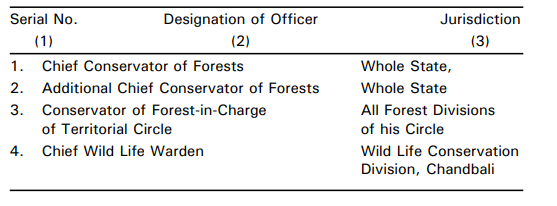
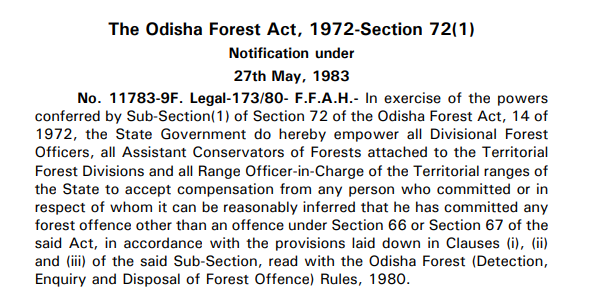
(1) Any Forest Officer specially empowered in this behalf by the State Government may accept as compensation from any person who committed or in respect of whom it can be reasonably inferred that he has committed any forest offence (other than an offence under Section 66 or Section 67 or an offence in the committing of which a vehicle has been used.
Any person found in possession of any forest produce within the limits of any reserved forest, shall, until the contrary is proved, be presumed to be guilty of removing, or as the case may be, transporting such forest produce from the reserved forests without authority.
When in any proceedings taken under this Act, or in consequence of anything done under this Act, a question arises as to whether any forest produce is the property of Government, such produce shall be presumed to be the property of Government until the contrary is proved.
Nothing in this Act shall be deemed to bar the prosecution of any person under any other law for any act or omission which constitutes a forest offence or from being liable under such other law to any highest punishment or penalty that is provided under this Act or the rules thereunder :
Provided that no person shall be prosecuted and punished for the same offence more than once.
Cattle trespassing in a reserved forest or in any portion of a protected forest which has been lawfully closed to grazing shall be deemed to be cattle doing damage to a public plantation within the meaning of Section 11 of the Cattle Trespass Act, 1871 (1 of 1871) and may be seized and impounded as such by any Forest Officer or Police Officer.
The State Government may, by notification, direct that, in lieu of the fines fixed under Section 12 of the Cattle Trespass Act, 1871 (1 of 1871), there shall be levied for each head of cattle impounded under Section 75 such fines as they think fit, but not exceeding the following, that is to say –
(1) The State Government may invest any Forest Officer with all or any of the following powers, that is to say –
(2) Any evidence recorded under Clause (d) of Sub-Section (1) shall be admissible in any subsequent trial before a Magistrate; provided that it has been taken in the presence of the accused person.
All Forest Officers shall be deemed to be :-
(1) No suit, prosecution or other legal proceeding shall lie against any Forest Officer for anything done or omitted to be done by him in good faith under this Act or the rules or orders made thereunder.
(2) No Court shall take cognizance of any offence alleged to have been committed by any Forest Officer while acting or purporting to act in the discharge of his duties under or in pursuance of the provisions of this Act or the rules or orders made thereunder, except with the previous sanction of State Government :
Provided that if the sanction or otherwise under this Sub-Section is not communicated within six months from the date the application for that purpose is made, it shall be deemed that the State Government has accorded the required sanction.
Except with the permission in writing of the State Government no Forest Officer shall, as a principle or agent, trade in timber or other forest produce or be or become interested in any lease of any forest or in any contract for working any forest, whether in or outside the State.
(1) Notwithstanding anything contained in this Act or in any other law for the time being in force, any forest land or waste land in the merged territories, which has been recognised by the Ruler or any merged State immediately before the date of merger as a reserved forest in pursuance of any law, custom, rule, regulation, order or notification for the time being in force or which has been dealt with as such in any administration report or in accordance with any working plan, or register maintained and acted upon immediately before the said date and has been continued to do so, dealt with thereafter, shall be deemed to be a reserved forest for the purpose of this Act.
(2) In the absence of any rule, order of notification under this Act, applicable to the area in question, any law, custom, rule, regulation, order or notification mentioned in Sub-Section (1) shall notwithstanding anything in any law to the contrary, be deemed to be validly in force as if the same ha
(1) The State Government may make rules :
(2) All rules made under this Act shall, as soon as may be after, they are made, be laid before the State Legislature for a total period of fourteen days which may be comprised in one session or in two or more successive sessions and if during the said period, the State Legislature makes modifications, if any, therein, the rules shall thereafter have effect only in such modified form, or, however, that such modifications shall be without prejudice to the va
Any person contravening any provision of this Act or the Rules made thereunder for the contravention of which no special penalty is provided, shall be punishable with imprisonment for a term which may extend to two months or with fine which may extend to one thousand rupees, or with both.
(1) Every person who exercises any right in a reserved or protected forest, or who is permitted to take any forest produce or to cut and remove timber from or to pasture cattle in such forest and every person who is employed by any such person in such forest and every person in any village contiguous to such forest who is employed by the Government or who receives emoluments from the Government for services to be performed to the community, shall be bound to furnish with due despatch to the nearest Forest Officer or Police Officer any information he may possess respecting the commission of, or the intention to commit any forest offence and shall forthwith take steps, whether so required by any Forest Officer or the Police Officer or not —
Whoever abets the commission of a forest offence shall be punished with the punishment provided for the offence.
If any person be entitled to a share in the produce of any forest which is the property of Government or over which the Government has proprietary right or to any part of the forest produce of which the Government is entitled, upon the condition of duly performing any service connected with such forest, such share shall be liable to confiscation in the event of the State Government being satisfied that such service is not being duly performed :
Provided that no share shall be confiscated until the person entitled thereto, and the evidence, if any, which he may produce in proof of the due performance of such service have been heard by any officer duly appointed in that behalf by the State Government.
All money, other than fines, payable to the State Government under this Act, or the expenses incurred in the execution of this Act in respect of timber or other forest produce, or under any contract relating to timber and other forest produce including any sum recoverable thereunder for the breach thereof, or in consequence of its cancellation, or under the terms of a notice relating to the sale of timber or other forest produce by auction or by invitation of tenders, issued by or under the authority of a Forest Officer and all compensation awarded to the State Government under this Act, may if not paid when due, be recovered as if it were an arrear of public demand.
(1) When any such money is payable for or in respect of such forest produce, the amount thereof shall be deemed to be a first charge on such produce, and such produce may be taken possession of by a Forest Officer until such amount has been paid.
(2) If such money is not paid when due, the Forest Officer may order such produce to be confiscated and thereupon he may sell such produce by public auction or by calling tenders.
(3) The proceeds of the sale as aforesaid shall be applied first in discharging the aforesaid dues and the balance of the dues, if any, shall be recovered, as if it were an arrear of public demand.
When any person in accordance with any provision of this Act, or in compliance with any rule, binds himself by any bond or instrument to perform any duty, or covenants by any bond or instrument that he or his employees and agents will abstain from any act, the whole sum mentioned in such bond or instrument as the amount to be paid in case of a breach of the conditions thereof may, notwithstanding anything in Section 74 of the Indian Contract Act, 1872 (9 of 1872), be recovered from him in case of such breach as if it were an arrear of public demand.
The State Government may, by notification, declare that any of the provision of this Act shall apply to any land on the banks of canals or the sides of roads which are the property of the State Government or a local authority and thereupon such provisions shall apply to such lands accordingly.
The Indian Forest Act, 1972 (6 of 1972) and the Madras Forest Act, 1882 (Madras Act 5 of 1882) hereinafter referred to as the ('said Acts') in their application to the State of Odisha are hereby repealed: Provide that -

Elevate your legal practice with advanced AI-driven research and drafting solutions. Experience unmatched efficiency, precision, and security, tailored exclusively for legal professionals.


An indispensable Tool for Legal Professionals, Endorsed by Various High Court and Judicial Officers
Please visit our Training & Support
Center or Contact Us for assistance

India’s Legal research and Law Firm App, Download now!


For Daily Legal Updates, Join us on :




 Back to top



 AI Assistant


