Searching Case Laws & Precedent on Legal Query.....!
Analysing the retrieved Case Laws
Scanned Judgements…!



Searching Case Laws & Precedent on Legal Query.....!
Analysing the retrieved Case Laws
Scanned Judgements…!
Use of Statements by Investigation Officer - Statements recorded under Section 161 CrPC are primarily for the purpose of aiding investigation and are not admissible as evidence in court, except for limited purposes such as contradiction under Section 145 of the Evidence Act. Section 162 CrPC explicitly bars the use of these statements for any purpose in inquiry or trial unless specified, emphasizing their role as safeguards against police misconduct ["2024 0 Supreme(SC) 281"], ["2023 0 Supreme(All) 1679"], ["2024 0 Supreme(Gau) 481"], ["2024 0 Supreme(Pat) 482"].
Section 162 CrPC and its Restrictions - The section restricts the use of police-recorded statements (including FIRs and statements under Section 161) in court proceedings, allowing their use mainly for contradiction or impeachment. Statements made to police are not considered substantive evidence unless exception conditions are met, such as confessional FIRs made before investigation ["2023 0 Supreme(All) 1679"], ["2021 0 Supreme(Cal) 303"], ["2024 0 Supreme(Gau) 481"], ["2024 0 Supreme(Pat) 482"].
FIR and Its Legal Status - An FIR (under Section 154 CrPC) is a crucial document marking the commencement of investigation. Information obtained after the FIR is generally considered under Section 162 CrPC, which restricts its use in court. The initial FIR is not barred by Section 162, but subsequent statements are ["2021 0 Supreme(Cal) 303"], ["2024 0 Supreme(Pat) 482"].
Use of Documents in Investigation - Investigating officers can record statements under Section 161 CrPC, but these are not substantive evidence and are mainly for investigation purposes. Any document or statement used in court must adhere to the restrictions of Section 162 CrPC, which limits their admissibility and purpose ["2024 0 Supreme(SC) 281"], ["2024 0 Supreme(Gau) 481"].
Investigation Procedure and Evidence Collection - The investigation begins with the FIR, followed by collection of statements and evidence. Statements recorded during investigation, including those in case diaries, are protected under Section 162 CrPC, and their use is limited to specific purposes such as contradiction or impeachment, not as primary evidence ["2024 0 Supreme(Pat) 482"], ["2021 0 Supreme(Cal) 303"].
Analysis and Conclusion:Statements collected by a Primary Inquiry Officer (PIO) can be used by the Investigation Officer (IO) during the investigation, but their use in court is strictly limited by Section 162 CrPC. These statements are not admissible as substantive evidence unless they fall under specific exceptions, such as confessional FIRs made prior to investigation. The legal framework emphasizes safeguarding individuals from police misconduct by restricting the use of such statements, ensuring that only properly recorded and compliant documents are used in judicial proceedings. Therefore, if the IO uses documents or statements collected by the Primary Inquiry Officer, such use must conform to the provisions of Section 162 CrPC, primarily for contradiction or impeachment purposes, not as direct evidence in trial.
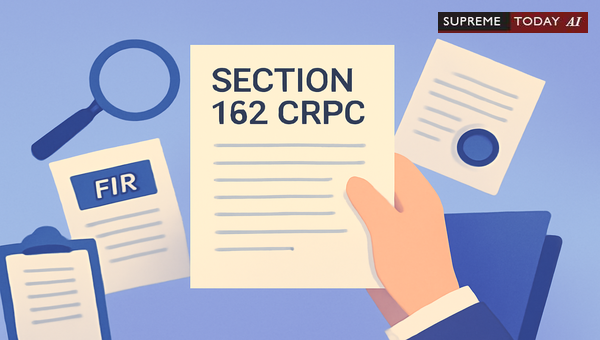
In criminal investigations under the , questions often arise about the accused's access to key documents like the (FIR), remand reports, Section 41A notices, and statements recorded under Section 161(3). A common query is: Is the accused entitled to get a copy of the FIR, , 41A CrPC notice, and 161(3) statement during the investigation stage?
This issue touches on procedural safeguards, evidentiary rules, and the balance between investigation integrity and the accused's right to a fair defense. While certain disclosures occur post- under , access during ongoing investigation is typically restricted. plays a pivotal role here, limiting the use of police-recorded statements. This post breaks down the legal position, drawing from judicial precedents and statutory provisions. Note: This is general information, not specific legal advice. Consult a qualified lawyer for your case.
Under Section 162 of the CrPC, documents collected by a during investigation can be used by the himself for certain limited purposes, such as contradicting witnesses or refreshing memory, but only within the scope and conditions prescribed by law. 2015 5 Supreme 614
Key restrictions include:- Prohibition on general use: prohibits the use of statements made to police officers in the course of investigation for any purpose at inquiry or trial, unless specifically permitted. 2008 0 Supreme(SC) 393- Limited purposes allowed: The section allows the to use such documents to contradict witnesses or refresh memory, but only when the document is duly proved and used per . 2015 5 Supreme 614- No : These cannot extend to in trial without meeting strict conditions. 2008 0 Supreme(SC) 393
This framework implies limited disclosure to the accused during investigation, prioritizing probe confidentiality.
explicitly states: No statement made by any person to a police officer in the course of an investigation... shall, if reduced to writing, be signed by the person making it; nor shall any such statement or any record thereof... be used for any purpose, save as hereinafter provided, at any inquiry or trial... 2008 0 Supreme(SC) 393
This provision safeguards against potential police overreach, ensuring statements under Section 161 are not readily admissible. For the accused, it means no automatic right to copies like 161 statements during investigation—access typically comes later via Section 207 after filing.
The has clarified: The words in 'if duly proved' clearly show that the record of the statement of witnesses cannot be admitted in evidence straightaway nor can be looked into but they must be duly proved for the purpose of contradiction by eliciting admission from the witness during and also during the of the investigating officer. 2015 5 Supreme 614
Further, courts cannot use unproved police statements: The court cannot make use of statements to police not proved and ask questions with reference to them which are inconsistent with the testimony of the witness in the court. 2008 0 Supreme(SC) 393
In practice, a 's documents can aid the main IO in challenging witnesses, but only if proved in trial via under Section 145 Evidence Act. Without this, no evidentiary value—impacting accused's defense strategy. 2022 0 Supreme(HP) 743
Several cases reinforce these limits:- Statements under Section 161 CrPC are not : Statement recorded by Police Officer under Section 161 of Cr.P.C. is not a substantive piece of evidence by itself. Charging misconduct based solely on such statements, assuming their truth, rewrites Section 162 by attaching undue presumption. 2022 0 Supreme(HP) 743- Only contradictory portions usable: Only the actual portion of the statement that contradicts the witness can be used under . Entire statement cannot be used as . This acts as a safeguard against police abuse. 2025 0 Supreme(All) 2258- Confessions inadmissible: Even if containing admissions, Section 161 statements attract Section 162 bar. Confessions to police are inadmissible. 2024 0 Supreme(Cal) 1180- No presumption of truth: Assuming 161 statements correct over court testimony violates . 2022 0 Supreme(HP) 743
In another context, confessional FIRs may benefit the accused for mitigation, distinguishing from barred investigation confessions under Section 162. 2024 0 Supreme(Mad) 2479
These rulings highlight that while accused may seek documents via court orders (e.g., under for production), routine supply during investigation is not mandated, preventing prejudice to the probe.
In trials, IOs use these documents narrowly:- To contradict witnesses during cross-exam.- Refresh memory if proved.
Exceptions and Limitations:- Cannot be without proof.- Limited to contradiction/refreshing memory.- Court cannot use without procedure. 2008 0 Supreme(SC) 393
For accused, post- disclosure under Section 207 includes 161 statements, FIR, etc., enabling preparation. During investigation, applications under (right to know accusations) may yield limited access, but courts balance interests.
Understanding these nuances empowers better navigation of CrPC proceedings. For personalized guidance, approach legal experts promptly.
References:1. 2008 0 Supreme(SC) 393: Statements to police—restrictions on use.2. 2015 5 Supreme 614: Scope of Section 162, proof requirement.3. 2022 0 Supreme(HP) 743: 161 statements not substantive; no presumption of truth.4. 2025 0 Supreme(All) 2258: Only contradictory portions usable.5. 2024 0 Supreme(Cal) 1180: Admissions in 161 statements barred.6. 2024 0 Supreme(Mad) 2479: Distinction in .
#CrPC162, #AccusedRights, #LegalIndia


The object of these sub-sections is to facilitate a fair investigation since a statement made under Section 161 of CrPC is not expected to be signed as mandated by Section 162 of CrPC. ... Failure on the part of the Investigating Officer to comply with the provisions of Section 172 CrPC is a serious lapse on his part resulting in dimi....

The High Court in the impugned judgment proceeded on the basis that a statement recorded by an investigating officer in any case which was under investigation, being a statement made under Section 161 of the Code, the same can be used for the limited purpose provided under Section 162 of the Code read ... (c) Whether Section 162 of the Cr.P.....

Thus, in view of the above, the law on the subject emerges to the effect that an FIR under Section 154 CrPC is a very important document. It is the first information of a cognizable offence recorded by the officer in charge of the police station. ... All other information given orally or in writing after the commencement of the investigation into the facts mentioned in the firs....

162 of Cr.P.C. by attaching presumption of truth to statements recorded under Section 161 of Cr.P.C - Aspect discussed above has ... been recorded in his statement under Section 161 Cr.P.C., be it incorrect and against true facts - It will amount to rewriting Section ... Under Section 162 of the Code of Criminal Procedure, the statements recorded by the Police Officer under sec....

162 of Cr.P.C. which bars their usage against the accused. ... confession can be used in favor of the accused to mitigate punishment, supporting the view that confessions do not always invoke Section ... on the ground that it is inadmissible under Section 162 of the Cr.P.C., and it is not a relied upon document by the prosecution. ... 162 of the Cr.P.C....
Only the actual portion of the statement that contradicts the witness can be used under Section 162 CrPC. Entire statement cannot be used as substantive evidence. Reinforced the purpose of Section 162 CrPC as a safeguard against police abuse. ... According to Section 162 of the Code of Criminal Procedure#H....

Therefore, even if a statement contains admission, the statement being one under Section 161, it would immediately attract the bar under Section 162 CrPC. 51. A confession made to a police officer is clearly inadmissible. ... Such evidence collected during investigation cannot be said to be a document for initiation of a criminal proceeding agisnt the....

162 Cr.P.C. ... 162 Cr.P.C. ... 162 Cr.P.C. ... The purpose for and the manner in which the police statement recorded under Section 161 Cr.P.C. can be used at any trial are indicated in Section 162 Cr.P.C. Section 162 Cr.P.C. reads as under: “162. ... The wo....

An information given under sub-section (1) of Section 154 CrPC is commonly known as first information report (FIR) though this term is not used in the Code. It is a very important document. ... notice during the investigation, will be statements falling under Section 162 CrPC. ... On completion of #....
State of Punjab reported in 1956 SCC OnLine SC 47 for the point that the statements recorded by the Police would be inadmissible under Section 162 of Cr.P.C and utmost it can be used for the purpose to corroborate the previous statement under Section 157 of Indian Evidence Act. ... It is a practise that the document writer used to show the document pri....

Detailed departmental enquiry was conducted and the inqury officer submitted its inquiry report on 7.8.2006 before the disciplinary authority. The inquiry officer found charges No.1, 2 & 5 to be proved and charges No.3 & 4 to be partly proved.

This seems to be in pari materia with section 197 Cr.P.C. and also in tune with the scope of the law laid down by the Supreme Court in its various decisions referred to earlier, while discussing the scope of section 197(1), Cr.P.C. Hence, it is clear that the intention of the Parliament was not to insist for previous approval in relation to enquiry, inqury or investigation only in relation to every offence committed by the public servant. If the intention of the Parliament was to impose a pre ....

If section 17A is interpreted as intending to cover every investigation, enquiry or inqury into any offence allegedly committed by a public servant, then it would have run counter to the spirit of all the above decisions. A contra view that section 17A covers every offence, would have resulted in a dichotomy, by which prosecution of a public officer for offences under IPC and Prevention of Corruption Act may not require sanction under section 197 (1) Cr.P.C. This seems to be ....

This Court directed the report to be given and set aside the proceedings from that stage and stated that no order for reinstatement or backwages need be passed at that stage. But in cases like the present where no departmental inqury whatsoever was held. As to backwages, on facts the position in the present case is that there is no material to say that the appellant has been gainfully employed. Karunakar’s case in our view, cannot be an authority.
The Committed deliberated upon the reliability of the complaint and assessed the evidence in full. Considering the fact and circumstances given above, I find no reason to intervene in the matter and modify the orders of the Commissioner, NVS. The Commissioner, NVS has applied his mind on the inqury report before awarding the punishment of termination. There is no merit in the contentions raised in the appeal of Sh. Paliwal.


An indispensable Tool for Legal Professionals, Endorsed by Various High Court and Judicial Officers
Please visit our Training & Support
Center or Contact Us for assistance

Scan Me!
India’s Legal research and Law Firm App, Download now!


For Daily Legal Updates, Join us on :



 Back to top


