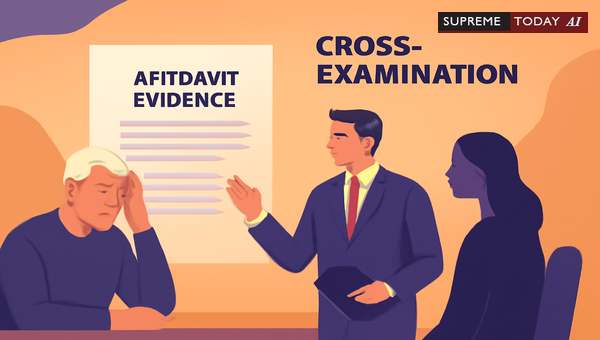
Affidavit Evidence: Admissible Without Cross-Examination?
In legal proceedings, a fundamental principle often echoed is that Evidence Shall Not be Admissible Without Cross Examination. This raises a critical question: What happens when a witness submits an affidavit in lieu of chief examination but is unable to face cross-examination due to health grounds, such as old age or illness? Does this render the evidence inadmissible?
Generally, courts in India have taken a pragmatic approach. Evidence from such affidavits can be considered admissible and relevant, provided certain conditions are met. This post delves into the nuances, drawing from key judicial precedents and legal principles under the Indian Evidence Act, 1872, and Article 142 of the Constitution. We'll explore when alternatives like cross-examination through a commissioner may be permitted, ensuring fairness without compromising justice. Note: This is general information and not specific legal advice. Consult a qualified lawyer for your case.
The Core Legal Principle: Cross-Examination's Role
Cross-examination serves as the bedrock of testing a witness's credibility, veracity, and reliability. Section 33 of the Indian Evidence Act addresses scenarios where a witness is dead, cannot be found, or is incapable of giving evidence. It allows previous testimony to remain relevant in subsequent proceedings between the same parties, if an opportunity for cross-examination existed or could be provided 2009 0 Supreme(SC) 668.
However, filing an affidavit in lieu of oral chief examination does not automatically exclude the testimony. Courts recognize that affidavits are a form of written evidence, especially useful when physical appearance is challenging 2009 0 Supreme(SC) 668. The key is judicial discretion to balance the right to cross-examine with practical realities.
When Health Issues Prevent Cross-Examination
If a witness is physically or mentally incapable due to illness or old age, evidence is not inadmissible per se. Courts may order alternative methods, such as cross-examination via a commissioner. For instance:
- In a notable case, the court permitted the investigating officer, unable to appear due to health, to be cross-examined through a Commissioner. The Commissioner was tasked with assessing the witness's capability 2009 0 Supreme(SC) 668.
- This approach fulfills the purpose of cross-examination—testing truthfulness—without mandating in-court presence 2009 0 Supreme(SC) 668.
Under Article 142 of the Constitution, courts can exercise extraordinary jurisdiction to ensure complete justice. This includes directing commissioner-led cross-examinations when traditional methods are infeasible 2009 0 Supreme(SC) 668.
Key Conditions for Admissibility
To maintain evidentiary value:- The affidavit must be relevant and given in proceedings involving the same parties.- An opportunity for cross-examination must have been available or can still be provided via alternatives.- The incapacity must be genuine, verified by medical evidence or court inquiry.
Courts emphasize that affidavits in lieu of chief examination should not be disregarded outright if health prevents appearance, especially with commissioner options 2009 0 Supreme(SC) 668.
Judicial Precedents and Insights
Case Insights on Commissioner Cross-Examination
One ruling clarifies: The court in the second document clarified that if a witness cannot be cross-examined in court due to illness or incapacity, cross-examination through a Commissioner can be ordered, and the Commissioner will assess the witness's capability 2009 0 Supreme(SC) 668. This underscores flexibility.
Another precedent notes that evidence can be considered with proper opportunity for cross-examination, and courts can limit or permit it based on circumstances 2023 2 Supreme 642.
Contrasting Views: When Evidence is Eschewed
Not all cases favor admission. In certain scenarios, courts have treated affidavit evidence as nil. For example: In those circumstances, the trial Court recorded that it treated the evidence of PW.2 as ‘nil’ and chief examination affidavit was eschewed
KOMMALAPATI BHASKARA RAO Vs INDIAN FARMWOOD PRODUCTS LTD
. This occurred when the witness's examination-in-chief via affidavit failed to meet procedural safeguards, highlighting that
availability without valid excuse can lead to exclusionKOMMALAPATI BHASKARA RAO Vs INDIAN FARMWOOD PRODUCTS LTD
.
These contrasts show courts weigh factors like prior opportunities and witness cooperation.
Limitations and Exceptions
While flexible, admissibility isn't guaranteed:- If the witness was available but refused cross-examination without valid health reasons, evidence faces stricter scrutiny 2009 0 Supreme(SC) 668.- Court discretion is paramount; affidavits can't fully replace cross-examination if the witness is capable of appearing 2023 2 Supreme 642.- Ordering a commissioner isn't automatic—it depends on proceedings' stage, health proof, and justice needs 2009 0 Supreme(SC) 668.
Parties must object timely and suggest facilitation measures. Failure to utilize granted opportunities may weaken claims 2023 2 Supreme 642.
Practical Implications for Litigants
For lawyers and parties:1. File supporting medical evidence early to justify affidavits and commissioner requests.2. Seek court directions under Article 142 proactively for alternatives.3. Prepare for commissioner proceedings, treating them as rigorous as in-court exams.
In family, civil, or criminal matters involving elderly witnesses, this approach prevents evidence loss due to incapacity, promoting access to justice.
Recommendations for Courts and Practitioners
- Courts should consider commissioner cross-examination when health issues are genuine, ensuring parties' rights 2009 0 Supreme(SC) 668.
- Provide objection opportunities and verify incapacity.
- Leverage Article 142 for innovative solutions in exceptional cases 2009 0 Supreme(SC) 668.
Conclusion and Key Takeaways
In conclusion, the mantra Evidence Shall Not be Admissible Without Cross Examination holds, but courts adapt it for health incapacities. Affidavits in lieu of chief examination generally remain admissible if cross-examination opportunities are provided via commissioners or other means, guided by judicial discretion and constitutional powers 2009 0 Supreme(SC) 668 2023 2 Supreme 642.
Key Takeaways:- Health grounds don't automatically bar affidavit evidence.- Commissioners offer a viable alternative under Article 142.- Always verify with precedents; outcomes vary by facts
KOMMALAPATI BHASKARA RAO Vs INDIAN FARMWOOD PRODUCTS LTD
.
This evolving jurisprudence balances procedure with equity. For tailored advice, engage legal experts. Stay informed on evidence law updates to strengthen your cases.
References:- 2023 2 Supreme 642- 2009 0 Supreme(SC) 668-
KOMMALAPATI BHASKARA RAO Vs INDIAN FARMWOOD PRODUCTS LTD
#EvidenceLaw, #CrossExamination, #IndianCourts