


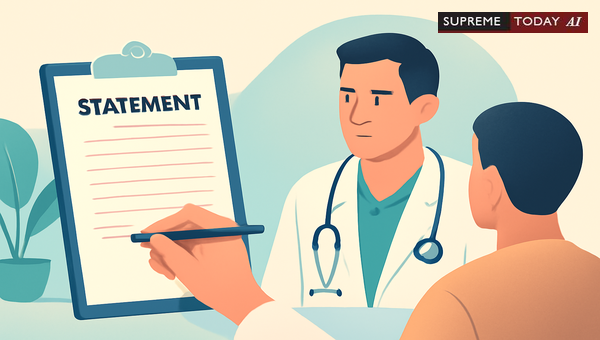
Does a Statement to a Doctor Count as an Under the ?
In legal proceedings, especially in criminal or civil cases involving injuries or incidents, statements made to medical professionals often play a pivotal role. But whether a statement before the doctor regarding the assistant would amount to is a nuanced question. Courts scrutinize such statements for their evidentiary value, balancing reliability with procedural fairness. This blog post delves into the legal principles, key criteria, and judicial precedents to provide clarity—remember, this is general information and not specific legal advice. Consult a qualified lawyer for your case.
Understanding Admissions Under the Indian
Under , an is a statement—oral, documentary, or electronic—that suggests an inference as to any or , made by a party to the proceeding. Admissions are against the maker, provided they are and relevant. However, not every casual remark qualifies; courts apply strict tests.
Statements to doctors, particularly about incidents or third parties like an 'assistant,' fall under this umbrella if they meet admissibility thresholds. As held in relevant case law, such statements can be properly admitted as an under Section 211971 0 Supreme(SC) 438. Yet, safeguards exist to prevent misuse.
Key Criteria for Admissibility of Doctor Statements as Admissions
For a statement made before a doctor to qualify as an , several conditions must align:
1. Voluntariness and Absence of
Statements must be made freely, without inducement, threat, or promise. renders statements inadmissible if extracted under such circumstances. Courts evaluate the context: Was the patient in pain? Under medication? The decision in 1971 0 Supreme(SC) 438 underscores that the question of inadmissibility under Section 26 is relevant, emphasizing nature.
2. Fitness of Mind and Physical Condition
The maker must be in a to make a reliable statement. A doctor's certification of fitness is crucial. For instance, 1978 0 Supreme(SC) 231 discusses the importance of the person's condition and the doctor's opinion regarding fitness to make a statement. Without this, reliability crumbles.
In another context, a doctor certified fitness at a specific time, but discrepancies raised doubts about ongoing suitability 2023 8 Supreme 763. Similarly, if a patient is semi-conscious, the statement may only qualify as an rather than a or 2022 Supreme(Online)(KER) 55707.
3. Relevance to the
The statement must pertain to the incident or assistant involved. Casual remarks unrelated to facts won't suffice. Courts look for direct implication, such as admitting involvement or causation.
Procedural Safeguards: The Requirement
A critical hurdle is during . The statement must be put to the witness (or maker) for explanation or denial. Failure to do so renders it unusable as an . As emphasized, the statement should be confronted with the witness, and if not, it does not amount to an 2003 6 Supreme 927 2003 0 Supreme(SC) 980.
This ensures fairness, allowing rebuttal. Non-examination of the doctor or related medical witnesses can further weaken the case, depriving the accused of challenge opportunities 2025 0 Supreme(AP) 128.
Judicial Precedents and Case Law Insights
Indian courts have consistently addressed this issue:
In 1971 0 Supreme(SC) 438, the court affirmed that statements made before a doctor can be properly admitted as an under Section 21, provided not barred by other provisions. This supports reliance on such evidence when procedural norms are met.
Contradictions between doctor statements and court testimonies undermine credibility. For example, discrepancies in injury details or examination dates cast suspicion 2023 0 Supreme(Del) 2390.
Distinguishing admissions from confessions: If such statement is an of guilt, it would amount to a whether it is communicated to another or not2019 0 Supreme(Pat) 1696 2017 0 Supreme(MP) 1167 2011 0 Supreme(Chh) 348. However, statements to doctors during treatment often remain admissions unless elevated to confessions.
In contexts, consent forms signed before doctors can imply admissions, but requests ignored by doctors complicate matters 2025 Supreme(Online)(Cal) 3995. Unchallenged doctor evidence on injuries may be deemed accepted, bolstering its weight
.
Police-related statements, like those under , are generally inadmissible as but can serve as admissions if not confessional 2025 0 Supreme(All) 2258.
These precedents highlight that while doctor statements hold value, context is king.
Limitations and Exceptions
Not all statements qualify:- Inadmissibility under Section 26: Coerced statements are out 1971 0 Supreme(SC) 438.- Lack of : Fatal flaw 2003 6 Supreme 927 2003 0 Supreme(SC) 980.- Unconscious or Unfit Makers: Limited to weak admissions 2025 Supreme(Online)(KAR) 11520.- No Hymen Examination or Gaps in Medical Evidence: Creates doubt on thoroughness 2024 0 Supreme(Gau) 1184.- FIR Statements: Not unrebutted admissions 2019 0 Supreme(Telangana) 285.
Additionally, statements to police via doctors (e.g., ruqa for ) require fitness certification 2010 0 Supreme(P&H) 418.
Practical Implications for Litigants
- Prosecution: Prove voluntariness, fitness, and to leverage these statements.
- Defense: Challenge via , highlight contradictions, or question fitness.
- Doctors as Witnesses: Their unchallenged testimony strengthens cases, but omissions (e.g., not examining key aspects) weaken them
2024 0 Supreme(Gau) 1184.
In DVC or injury cases, consistency across statements is vital 2023 0 Supreme(Del) 2390.
Conclusion and Key Takeaways
Yes, a statement before a doctor regarding the assistant can amount to an if , made in a fit state, relevant, and properly confronted 1971 0 Supreme(SC) 438. Courts uphold this under Section 21, subject to Section 26 exclusions and procedural rigor 2003 6 Supreme 927 2003 0 Supreme(SC) 980 1978 0 Supreme(SC) 231.
Key Takeaways:- Ensure doctor's fitness endorsement.- Confront the statement in .- Beware or inconsistencies.- Distinguish from confessions for evidentiary weight.
This analysis draws from established precedents, offering general guidance. Legal outcomes vary by facts—seek professional advice. For more on evidence law, stay tuned!
Key References:- 1971 0 Supreme(SC) 438- 2003 6 Supreme 927- 2003 0 Supreme(SC) 980- 1978 0 Supreme(SC) 231
#EvidenceAct #LegalAdmission #DoctorStatement












