Searching Case Laws & Precedent on Legal Query.....!
Analysing the retrieved Case Laws
Scanned Judgements…!



Searching Case Laws & Precedent on Legal Query.....!
Analysing the retrieved Case Laws
Scanned Judgements…!
MARUTI EQUIPMENTS PVT. LTD. VS STATE OF WEST BENGAL - Dishonour Of Cheque
"], ["Syndicate Bank VS K. K. Parthasarathy - Consumer
"], ["2024 0 Supreme(All) 848"].SANTOSH SHARMA VS ALLAHABAD BANK - Consumer
"], ["2024 0 Supreme(Kar) 439"].The period of limitation for filing a complaint begins from the date of the last dishonour memo or endorsement ["
Syndicate Bank VS K. K. Parthasarathy - Consumer
"], ["2025 0 Supreme(Ker) 1989"].Analysis and Conclusion:
Syndicate Bank VS K. K. Parthasarathy - Consumer
"], ["2025 0 Supreme(Ker) 1989"].References:- ["2024 0 Supreme(All) 848"]- ["2024 0 Supreme(MP) 723"]- ["1996 Supreme(Online)(SC) 20"]- ["2024 0 Supreme(Cal) 304"]- ["
SANTOSH SHARMA VS ALLAHABAD BANK - Consumer
"]- ["2024 0 Supreme(Ker) 1041"]- ["2026 Supreme(Online)(MP) 1580"]- ["2023 0 Supreme(AP) 1552"]- ["SAHADEVAN vs KUNJUKRISHNA PILLAI - Kerala"]- ["2025 0 Supreme(Ker) 1989"]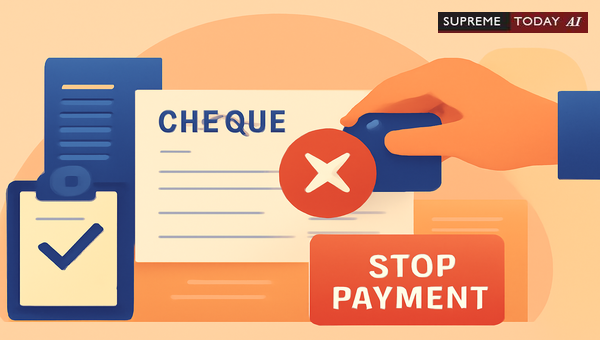
In the fast-paced world of business transactions, cheques remain a common payment method in India. However, when a cheque bounces, it can lead to serious legal consequences under of the . A frequent question arises: Does the dishonour of a cheque by endorsement such as '' or similar remarks refer to the branch, amounting to dishonour under ?
This blog post delves into the judicial stance on via endorsements like , , or . Drawing from landmark cases and statutory interpretations, we'll clarify when such endorsements trigger . Note: This is general information based on case law and not specific legal advice. Consult a qualified lawyer for your situation.
NI Act aims to promote the efficacy and credibility of banking operations by penalizing the dishonour of cheques due to insufficient funds or other specified reasons. The provision is triggered when a cheque is returned unpaid by the bank, typically with an endorsement explaining the cause.
Courts have consistently held that certain bank endorsements equate to dishonour. For instance, phrases like , , or are not mere clerical notes but legally significant indicators. As established in key judgments, these endorsements invoke the offence under 1998 2 Supreme 471.
The Indian judiciary, particularly the , has outlined specific endorsements that constitute dishonour:
: This politely signals that the cheque cannot be honoured, often due to insufficient funds. It explicitly refers the matter back to the drawer (issuer), triggering 1999 4 Supreme 378. In Modi Cements Ltd. v. Kuchil Kumar Nandi, the clarified: endorsements like 'referred to drawer,' 'instructions for stoppage of payment,' and '' are regarded as dishonour within the scope of 1999 4 Supreme 378.
or Instructions for Stoppage of Payment: Even if funds exist, stopping payment post-issuance amounts to dishonour. The arises, and the drawer must rebut it 1998 2 Supreme 471.
or : These directly point to inadequate balances, solidifying dishonour 1996 1 Supreme 744.
In Electronics Trade & Technology Development Corporation Ltd. v. Indian Technologists & Engineers (Electronics), it was reinforced: such endorsements amount to dishonour within the meaning of of the Act 1996 1 Supreme 744.
The phrase is elastic but commonly implies insufficiency of funds. In one case, the court noted: in business it is well known that the expression '' is employed by a bank to convey courteously that the cheque issued by a customer cannot be honoured on the ground of insufficiency of funds. It is quite possible that the expression '' may be elastic enough to take within its sweep, certain other contingencies also 2003 0 Supreme(Mad) 582. Non-mention of these exact words in a complaint isn't fatal if the endorsement implies dishonour 2003 0 Supreme(Mad) 582.
Stop payment instructions post-issuance don't absolve the drawer. As held: Once the cheque has been drawn and issued to the payee and the payee has presented the cheque and thereafter, if any instructions are issued to the bank for non-payment and the cheque is returned to the payee with such an endorsement, it amounts to dishonour of cheque and it comes within the meaning of 1998 0 Supreme(AP) 12
KUSUM INGOTS VS State OF A. P.
.The onus shifts to the drawer to prove no dishonest intent, a question of fact determined at trial 1998 0 Supreme(AP) 12.
Endorsements extend beyond insufficiency:
or Frozen: Even or constitutes dishonour. A complaint is maintainable for frozen accounts, with the accused bearing the burden to prove circumstances 2024 0 Supreme(J&K) 328. The court emphasized: dishonour due to reasons beyond the drawer's control does not exempt liability under 2024 0 Supreme(J&K) 328.
Multiple Presentations: A cheque can be presented multiple times within . Initial dishonour doesn't bar re-presentation, and arises per (c)
. Dishonour of cheque – Within cheque may be presented several times
.
These rulings ensure unscrupulous drawers can't evade liability by manipulative tactics like stop payments without funds
KUSUM INGOTS VS State OF A. P.
.While robust, there are nuances:- Endorsements must be bank-stamped and documented properly.- Drawers may rebut presumptions under (e.g., proving no debt), but this requires evidence at trial.- still implies insufficiency if post-issuance
.
Mere claims that the endorsement wasn't valid fail; courts prioritize the statutory object of banking credibility 1996 1 Supreme 744.
To navigate cheque-related disputes:- Examine Returned Cheques Thoroughly: Note endorsements like or – they form the basis for complaints 1998 2 Supreme 471.- Issue Legal Notice Promptly: Within 30 days of dishonour, demand payment within 15 days (per (b)).- Preserve Bank Memos: Retain originals as evidence.- Re-Present if Viable: Within validity period, especially if initial bounce was for stop payment
.- Seek Settlement: Many cases resolve pre-trial, but document everything.
Banks should clearly endorse reasons to aid legal proceedings.
Endorsements such as , , or are firmly recognized as under NI Act, enabling criminal proceedings upon notice and non-payment 1999 4 Supreme 378 1996 1 Supreme 744. This upholds transactional trust, deterring casual cheque issuance.
Key Takeaways:- Such endorsements trigger – rebuttal is drawer's burden.- Applies to stop payments, frozen accounts, and more 2024 0 Supreme(J&K) 328.- Multiple presentations allowed within
.
Disclaimer: Legal outcomes depend on facts; this overview isn't advice. For tailored guidance, contact a legal expert.
References:- 1998 2 Supreme 471, 1996 1 Supreme 744, 1999 4 Supreme 378,
, 2024 0 Supreme(J&K) 328, 2003 0 Supreme(Mad) 582,
, 1998 0 Supreme(AP) 12,
KUSUM INGOTS VS State OF A. P.
Stay informed, issue cheques responsibly, and protect your financial interests.
#ChequeBounce, #NIAct138, #ReferToDrawer


Branch Bhatiya Road, Ghaziabad, same was presented before the bank on 11.07.2023, but the same was returned by the bank on 12.07.2023 with the endorsement 'account closed'. ... Ltd. and another, 1996 (2) SCC 739, observed that if cheque is returned by the bank which was issued in discharge of any liability with the endorsement, (1) 'refer to the drawer of cheque' (2) 'instructions for stop payment' and (3) 'exceeds arrangements'. ... (1) in this case, “refer to the dr....

On the first occasion, the cheque was returned with an endorsement "Insufficient Funds and Drawer Signature differ" and on re- presentation, the cheque was returned with an endorsement of "Insufficient Funds and Alteration Requires Full Signature". ... Just as dishonour of a cheque on the ground that the account has been closed is a dishonour falling in the first contingency referred to in a href="./.. ... The said cheque was presented and the same ....

It is seen that once the cheque has been drawn and issued to the payee and the payee has presented the cheque and thereafter, if any instructions are issued to the bank for nonpayment and the cheque is returned to the payee with such an endorsement, it amounts dishonour of cheque and it comes within ... like (1) in this case, "I refer to the drawer" (2) "instructions for stoppage of payment" and (3) "stamp exceeds arrangement", it amounts to dishonour#HL_END....
The cheque was presented on 21.07.2020 in Union Bank of India, Branch Raniganj, Rewa, but was dishonoured vide return memo dated 23.07.2020 with the endorsement “Funds Insufficient”. A statutory demand notice dated 04.08.2020 was duly served upon the applicant on 06.09.2020. ... Act and there is no exclusion carved out for cheques bearing the endorsement “Not Negotiable”. The endorsement “Not Negotiable” does not render the cheque non-existent or invalid. ... Even then, such #HL_START....

There was no endorsement whatsoever made by the drawee bank in the cheque, to show that it was a stale one. ... When that cheque was sent for collection through his bank i.e. Dhanlaxmi Bank, Cherthala Branch on 20/2/2002, it was returned dishonoured for the reason ‘Payment stopped by the drawer’, as per Ext.P3 dishonour memo dated 25/2/2002. ... "The" would, therefore, refer implicitly to a specified bank and not to any bank. ... Dishonour on a subsequent date will no....

The L.I.C. of India deposited the said cheque on the next day with its banker, Bank of India, Chirkunda Branch, through pay-in-slip No. 11794. On 20.3.2004 the Bank of India, Chirkunda branch returned the cheque with cheque return memo from Allahabad Bank with endorsement Refer to Drawer . ... Hence, we have gone into this aspect of the matter and found that admittedly the said bank on account of sudden technical fault in computer on 18.3.2004 same day returned the #H....

Dishonour of cheque for insufficiency, etc., of funds in the account. ... The petitioner duly presented the Cheque bearing No. 242559 dated 30th March, 2013 for encashment with his Bank Syndicate Bank, Barrackpore Branch, but the said Cheque was returned by the bank on 2nd April, 2013 with an endorsement “Account Closed” vide a cheque returning Memo. ... The cheque return memo clearly bears the date of dishonour as 02.04.2013. 34. .....

(b) Ex.B4-Legal notice would show that, on 21.04.2011 also the cheque was returned with same endorsement as that of 21.12.2010. But the cheque was not returned for the same endorsement on 21.12.2010 and 21.04.2011. ... not match the signatures on the cheque would constitute a dishonour within the meaning of Section 138 of the Act.” ... Just as dishonour of a cheque on the ground that the account has been closed is a dishonour fallin....
Dishonour of cheque for insufficiency, etc., of funds in the account. ... In the present case, the complainant had not filed the complaint on the dishonour of the cheque in the first instance, but presented the said cheque again for encashment. ... At this juncture, it would be apt to refer the provisions of Section 94 of the Act, the same are quoted below:— 94. Mode in which notice may be given. ... ‘2. … whether the payee or holder of a cheque can initiate prosecu....

The petitioner presented the said cheque for encashment with his bank but the same was dishonoured by the banker of the respondent vide memo dated 14.07.2014 with the endorsement ‘Account Frozen’. ... Dishonour of cheque for insufficiency, etc., of funds in the account. ... likewise a complaint can be filed, even in case of dishonour of cheque due to frozen account. ... Learned counsel for the respondent has submitted that the cheque was dishonoured not because of th....

As I have already adverted to, in business it is well known that the expression “refer to drawer” is employed by a bank to covey courteously that the cheque issued by a customer cannot be honoured on the ground of insufficiency of funds. It is quite possible that the expression “refer to drawer” may be elastic enough to take within its sweep, certain other contingencies also. 9. While considering this question first of all, the endorsement on the cheque is important. The cheque is dishonoured with the endorsement “refer to drawer”.
(2) Whether the cause of action arises from the date of dishonour of the Cheque or after 15 days as is provided under Section 138, 138(b) & 138(c) of the NI Act ? (1) Whether the endorsement "account closed" gives rise to a meaning, amounting to dishonour of cheque or the account is insufficient to honour the cheque ? 5. In the light of the submissions, the short point for consideration that arise.

Section 138 draws presumption that one commits the offence if he issues the cheque dishonestly. Once the cheque has been drawn and issued to the payee and the payee has presented the cheque and thereafter, if any instructions are issued to the bank for non-payment and the cheque is returned to the payee with such an endorsement, in amount to dishonour of cheque and it comes within the meaning of Section 138. It, after the cheque is issued to the payee or to the holder in due course and before it is presented for encashment, notice is issued to him not to present the same fo....
Once the cheque has been drawn and issued to the payee and the payee has presented the cheque and thereafter, if any instructions are issued to the bank for non-payment and the cheque is returned to the payee with such an endorsement, in amount to dishonour of cheque and it comes within the meaning of Section 138. It, after the cheque is issued to the payee or to the holder in due course and before it is presented for encashment, notice is issued to him not to present the same for encashment and yet the payee or holder in due course presents the cheque to the bank for payme....


An indispensable Tool for Legal Professionals, Endorsed by Various High Court and Judicial Officers
Please visit our Training & Support
Center or Contact Us for assistance

Scan Me!
India’s Legal research and Law Firm App, Download now!


For Daily Legal Updates, Join us on :



 Back to top


