


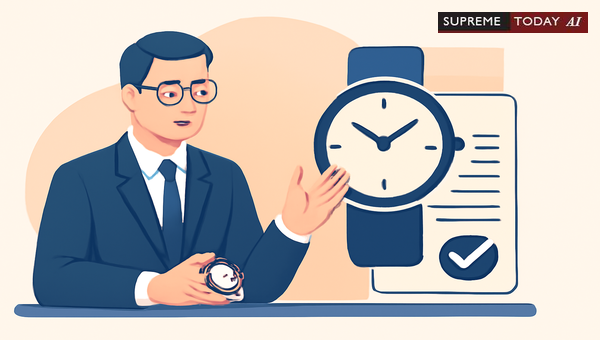
Can Watch Technician Evidence Be Expert Testimony in Indian Courts?
In legal disputes involving luxury goods, trademarks, or consumer complaints, questions often arise about identifying a product's authenticity. Imagine a scenario where a watch technician testifies that a disputed wristwatch was manufactured by a specific brand. Can his evidence be treated as ? This is a common query in cases, theft prosecutions, or claims under Indian law.
This blog post examines the of such testimony, drawing from . While courts assess expertise based on knowledge, experience, and reliability, not every technician automatically qualifies as an 'expert.' We'll explore relevant cases, general principles under the , and practical considerations. Note: This is general information, not legal advice. Consult a qualified lawyer for specific cases.
Understanding Under Indian Law
Section 45 of the , allows opinions of experts in matters requiring specialized knowledge, such as science, art, foreign law, or technical fields. Courts determine if a witness is an 'expert' based on:
- Specialized training or experience in the field.
- Relevance to the issue at hand (e.g., brand origin via manufacturing marks).
- Reliability and corroboration, avoiding '.'
A watch technician might qualify if they demonstrate deep knowledge of watch mechanics, branding, and authentication methods. However, mere repair experience may not suffice for complex trademark analysis. Courts often demand objective tests or lab reports over subjective opinions.
The Primary Case: No Direct Ruling on Expert Testimony
In a notable criminal matter under the involving theft of a wristwatch from an unregistered parcel, the court convicted the appellant based on admissions, recipient contact, and . Crucially, there is no indication that expert testimony, such as that from a watch technician, is admissible or inadmissible as evidence1976 0 Supreme(SC) 203. The judgment focused on factual proofs like the appellant's admission to opening the parcel and retaining the watch, without referencing expert witnesses.
Key observations:- Evidence relied on direct testimonies and admissions, not technical analysis.- No discussion on trademark or brand identification, as it was a straightforward theft case.
This absence highlights that isn't always necessary but doesn't preclude its use in brand-specific disputes. The document does not provide any legal rule or precedent on the of expert testimony in trademark cases1976 0 Supreme(SC) 203.
Insights from Consumer Protection Cases: Emphasis on Reliable Proof
Consumer forums frequently encounter watch repair disputes, underscoring the need for expert backing. In one appeal, the noted that complainants failed to prove any deficiency in service... supported by any believable evidence or any evidence of an expert regarding Cartier watches
Vivek Sud VS Rajan Watch Co.
. The dismissed claims partly because no was brought on record by the complainant to prove that the watches remained non-functional even after carrying out repairsVivek Sud VS Rajan Watch Co.
.Similarly, in a case:
The watch was not sent to any approved laboratory to ascertain whether it suffered from or not... No is adduced before the Forum below to prove a case that there was for the watch.
The forum's assumption of defect without lab tests or expert input was overturned. In absence of any , would not be justified to reach a conclusion that wrist watch... suffered only on assumption
. These rulings stress that technician opinions must be substantiated, not mere assertions.
Criminal Cases: Scrutiny of Watch Repairer Testimony
In criminal contexts, watch repairers' evidence faces rigorous testing. For instance, in a murder appeal, a repairer identified a watch via his mark ARS, but the court deemed it unconvincing:
Watch repairer said that the mark 'ARS' was put by him on each watch... If he put the mark on all watches repaired by him he could give no reason to say that the watch belonged to Allauddin. 1971 0 Supreme(SC) 181
Another witness recalled the watch number only after seeing it in court, rendering the identification unreliable. In a smuggling case, an HMT expert opined that watches did not contain the HMT movements... watch movements are not manufactured in India
Standard Watch Co. VS Collector of Customs
. While accepted here, it was tied to technical disassembly, not casual inspection.In a robbery acquittal, proving a recovered watch belonged to the victim required owner identification during trial, beyond technician input 2009 0 Supreme(Del) 1360. These cases illustrate that technician evidence may qualify as expert if corroborated but often fails without it.
Qualification Criteria for Watch Technicians as Experts
Courts apply a multi-factor test:
- Experience Level: Years repairing specific brands? Familiarity with serial numbers, movements, or hallmarks?
- Methodology: Did they use tools like microscopy or compare against authentic samples?
- Independence: No bias from prior dealings?
- Corroboration: Lab reports, purchase documents, or multiple experts?
In trademark suits, technicians might opine on '' or counterfeits, but IP courts prefer certified gemologists or brand-authorized experts. General repairers risk rejection as 'interested' or unqualified.
Practical Recommendations and Limitations
- For Litigants: Bolster technician testimony with forensic reports or brand affidavits. Avoid relying solely on oral opinions.
- Jurisdictional Note: Rules vary; consumer forums are lenient but evidence-centric, while High Courts demand rigor.
- Limitations from Sources: Most cases (e.g., theft 1976 0 Supreme(SC) 203, dowry 2015 0 Supreme(Bom) 1025) don't directly address trademarks, focusing instead on general evidentiary standards like trustworthy and corroborated evidence.
Key Takeaways
- A watch technician's brand identification may be treated as if they prove specialized skill and reliability, per Section 45, Evidence Act.
- Absent direct precedent in theft cases 1976 0 Supreme(SC) 203, consumer rulings demand experts for defects
.
- Criminal identifications often falter without corroboration 1971 0 Supreme(SC) 181.
- Always pair with objective proof to enhance .
Conclusion
While a watch technician can potentially serve as an expert witness on brand origin, success hinges on demonstrated expertise and supporting evidence. Indian courts prioritize substance over labels, as seen across consumer and criminal precedents. For trademark battles, invest in robust authentication to avoid dismissals. Stay informed on evolving jurisprudence, and seek professional counsel to navigate these nuances effectively.
#ExpertEvidence #WatchTechnician #IndianLaw















