


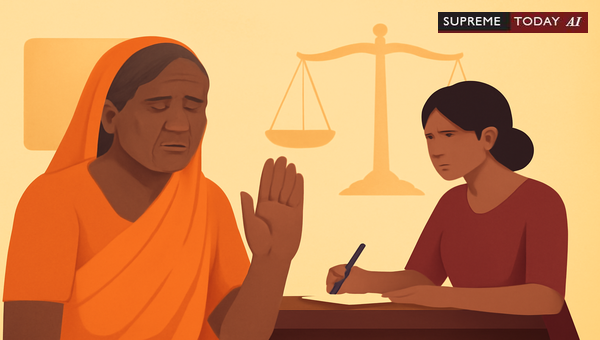
How Courts Value Rustic Illiterate Women's Testimony in India
In the Indian judicial system, witness testimony forms the backbone of many criminal cases, particularly in rural settings where eyewitnesses often come from humble, uneducated backgrounds. Imagine a village incident where an elderly, illiterate woman provides crucial details—but her account has minor inconsistencies. Does this mean her entire statement should be discarded? The question of arises frequently, highlighting how courts must balance scrutiny with empathy.
This blog post delves into the legal principles guiding the evaluation of such testimonies. Drawing from landmark judgments and additional case insights, we'll explore why minor errors don't automatically undermine credibility, and how courts adopt a holistic approach. Note: This is general information based on case law and not specific legal advice. Consult a qualified lawyer for your situation.
The Core Legal Principle:
Indian courts have consistently held that the testimony of old, rustic, illiterate women witnesses should be evaluated as a whole, rather than fixating on . These witnesses, often from rural backgrounds with limited education, are prone to small mistakes in narration or identification due to factors like shock, agitation, or lack of legal awareness. However, this does not render their evidence unreliable.
As emphasized in key judgments, in the testimony of rustic, illiterate witnesses are common and should not be overemphasized2023 7 Supreme 433. Courts are directed to consider:- The witness's social and educational background.- Their mental state during the incident, such as emotional distress from witnessing violence.- Circumstances like rural settings where precise recall may not be expected.
In , the Court noted: > Being a rustic woman, in that agitated mood she might have committed one or two mistakes in the actual identification or as to who chased accused 1 or accused 2. These, in our considered view, are bound to happen. 2023 7 Supreme 433
This underscores that —such as slight variations in describing events—should not lead to outright rejection, especially when the core testimony rings true.
Key Case Law Insights
: A Landmark View
The judgment in provides a foundational perspective: The evidence of such witnesses has to be appreciated as a whole. A rustic witness is not expected to remember every small detail of the incident and the manner in which the incident had happened2023 7 Supreme 433.
Further, it highlights emotional factors: > A witness is bound to face shock of the untimely death of his near relatives. Therefore, the court must keep in mind all these relevant factors while appreciating evidence of a rustic witness. 2023 7 Supreme 433
Other Supporting Precedents
In Krishna Master, the ruled that discrepancies on trivial matters should not lead to rejection of the entire testimony, especially when the evidence appears to have a 2021 8 Supreme 698. Similarly, observed that minor contradictions are natural in the testimony of rustic witnesses and should be appreciated in their proper context2023 7 Supreme 433.
Additional cases reinforce this. For instance, in a matter, a rustic and illiterate woman (P.W.2) was the in a sensitive case. Her testimony was deemed reliable despite her background, as she promptly informed family after the incident
. Courts noted her involvement in simple avocations like fishing, emphasizing contextual evaluation
.
In another case, the informant—a rustic and tribal woman—was accepted as credible. The trial Court, on appreciation of the evidence, found her reliable despite being an 2022 Supreme(Online)(Bom) 7706.
Integrating Broader Judicial Trends from Other Sources
Recent judgments echo these principles. In proceedings, appreciation of women witnesses unacquainted with legal ways was highlighted, akin to pardanasheen women, where the has to be reversed for certain classes
. This shows empathy for vulnerable witnesses.
Sources also point to consistent patterns:- Testimony of rustic, illiterate women witnesses is considered natural, trustworthy, and credible, despite minor contradictions due to lack of formal education 2024 Supreme(Online)(Bom) 7915 2021 Supreme(Online)(MAD) 1519 2024 Supreme(Online)(MP) 35576 2023 Supreme(Online)(MAD) 508 2024 Supreme(Online)(MP) 35487.- Their immediate reporting and consistent narratives bolster reliability, especially in crimes like sexual assault or accidents 2024 Supreme(Online)(Bom) 7915 2024 Supreme(Online)(Mad) 61482 2024 Supreme(Online)(MP) 35487.- Courts value natural, unembellished accounts, corroborated by circumstances, without discarding due to minor inconsistencies from lack of legal awareness 2024 Supreme(Online)(Bom) 7915 2021 Supreme(Online)(MAD) 1519.
A observation notes societal factors affecting women: A confluence of factors like lack of legal awareness, scant knowledge of inheritance right and years of societal conditioning have worked against helpless women
. This contextual lens applies to criminal testimonies too.
Practical Considerations and Exceptions
When appreciating such evidence, courts typically consider:- No expectation of photographic memory—rustic witnesses rely on general impressions.- Influence of social, educational, and emotional factors on observation.- Minor mistakes like misnaming accused or timeline variations are understandable and not indicative of falsehood.
However, leniency has limits. Discrepancies that go to the heart of the case or contradict overall evidence may warrant deeper scrutiny. The core must remain consistent and corroborated. As one analysis concludes, courts adopt a lenient approach for immediate reporting and consistency, ensuring proper appreciation without bias against background 2024 Supreme(Online)(Bom) 7915 2021 Supreme(Online)(MAD) 1519.
Recommendations for Judicial Practice
- Adopt a holistic approach, factoring in background and circumstances.
- View through the lens of emotional state and rural life.
- Prioritize overall consistency over isolated errors.
Conclusion and Key Takeaways
The appreciation of old, rustic, illiterate women witnesses underscores a humane judicial ethos in India. By recognizing natural limitations and valuing truthful cores, courts uphold justice for vulnerable voices. Key takeaways:1. Minor errors are normal—don't overemphasize them 2023 7 Supreme 433.2. Evaluate holistically, considering context 2021 8 Supreme 698.3. Credibility stems from consistency and corroboration, not perfection.
This approach not only ensures fair trials but also empowers marginalized witnesses. For case-specific guidance, always seek professional legal counsel.
References
- 2023 7 Supreme 433 – Core judgment on rustic witness appreciation.
- 2021 8 Supreme 698 – Principles on trivial discrepancies.
, 2022 Supreme(Online)(Bom) 7706,
, 2024 Supreme(Online)(Bom) 7915, 2021 Supreme(Online)(MAD) 1519, and others as cited.












