



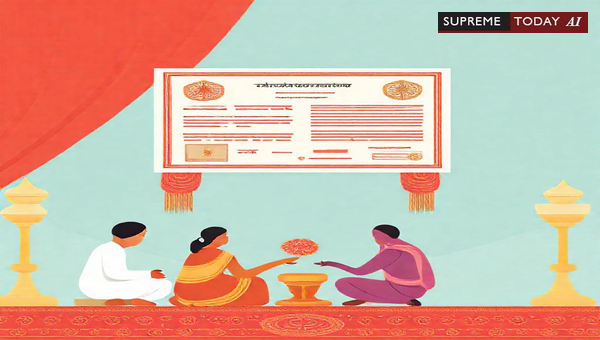
Legal Validity of Marriage Certificates Issued by Arya Samaj Under the Hindu Marriage Act
In recent years, Arya Samaj temples have become popular venues for couples seeking to formalize their relationships through quick ceremonies that avoid elaborate traditional festivities. While these institutions provide a spiritual and social platform for union, a critical legal misunderstanding often persists regarding the documentation they provide. Many couples believe that the certificate issued by the temple serves as a legally binding proof of marriage in the eyes of the state. However, this brings us to a pivotal legal question: Does Arya Samaj have the jurisdiction to issue marriage certificates?
Based on extensive judicial precedents and statutory frameworks, the answer is a resounding no. While Arya Samaj is empowered to solemnize marriages according to specific rites, its certificates lack the statutory authority required to serve as conclusive evidence of a legal marriage. This distinction between the act of and the issuance of a legal certificate is vital for anyone navigating family courts, inheritance claims, or maintenance proceedings.
The Statutory Framework for Hindu Marriages
To understand why an Arya Samaj certificate is insufficient, one must look at the laws governing Hindu unions. Under the (HMA), the validity of a marriage is not determined by a piece of paper, but by the performance of essential ceremonies.
The Role of Essential Rites
mandates that for a marriage to be legally recognized, specific customary rites must be performed. The most critical of these is (the seven steps around the sacred fire). The law is clear: mere documentation or the possession of a certificate cannot substitute for these mandatory rituals 2014 0 Supreme(Bom) 2270. Without proof that these rites occurred, the marriage may not be recognized as valid under the law.
The
The was designed to validate marriages performed by Arya Samajis according to their specific customs. However, this Act grants the power of , not the power of certification. Courts have repeatedly clarified that the does not contemplate issuance of marriage certificate 2016 0 Supreme(MP) 611.
In essence, there is a fundamental difference between a religious body conducting a ceremony and a government authority issuing a legal record. The former is a matter of faith and custom; the latter is a matter of statutory jurisdiction.
Judicial Perspective on the of Certificates
Indian courts have consistently held that Arya Samaj marriage certificates lack standalone . They are often viewed as mere pieces of paper unless supported by independent evidence of the marriage rites.
Certificates Do Not Prove Marriage
In several appeals, judges have noted that a certificate from an Arya Samaj Mandir does not automatically establish a marital relationship. For instance, the courts have ruled that The Certificate issued by the Arya Samaj Mandir... does not by itself prove marriage
Shruti Agnihotri VS Anand Kumar Srivastava
2025 Supreme(Online)(Tel) 66801. In such cases, if no priest or witnesses are produced to confirm the performance of the rites, the certificate is rendered invalid as proof of marriage.Furthermore, judicial observations suggest that such certificates have no meaning unless and until prerequisites for a valid Hindu marriage are completed/satisfied and proved 2024 0 Supreme(All) 1015.
Risks of Fraud and Invalidity
The lack of statutory oversight in temple-issued certificates has led to instances of misuse. Courts have flagged cases where certificates were issued in violation of the or were entirely fraudulent 2022 0 Supreme(MP) 1369. In other proceedings, courts found that an alleged Arya Samaj certificate and corresponding registration entry did not establish a valid marriage because the trial court erred in treating the document as 2025 Supreme(Online)(MP) 11147.
Why Arya Samaj Certificates Fail the Legal Test
There are four primary reasons why these documents generally fail to satisfy the requirements of a court of law:
- Lack of Statutory Backing: Unlike a government registrar appointed under Section 8 of the HMA or the , Arya Samaj is not a notified statutory authority with the power to create a legal record of marriage 2021 Supreme(Online)(MP) 8551.
- Evidentiary Weakness: In the eyes of the law, the proof of a marriage is the ceremony itself. Courts typically require witnesses, photographs, or video evidence of the to validate a union; a certificate alone is insufficient 2025 0 Supreme(All) 2375.
- Vulnerability to Manipulation: Because these certificates are issued privately, there are higher risks of forgery, underage marriages, and lack of genuine consent. Consequently, courts often direct the verification of Aadhaar cards, age proofs, and explicit consent 2025 0 Supreme(All) 2305.
- Limited Judicial Scope: In Habeas Corpus petitions involving runaway couples, courts have emphasized that while they respect the power of Arya Samaj to solemnize marriages, the judiciary cannot create new legislation or rules to make those certificates legally binding 2017 0 Supreme(MP) 972 and 2017 0 Supreme(MP) 189.
Practical Steps for Ensuring Legal Validity
For couples who have married through an Arya Samaj ceremony, relying solely on the temple certificate is a legal risk. To ensure the marriage is recognized for all legal purposes, the following steps are typically recommended:
- Official Registration: Promptly approach the Sub-Registrar's office under the Hindu Marriage Act (HMA) to obtain an official government marriage registration.
- Preservation of Evidence: Maintain a detailed record of the ceremony, including high-quality photographs and videos showing the and other essential rites.
- Witness Affidavits: Keep contact information and, if necessary, sworn affidavits from the priest and witnesses who attended the ceremony.
Without these steps, a couple may find themselves in a precarious position during divorce proceedings, claims for maintenance, or disputes over succession and inheritance.
Key Takeaways
The core of the issue is a conflict between religious practice and statutory law. While an Arya Samaj ceremony can be spiritually and customarily valid, the jurisdiction to issue a legal marriage certificate remains exclusively with government-notified authorities.
- $\neq$ Certification: Arya Samaj can perform the wedding, but it cannot legally certify it.
- Rites over Paper: Courts prioritize evidence of essential ceremonies (like ) over a temple certificate.
- Statutory Registration is Essential: Only registration under the HMA or provides the legal security needed for civil proceedings.
This analysis is based on a synthesis of public case law and should be treated as general information. Because legal outcomes depend heavily on individual facts and specific state rules, couples should seek professional legal counsel to secure their marital status.
#AryaSamajMarriage #HinduMarriageAct #MarriageLawIndia #LegalValidity










