Searching Case Laws & Precedent on Legal Query.....!
Analysing the retrieved Case Laws
Scanned Judgements…!



Searching Case Laws & Precedent on Legal Query.....!
Analysing the retrieved Case Laws
Scanned Judgements…!
The assessment of disability percentage can vary; in some cases, medical certificates or expert opinions are crucial for determining the extent and nature of disability 2023 1 Supreme 555, 2024 0 Supreme(Mad) 546, 2023 0 Supreme(P&H) 2371.
Analysis and Conclusion:
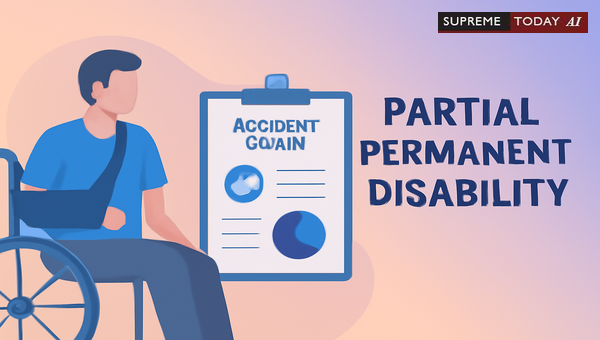
Imagine surviving a car crash or workplace accident, only to face ongoing limitations in daily tasks or work. What does mean in legal terms, and how does it affect your compensation claim? If you're navigating an accident claim, understanding Definition in Accident Claim Cases is crucial for securing fair compensation.
This blog post breaks down the concept, drawing from key legal precedents and principles. We'll explore definitions, assessments, distinctions from , and the critical link to earning capacity. Note: This is general information, not specific legal advice. Consult a qualified attorney for your case.
refers to a lasting condition from an accident that reduces an injured person's ability to perform some duties or bodily functions they could before the incident, but not all. The individual remains capable of some gainful activity, distinguishing it from more severe impairments.
As clarified in legal documents, refers to a person's inability to perform all the duties and bodily functions that he could perform before the accident, though he is able to perform some of them and is still able to engage in some gainful activity 2022 8 Supreme 632 2022 0 Supreme(SC) 1169. This definition emphasizes — the person isn't fully incapacitated.
In broader contexts, such as under statutes referencing the , injury includes or sickness resulting out of an accident2022 0 Supreme(All) 784 2017 0 Supreme(MP) 433 2016 0 Supreme(MP) 941 2014 0 Supreme(All) 1581. This statutory inclusion highlights its relevance in compensation frameworks.
Total permanent disability renders a person incapable of any employment or gainful activity, often due to severe, whole-body impairment. In contrast, allows for some residual function.
Courts distinguish this clearly: partial involves reduction in ability for some duties, while total means no capacity for employment 2023 1 Supreme 555 2013 4 Supreme 665. For example, a worker with a 25-30% permanent partial disability to a limb might still work in adjusted roles, but would preclude all work 2023 0 Supreme(AP) 284.
This differentiation is vital in claims, as it affects compensation schedules under acts like the or Workmen's Compensation Act 2023 1 Supreme 555 2023 0 Supreme(AP) 130 2022 0 Supreme(AP) 446.
Disability is typically quantified as a percentage relative to the affected limb or body part, not the whole body. For instance, When a states that the injured has suffered permanent disability to an extent of 45% of the left lower limb, it is not the same as 45% permanent disability with reference to the whole body 2023 1 Supreme 555 2013 4 Supreme 665.
The sum of percentages across limbs cannot exceed 100%, focusing on per part. Assessment relies on medical evidence, such as disability certificates and expert opinions 2023 1 Supreme 555 2024 0 Supreme(Mad) 546 2023 0 Supreme(P&H) 2371. In one case, an accident led to permanent partial disability, supported by medical records post-incident 2016 0 Supreme(Guj) 967.
However, certificates alone may not suffice if they lack clarity on permanence or partial nature, requiring further evidence evaluation 2023 0 Supreme(AP) 130 2023 0 Supreme(P&H) 2371.
A common misconception is equating physical disability percentage directly with economic loss. Courts stress this mismatch: The percentage of physical or functional disability of a limb or body part does not automatically translate into a corresponding percentage of 2023 1 Supreme 555 2013 4 Supreme 665.
demands a holistic review of:- Profession: Manual labor vs. desk job impacts differ 2023 1 Supreme 555.- Age and Education: Younger, skilled workers may adapt better.- Functional Impact: How the impairment affects specific work duties 2023 0 Supreme(AP) 130 2022 0 Supreme(AP) 446 2024 0 Supreme(Guj) 109.
The holds: The percentage of economic loss, that is, percentage of , arising from a permanent disability will be different from the percentage of permanent disability 2023 1 Supreme 555 2013 4 Supreme 665. must avoid , analyzing evidence thoroughly 2023 1 Supreme 555 2024 0 Supreme(Gau) 141.
From additional insights, this separation ensures fairness: disability percentages guide physical impairment, but earning loss reflects real-world vocational impact 2023 1 Supreme 555 2023 0 Supreme(AP) 130 2023 0 Supreme(Guj) 773.
Judicial precedents reinforce individualized assessments. should decide: (i) if disablement is permanent or temporary; (ii) if permanent, total or partial 2023 0 Supreme(AP) 284. Medical and occupational evidence is paramount 2023 1 Supreme 555 2024 0 Supreme(Guj) 109 2024 0 Supreme(Gau) 121.
In practice, courts consider expert testimony beyond certificates to determine extent 2024 0 Supreme(Mad) 546. This fact-specific approach prevents under- or over-compensation.
To strengthen claims:- Obtain detailed medical evaluations specifying limb vs. whole-body reference and functional work impact.- Gather occupational evidence like vocational expert reports on earning potential.- Avoid relying solely on percentages; present holistic proof.
For :- Conduct case-specific analyses, not formulaic ones.- Reference precedents for balanced rulings 2023 1 Supreme 555 2013 4 Supreme 665.
In accident claims, grasping these nuances can significantly influence outcomes. This overview is for informational purposes only—seek professional legal counsel for personalized guidance.


Before adverting to the merits of the case, it is necessary to analyse the meaning of compensation awarded in cases where the victim has suffered permanent partial disability. ... Permanent Total Disablement– Total permanent disability (TPD) is a condition in which an individual is no longer able to work due to injuries. Total permanent disab....

In most cases, the percentage of economic loss, the loss of earning capacity arising from a permanent disability, will differ from the percentage of permanent Disability. 9. ... Partial permanent Disability refers to a person's inability to perform all the duties and bodily functions that he could perform before the accident. However,....

which is partial permanent disability in nature. ... In most of the cases, the percentage of economic loss, that is, percentage of loss of earning capacity, arising from a permanent disability will be different from the percentage of permanent disability. ... Partial permanent disability refers to a....

In most of the cases, the percentage of economic loss, that is, percentage of loss of earning capacity, arising from a permanent disability will be different from the percentage of permanent disability. ... Partial permanent disability refers to a person’s inability to perform all the duties and bodily functions that he could perform before the #HL_STA....

Based upon Ex.C2 - explanation, the Joint Director of Medical Board has assessed the disability as 60% partial permanent disability. ... Admitedly, under Ex.C1 – Medical Board Certificate, the appellant has suffered partial and permanent disability. PW1 as described the nature of injuries suffered by him after the accident. ... From the deposition of a....

Fletcher (supra) can apply in motor accident cases.” ... Partial permanent disability refers to a person's inability to perform all the duties and bodily functions that he could perform before the accident, though he is able to perform some of them and is still able to engage in some gainful activity. ... In most of the cases, the percentage of economic loss, that is, p....
Fletcher (supra) can apply in motor accident cases.” ... Partial permanent disability refers to a person's inability to perform all the duties and bodily functions that he could perform before the accident, though he is able to perform some of them and is still able to engage in some gainful activity. ... In most of the cases, the percentage of economic loss, that is, p....

Partial permanent disability refers to a person's inability to perform all the duties and bodily functions that he could perform before the accident, though he is able to perform some of them and is still able to engage in some gainful activity. ... In most of the cases, the percentage of economic loss, that is, percentage of loss of earning capacity, arising from a permanent d....
suffered permanent partial disability 25 to 30%. ... towards disability to the extent suffered by him due to the accident. ... This means that the tribunal should consider and decide with reference to the evidence: (i) whether the disablement is permanent or temporary; (ii) if the disablement is permanent, whether it is permanent total disablement or #....

In the disability certificate Ex.C2, it has not been mentioned as to whether the aforesaid physical disability is permanent, permanent partial or temporary (total or partial). ... Even the concerned doctor while appearing in the witness box as CW-4 failed to clarify as to whether the aforesaid physical disability is permanent, permanent#HL_EN....

(i) "workman" has the meaning assigned to it in the Workmen's Compensation Act, 1923 (8 of 1923); (1) An application for claim for relief may be made - (ii) "injury" includes permanent total or permanent partial disability or sickness resulting out of an accident.

(ii) "injury" includes permanent total or permanent partial disability or sickness resulting out of an accident. (i) "workman" has the meaning assigned to it in the Workmens Compensation Act, 1923 (8 of 1923);
Thus primary and ultimate onus is on the owner of hazardous substance to discharge the burden as to how the hazardous substance has been maintained and handled. (i) "workman" has the meaning assigned to it in the Workmens Compensation Act, 1923 (8 of 1923); (ii) "injury" includes permanent total or permanent partial disability or sickness resulting out of an accident.
The petitioner submits that thereafter on 23.4.1990, the petitioner met with an accident when he was on his official duty. After resuming his duties, the petitioner had again requested the Inquiry Officer vide his letter dated 17.1.1991 to supply him relevant documents. The accident resulted into permanent partial disability. As a result of the accident, the petitioner remained on leave upto 7.12.1990.

(i) “workman” has the meaning assigned to it in the Workmen’s Compensation Act, 1923 (8 of 1923); (ii) “injury” includes permanent total or permanent partial disability or sickness resulting out of an accident.”


An indispensable Tool for Legal Professionals, Endorsed by Various High Court and Judicial Officers
Please visit our Training & Support
Center or Contact Us for assistance

Scan Me!
India’s Legal research and Law Firm App, Download now!


For Daily Legal Updates, Join us on :



 Back to top


