


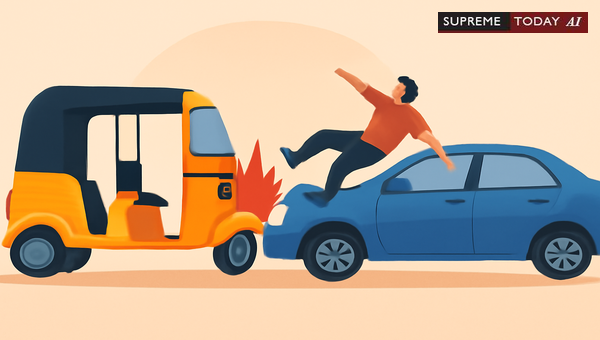
Autorickshaw Driver Turns Wrong: IPC 304A Liability Guide
Introduction
Imagine boarding an autorickshaw for a routine trip, only for the driver to suddenly veer into the wrong direction. Panic ensues, passengers jump out in fear, and injuries follow. What legal recourse do the injured have? This scenario raises a critical question in Indian traffic law: Autorikshaw driver turns wrong direction passengers run out due to fear and injured which section attracts judgement?
Such incidents highlight the thin line between everyday commuting and potential criminal liability. While drivers must navigate busy roads, failing to exercise reasonable care can lead to serious consequences under the (IPC). This post delves into the applicable law, primarily , analyzes real-world applications, and draws from judicial precedents to provide clarity. Note: This is general information, not legal advice—consult a qualified lawyer for specific cases. (2023 5 Supreme 130)
Understanding the Core Legal Provision:
Section 304A of the IPC addresses or hurt through rash or negligent acts not amounting to . It punishes acts done with or that endanger human life or safety, even without intent to harm. Punishment can include up to two years' imprisonment, a fine, or both.
Key elements include:- : Acting with reckless disregard for obvious consequences.- : Failure to exercise the care a reasonable person would in similar circumstances.- No knowledge or intention to cause death or hurt is required—mere deviation from prudence suffices. (2023 5 Supreme 130)
In the autorickshaw scenario, turning the wrong way—especially abruptly—can trigger panic, leading passengers to flee and sustain injuries. Courts assess if a prudent driver would have avoided such a maneuver. As noted in related judgments, rash or negligent driving includes acts that a reasonable driver would avoid, especially when such acts endanger passengers. (2023 5 Supreme 130)
Applying Section 304A to the Wrong Turn Incident
The driver's action of turning in a wrong direction must be evaluated for or . If it causes foreseeable panic and injuries, liability typically arises under Section 304A for .
- Panic as a Consequence: Passengers running out due to fear directly links the driver's maneuver to the harm. This mirrors cases where drivers ignored warnings or drove recklessly, endangering lives. (2023 5 Supreme 130)
- Standard of Care: A reasonable autorickshaw driver signals turns, checks mirrors, and avoids unsafe paths. Abrupt wrong turns breach this duty.
- Causation: Injuries must stem from the negligent act, not external factors.
For instance, in a bus driver case, the court held that running over a child despite passenger warnings constituted , emphasizing acts endangering safety. Similarly, a wrong turn inducing panic fits this mold. (2023 5 Supreme 130)
Insights from Relevant Case Laws
Indian courts, particularly the , have repeatedly addressed autorickshaw accidents involving . These precedents reinforce Section 304A's application to rash driving.
Convictions for Wrong-Side or Reckless Driving
- In one case, a mini lorry driver crossed into the opposite lane, colliding with an autorickshaw, killing two passengers. The court affirmed conviction under , relying on witness identification: P.W.1, who was the driver of the autorikshaw... has clearly identified the Revision Petitioner as the driver. Sentences were adjusted for a first offender, underscoring credible evidence's role.
- Another involved a bus on the wrong side hitting an autorickshaw, killing passengers. Witnesses (autorickshaw driver PW2 and passenger PW3) testified: the accident took place on the wrong side of the bus. However, inconsistencies led to acquittal, highlighting proof burdens.
Rash Overtaking and Autorickshaw Collisions
- A bus driver overtaking recklessly hit an autorickshaw: The autorikshaw in question was driven by PW3. PW2 was one of the passengers. Conviction under 304A was upheld for reckless driving on the wrong side.
- Bus overspeeding injured autorickshaw occupants: PWs’ 2 to 4 are the persons traveling in the Autorikshaw. According to PW2 the accident was due to the of the driver of the Bus who drove it in over speed. Benefit of doubt led to acquittal due to conflicts. 2007 Supreme(Online)(KER) 3655
Broader Principles
- Tractor driving on the wrong side collided with an autorickshaw: Driving on the wrong side inherently suggests . Conviction under 304A upheld, sentence modified.
- Mini pickup van on wrong side hit autorickshaw: a mini pick up van, which was driven by the accused, came from the opposite side through its wrong side. Acquittal followed settlement and evidence gaps.
These cases illustrate that wrong-direction maneuvers often attract Sections 279 (rash driving), 337/338 (causing hurt), and 304A IPC, but convictions hinge on consistent evidence like eyewitnesses and scene reports. (2000 3 Supreme 698) (2023 5 Supreme 130)
Exceptions, Defenses, and Limitations
Not every wrong turn leads to liability:- Reasonable Care Exercised: If due to sudden obstacles or traffic, it may not qualify as negligent.- : Passengers' overreaction could mitigate, though rare.- Evidence Shortfalls: Inconsistencies or lack of proof grant benefit of doubt, as in several Kerala HC rulings. (THANKAPPAN vs STATE OF KERALA - Kerala_HC_KLHC010247952013) (THANKAPPAN vs STATE OF KERALA - Kerala_HC_KLHC010146412000)
Other sections like 279 ( rash driving) or 337 IPC may compound charges, but 304A focuses on hurt/death by . (2023 5 Supreme 130)
Practical Recommendations for Victims and Drivers
- For Injured Passengers:
- File promptly, citing Section 304A.
- Collect eyewitness statements, CCTV, and medical reports.
Pursue for compensation.
For Drivers:
- Always signal turns and avoid wrong ways.
Carry valid license—courts note licenses permitting autorickshaws validate insurance. (2011 0 Supreme(Kar) 811)
Evidence Tips: (scene sketches) and wound certificates strengthen cases. (2006 0 Supreme(Ker) 650)
Key Takeaways and Conclusion
Autorickshaw drivers turning wrong, causing passenger panic and injuries, typically attract for rash/negligent hurt, absent intent. Judicial trends emphasize reasonable care, with convictions in clear cases and acquittals on doubt. (2023 5 Supreme 130) (2000 3 Supreme 698)
Road safety demands vigilance—drivers, prioritize prudence; passengers, know your rights. While these insights draw from precedents, outcomes vary by facts. Always seek professional legal counsel for personalized guidance.
Disclaimer: This article provides general educational content based on legal principles and is not a substitute for legal advice.
#IPC304A, #RashDriving, #AutorickshawNegligence












