


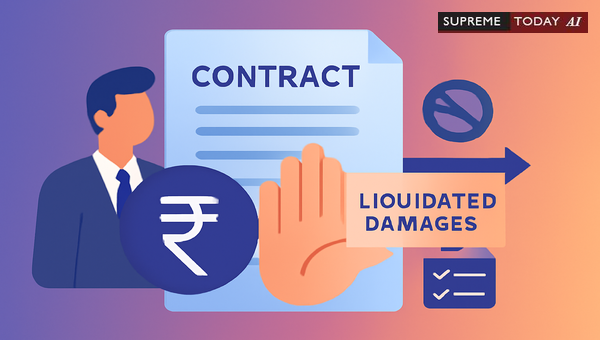
Breach of Contract Damages Under Indian Contract Act: Key Case Laws Explained
In the world of business and commerce, contracts form the backbone of agreements. But what happens when one party breaches the contract? Can you claim damages, and under what conditions? A common query from businesses and individuals alike is: Search for Case Laws on Breach of Contract Damages under Indian Contract Act. This blog post dives deep into the principles governing damages for breach of contract under , drawing from landmark judicial precedents and legal insights to help you navigate this complex area.
Disclaimer: This article provides general information based on established case laws and is not intended as specific legal advice. Consult a qualified lawyer for advice tailored to your situation.
Understanding the Core Legal Principles
Under Indian Contract Law, damages for breach are not awarded arbitrarily. Sections 73 and 74 are pivotal. entitles the aggrieved party to compensation for losses naturally arising from the breach or those which the parties knew were likely at the time of contracting. Importantly, damages are recoverable only if there is or damage caused by the breach2014 0 Supreme(SC) 121 2023 0 Supreme(Gau) 1267.
addresses stipulated sums in contracts, such as or . Courts award not exceeding the stipulated amount, but only if it's a —not a disguised penalty 2014 0 Supreme(SC) 121 2023 0 Supreme(Gau) 1267. The has emphasized that the law eliminates complex English distinctions, focusing instead on whether the sum is compensatory or punitive 2014 0 Supreme(SC) 121.
Key Requirements for Claiming Damages
- : The claimant bears the burden unless damages are a genuine pre-estimate
.
- Liquidated vs. Penalty: Enforceable if genuine; otherwise, limited to 2014 0 Supreme(SC) 121 2023 0 Supreme(Gau) 1267.
- Difficult to Quantify Cases: Courts may award based on circumstances, ensuring no penalty 2025 0 Supreme(Ker) 2317 2011 0 Supreme(AP) 91.
Landmark Judicial Precedents
The 's ruling in Fateh Chand vs Balkishan Dass (AIR 1963 SC 1405) is foundational. It clarified that stipulated sums must be genuine pre-estimates; if , recovery is limited to reasonable amounts 2014 0 Supreme(SC) 121 2023 0 Supreme(Gau) 1267. The Court noted: the law aims to eliminate the complex English common law distinctions between and 2014 0 Supreme(SC) 121.
In Kailash Nath Associates v. Development Authority (2015) 4 SCC 136, the apex court summarized: Where a sum is named in a contract as a liquidated amount payable by way of damages, the party complaining of a breach can receive as such liquidated amount only if it is a genuine pre-estimate of damages fixed by both parties and found to be such by the court2025 0 Supreme(Ker) 2317. This case reiterated judicial scrutiny for
.
Another key case, Ghaziabad Development Authority v. Union of India (2000) 6 SCC 113, held that delay damages are measured by rental value, not mental agony, which is typically inadmissible 2000 4 Supreme 373.
Burden of Proof and Exceptions
The claimant must prove actual damage, but if stipulated damages are genuine, proof may not be strictly required
. Conversely, the party alleging a penalty must show it's not a pre-estimate. Courts examine contracts closely to prevent abuse.
Exceptions include:- : As per the explanation to , in estimating the loss or damage arising from a breach of contract, the means which existed of remedying the inconvenience caused by non-performance of the contract must be taken.- : Even without quantification in the contract, the non-defaulting party is entitled under
.- Calculation: Sections 73 and 74 provide for this, with awards compliant with Indian substantive law 2023 0 Supreme(Del) 9568.
like mental agony are generally excluded unless evidenced 2000 4 Supreme 373.
Practical Application in Different Scenarios
Consider a construction contract with a clause for delays. If the sum reflects probable loss (e.g., rental value during delay), it's enforceable 2000 4 Supreme 373. But if extravagant, courts cap it 2025 0 Supreme(Ker) 2317.
In commercial deals, parties often stipulate damages, but M/s Kailash Nath Associates v. DDA warns of scrutiny: damages must be proven or genuinely pre-estimated
. For GST-related contracts, mitigation principles apply directly from .
High Court rulings reinforce this: A bare review of ... indicates that even though are not quantified in the contract but the non-defaulting is entitled
. Arbitration tribunals must align awards with these sections 2023 0 Supreme(Del) 9568.
Drafting Tips to Avoid Disputes
To strengthen your position:- Clearly label clauses as with supporting rationale for the amount.- Base sums on probable losses, like market rates or expert estimates.- Include mitigation obligations.- Avoid vague or excessive , as courts will intervene 2014 0 Supreme(SC) 121.
Key Takeaways
- Damages hinge on actual loss proof or genuine pre-estimates2014 0 Supreme(SC) 121 2023 0 Supreme(Gau) 1267.
- are capped at reasonable levels 2025 0 Supreme(Ker) 2317.
- Judicial precedents like Fateh Chand and Kailash Nath guide enforcement.
- Always mitigate losses per .
In summary, Indian courts prioritize fairness, ensuring compensation reflects real harm without punishing breaches. For businesses, understanding these nuances can prevent costly litigation. Stay informed, draft wisely, and seek professional counsel for your contracts.
References:1. 2014 0 Supreme(SC) 121: Enforceability of and .2. 2023 0 Supreme(Gau) 1267: Principles on damages and burden of proof.3. 2025 0 Supreme(Ker) 2317: Summary of law.4.
: Proof requirements.5. 2011 0 Supreme(AP) 91: Actual loss linkage.6. 2000 4 Supreme 373: Delay damages measurement.7. : Mitigation under .8.
: .9. 2023 0 Supreme(Del) 9568: Calculation under Sections 73/74. #IndianContractAct, #BreachOfContract, #ContractDamages















