


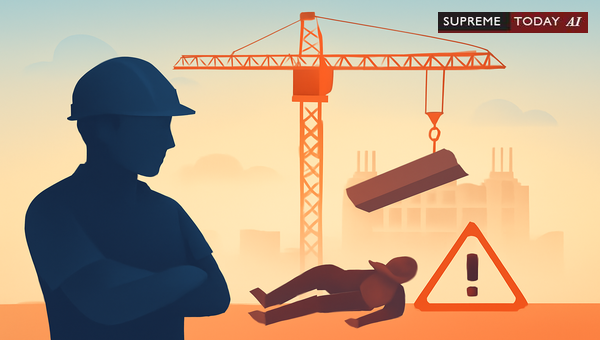
Can Building Contractors Be Liable Under ?
In the high-stakes world of construction, accidents can lead to tragic outcomes, raising critical questions about criminal liability. One common query from contractors, property owners, and legal professionals is: Can a building contractor be held liable under ? This section of the (IPC) deals with causing , often invoked in construction site fatalities like falls, collapses, or equipment mishaps. Understanding this liability is essential for mitigating risks and mounting effective defenses.
This article breaks down the legal principles, key case law, and practical recommendations, drawing from established precedents. Note that this is general information and not specific legal advice—consult a qualified lawyer for your situation.
Overview of
punishes whoever causes the death of any person by doing any rash or negligent act not amounting to culpable homicide. In construction contexts, this typically arises when workers die due to unsafe sites, faulty scaffolding, or inadequate safety measures. However, liability isn't automatic; courts require proof of as the of death 2005 0 Supreme(Del) 693 1999 0 Supreme(All) 916.
Mere accidents or minor oversights don't suffice. As highlighted in judicial interpretations, the act must be the of death without any intervening negligence 2005 0 Supreme(Del) 693 1999 0 Supreme(All) 916. This sets a high bar, distinguishing criminal liability from civil negligence claims.
Key Legal Principles for Contractor Liability
1. Negligence Requirement
To hold a contractor liable, prosecutors must demonstrate a () between the negligent act and the death, involving negligence of a gross or high degree. Mere negligence or recklessness is insufficient unless it is gross 2025 Supreme(Online)(KAR) 496 2025 Supreme(Online)(KAR) 8282 2024 0 Supreme(Ker) 1396. Courts scrutinize whether the contractor's actions (or inactions) were the immediate trigger.
2. Delegation of Responsibility
Contractors often delegate safety to supervisors or subcontractors. If properly done, this shields the principal contractor: If the contractor has delegated safety responsibilities to others, they may not be held liable unless there is evidence of direct involvement in negligent acts 2022 0 Supreme(Mad) 3308 2020 0 Supreme(P&H) 1771. Mere ownership or contractual oversight doesn't trigger Section 304A liability.
3. Direct Supervision and Control
Liability strengthens if the contractor directly supervised the site and failed to enforce safety protocols. Conversely, absence during the incident often leads to quashed charges: Courts have consistently ruled that mere ownership or indirect involvement does not suffice for liability under -A IPC 2005 0 Supreme(Del) 693 2022 0 Supreme(Mad) 3308.
4. Limits
Owners or head contractors aren't automatically vicariously liable. Owners or contractors cannot be held vicariously liable for accidents if they have delegated supervisory responsibilities to qualified personnel 2022 0 Supreme(Mad) 3308 2007 0 Supreme(All) 1767. However, building owners may face liability if no formal contract exists with the contractor, as supervision defaults to them 2022 0 Supreme(Mad) 3308 2022 Supreme(Online)(MAD) 26377.
Distinction Between and 304A IPC
A common pitfall is confusing Section 304A () with (). (especially Part II) requires a higher , like knowledge that the act might cause death. (Part II) involves culpable homicide with a higher degree of negligence or intention, whereas Section 304A pertains to causing without intent 2023 0 Supreme(Bom) 1026 2023 Supreme(Online)(KAR) 14699 2025 Supreme(Online)(KAR) 8282.
In construction cases, charges under /34 IPC have been argued, but courts downgrade or quash if isn't proven: is not applicable for the facts of the case 2025 Supreme(Online)(Kar) 26365. For instance, In no way, it can be held as the case under -A IPC and not under 2018 0 Supreme(P&H) 3232, emphasizing evidence-based classification.
Relevant Case Law
: The court quashed an against the contractor, ruling that the responsibility for safety measures lay with the contractor, not the petitioner 2020 0 Supreme(P&H) 1771. This underscores delegation's protective role.
: A property owner (layman) escaped liability for workers' negligence, as a layman could not be held liable for the negligence of construction workers 2001 0 Supreme(P&H) 1423. Direct involvement is key.
: The clarified, the act causing death must be a direct consequence of the accused's actions, and mere negligence does not automatically lead to liability under -A IPC 2022 0 Supreme(Mad) 3308.
Other precedents reinforce: In BALCO-related matters, officers were held liable to face trial Under /34 I.P.C. due to evidence 2023 0 Supreme(Chh) 273. Yet, lack of often leads to relief 2025 Supreme(Online)(KAR) 496 2023 Supreme(Online)(KAR) 14699.
Evidence Assessment in Construction Cases
Courts demand substantial evidence of . The presence of negligence must be proven with clear material linking the act to the death 2025 Supreme(Online)(KAR) 496 2023 Supreme(Online)(KAR) 14699. FIRs against unknown persons under IPC have been filed in collapses, but quashed without nexus 2024 Supreme(Online)(KAR) 22805.
Practical Recommendations for Contractors
- Document Everything: Maintain records of safety delegations, training, and protocols to prove non-involvement.
- Legal Defense Strategy: Argue lack of direct control, proper delegation, and absence of . Cite cases like Krishan Lal for owner protections.
- Risk Mitigation: Appoint qualified supervisors, conduct regular audits, and secure insurances—though these don't absolve criminal liability.
Conclusion and Key Takeaways
Building contractors may be held liable under if directly causes a death and they exercised control without proper safeguards. However, delegation to competent personnel, lack of on-site presence, and insufficient causation often defeat charges. Owners face similar risks without clear contracts.
Key Takeaways:- Prove and for liability.- Delegation is a strong shield if documented 2022 0 Supreme(Mad) 3308 2020 0 Supreme(P&H) 1771.- Distinguish from to avoid harsher penalties.- Always prioritize safety to prevent tragedies.
By leveraging these principles and precedents, stakeholders can navigate claims effectively. For tailored advice, reach out to a legal expert specializing in construction law.
#IPC304A, #ConstructionLiability, #NegligenceLaw












