Searching Case Laws & Precedent on Legal Query..!
Scanned Judgements…!



Searching Case Laws & Precedent on Legal Query..!
Scanned Judgements…!
Self Property Burden of Failed Prove - Main points and insights
Burden of Proof in Property Claims:
Conversely, if a party claims a property is self-acquired, they must affirmatively prove this, especially when there is an existing joint family nucleus (e.g., 2025 0 Supreme(Kar) 821, 2023 Supreme(Online)(KAR) 20356).
Presumption of Joint Property:
When joint family status is established, the burden shifts to the person claiming the property is self-acquired to prove that the property was purchased with personal funds and not from joint family resources (e.g., 2025 0 Supreme(Kar) 821, 2025 0 Supreme(Kar) 452).
Failure to Prove Surplus or Source of Funds:
Plaintiffs or claimants often fail to prove the existence of surplus income or specific funds from the joint family nucleus used to acquire the property. This failure leads to a rejection of their claim that the property is joint family property (e.g., 2025 0 Supreme(Mad) 4476,
LIEW WAI LOY vs LIEW WAI HAN - High Court Malaya Kuala Lumpur
).Specific Case Findings:
When defendants claimed certain properties as self-acquired, they failed to provide sufficient evidence to rebut the presumption of joint family ownership, leading courts to uphold joint status (e.g., 2025 0 Supreme(Kar) 821, 2023 Supreme(Online)(KAR) 20356).
Legal Principles:
Analysis and Conclusion
Courts consistently emphasize that the burden of proof lies with the party asserting that a property is self-acquired. When the joint family status is established, this burden shifts to the claimant to prove self-acquisition through clear evidence of funds or source. Failure to meet this burden results in the property being presumed joint family property, and claims to the contrary are generally dismissed. Proper documentary evidence, proof of surplus income, and clear demonstration of source of funds are essential to successfully prove a property as self-acquired. Overall, failure to discharge the burden leads courts to uphold the presumption of joint ownership.
References
LIEW WAI LOY vs LIEW WAI HAN - High Court Malaya Kuala Lumpur
CHNG WHAI EARN & ANOR vs YEOH SHIAU HUI @ ATQUEENSON YEOH - High Court Malaya Penang
RAMLAH ABD AZIZ vs ECO COMMERCIAL VEHICLES SDN BHD - High Court Malaya Kuala Lumpur
KING v. JAMES CHANDRASEKERA
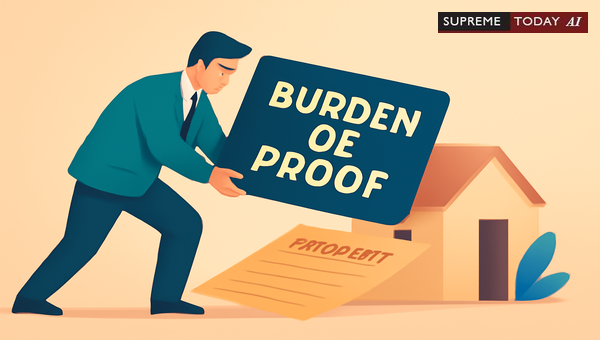
In family property disputes, determining whether a property is or can make or break a case. The question Self Property Burden of Failed Prove captures a common pitfall: what happens when a party fails to meet the in claiming a property as ? This issue frequently arises in contexts, where presumptions favor joint ownership unless convincingly rebutted.
This blog post breaks down the legal principles, key cases, and practical recommendations. Note: This is general information based on judicial precedents and not specific legal advice. Consult a qualified lawyer for your situation.
Under , properties can be classified as either (purchased with personal funds) or (acquired from family nucleus or joint efforts). The is pivotal. Generally, the party asserting that a property is must provide to support their claim. Failure to do so often results in the property being deemed , allowing for . 2020 0 Supreme(Kar) 519
As established in precedents, the lies on the person claiming self-acquisition of property. If they fail to establish this by , the suit may be decreed for partition, favoring the joint family claim. 2020 0 Supreme(Kar) 519
Courts often start with a , especially if there's an existing . Property acquired by a (manager) or family member is presumed to come from joint family income unless proven otherwise. 2005 0 Supreme(Mad) 1208
However, the burden can shift:- Once the self-acquisition claimant provides , the onus moves to the party alleging joint family status. 2013 0 Supreme(Mad) 1985- To claim self-acquisition without the aid of joint family income, the party must prove . 2005 0 Supreme(Mad) 1208
In cases without a clear joint family nucleus, the initial burden may lie on those claiming joint status. For instance, if plaintiffs fail to prove the property came from , it may be presumed . 2024 0 Supreme(Mad) 768 2025 0 Supreme(Mad) 4476
Proving self-acquisition demands :- are critical to validate claims. 2008 0 Supreme(Bom) 928- Financial records showing sources.- Clear separation from joint family funds.
Courts reject claims based solely on . Evidence and documentation are crucial; courts often reject claims based solely on without . 2023 0 Supreme(P&H) 1560
Defendants or claimants frequently falter:- Failure to provide adequate evidence: In multiple cases, those claiming self-acquisition couldn't substantiate, leading courts to uphold joint family status. 1933 0 Supreme(Mad) 109 2019 0 Supreme(Mad) 400- No proof of surplus or funds: Plaintiffs often fail to show joint family surplus funded the purchase, rejecting their joint claim. 2025 0 Supreme(Mad) 4476
LIEW WAI LOY vs LIEW WAI HAN - Kuala Lumpur
Exact case language underscores this: The appellants have failed to discharge the burden to prove that the suit property was property of Mangal Kumhar. 2020 0 Supreme(Mad) 1114 2019 0 Supreme(SC) 1209
Another example: In any case the burden was on the defendant No. 1... to prove that it is his self acquired property. 2015 0 Supreme(Bom) 2517
Apex Court rulings reinforce these principles. In , the suit is for recovery of possession on the strength of title, the burden is on the plaintiff to establish that title. Similarly, holds that the plaintiff has to stand on his own legs by proving his case. 2021 0 Supreme(UK) 574
In female member claims, lack of evidence to disprove self-acquisition capacity preserves the claim: there is no clear cut evidence to disprove the self acquiring capacity of the first defendant-female member. 2017 0 Supreme(Mad) 1083
Conversely, when joint status is proven, the self-acquisition claimant must rebut: When joint family status is established, the burden shifts to the person claiming the property is to prove that the property was purchased with personal funds. 2025 0 Supreme(Kar) 821 2025 0 Supreme(Kar) 452
Specific findings show:- Plaintiffs failed to discharge burden, upholding self-acquisition. 2024 0 Supreme(Mad) 768- Defendants couldn't rebut joint presumption. 2023 Supreme(Online)(KAR) 20356
notes: Presumption as to and self acquired property. 2019 0 Supreme(SC) 1209
To navigate these disputes:1. Gather robust evidence early: Financial statements, sale deeds, income proofs.2. Demonstrate independent source: Prove separate funds, especially against joint nucleus. 2013 0 Supreme(Mad) 19853. Anticipate shifting burdens: Prepare for counter-claims.4. Revenue records alone insufficient: Entries in the revenue records do not confer title. 2020 0 Supreme(Mad) 1114
Litigants should consider mediation to avoid costly failures.
The law is settled: the onus is on the claimant to prove the nature of the property. Failure to discharge the burden—especially for self-acquisition amid joint family presumptions—leads to dismissal or reclassification. Courts emphasize clear, over assertions. 2025 0 Supreme(Mad) 4476 2025 0 Supreme(Kar) 821
Key Takeaways:- Burden typically on self-acquisition claimant if joint nucleus exists. 2005 0 Supreme(Mad) 1208- Use registered docs and financial proofs. 2008 0 Supreme(Bom) 928- Presumption favors jointness without rebuttal. 2017 0 Supreme(Mad) 625- Stand on your own legs: prove your case affirmatively. 2021 0 Supreme(UK) 574
Property disputes hinge on proof. Arm yourself with evidence to succeed.
References: 2020 0 Supreme(Kar) 519 2005 0 Supreme(Mad) 1208 2013 0 Supreme(Mad) 1985 2008 0 Supreme(Bom) 928 1933 0 Supreme(Mad) 109 2019 0 Supreme(Mad) 400 2017 0 Supreme(Mad) 625 2021 0 Supreme(UK) 574 2020 0 Supreme(Mad) 1114 2019 0 Supreme(SC) 1209 2017 0 Supreme(Mad) 1083 2015 0 Supreme(Bom) 2517 2024 0 Supreme(Mad) 768 2025 0 Supreme(Mad) 4476 2025 0 Supreme(Kar) 821 2025 0 Supreme(Kar) 452 2023 Supreme(Online)(KAR) 20356 2023 0 Supreme(P&H) 1560
#BurdenOfProof, #SelfAcquiredProperty, #JointFamilyLaw


, the plaintiffs have miserably failed to discharge their initial burden to prove that the suit property is the joint family property. ... was available and that the said property had been purchased from the said nucleus and that the burden to prove such a situation lay on the party, who so asserted it. ... The question to be determined in the present ....

The plaintiff failed to prove any surplus from the family nucleus to buy these properties in the name of the first defendant as Manager of the family. ... If, however, the person so asserting proves that there was nucleus with which the joint family property could be acquired, there would be presumption of the property being joint and the onus would shift on the person who claims it to be self-acquired #H....

The burden should be applied to the defendant, who controlled the late father's company account, to prove that he had paid for the plaintiff's share of the Property; and (b) the SCJ failed to consider the oral and documentary evidence and wrongly applied the burden of proof and this led to the ... The plaintiff bears the burden of proof to prove what he had alleged, tha....

It held as on date of acquisition of item no.11 property, HUF had sufficient nucleus for acquiring it and defendants failed to establish that it as self-acquired. ... It turned down contention of defendants about item no.11 property being self-acquired property on ground that, once status of HUF was accepted, property purchased in name of one member would be presumed HU....
Even defendant No.6 has admitted that except Item Nos.1, 2, 4, 10 and 13, which are his self- acquired priorities, rest of the suit properties are the joint family property. ... Therefore, it was incumbent upon defendant No.6 to have led independent evidence in support of his claim of Item Nos.1, 2, 4, 10 and 13, being his self-acquired priorities, which he has failed to do. ... That, since defendant No.6 took specific ple....
He who asserts must prove. The burden of proof is on the Plaintiffs to prove their allegation of a trust. I find that the Plaintiffs have failed to prove the alleged trust on a balance of probabilities. ... They have failed to discharge the legal burden and the evidential burden. Consequently, this action must be dismissed. ... It is my finding that th....
[41] It is trite law that the burden to prove the existence of any fact, it is on the party that alleges it. ... (2) When a person is bound to prove the existence of any fact, it is said that the burden of proof lies on that person. ... [50] For the above reasons, on the balance of probabilities, the Plaintiff has failed to discharge her burden of proof. ... [62] Likewise, the Defend....
According to our law, regard being had to the definition of " proved ", he has failed to prove those facts and he has also thereby failed to prove his defence which is conditioned by the supposition that those facts existed. ... But Counsel's argument is that, although the accused has failed to carry conviction to the minds of the Jury, the prosecution has failed to discharge its #HL....
the joint family property of the plaintiff and the defendants and it is the burden to prove on the person who claims that a particular property is a self acquired property and the Courts ... Trial Court while answering issue No.5, the burden on defendant No.1 to prove that the suit schedule C property is self ....

Except the oral testimony of witnesses, plaintiff has failed to prove any document to prove her possession on the suit property. The plaintiff has failed to prove her possession. The plaintiff has not come to the Court with clean hands. ... The learned trial Court has opined that the plaintiff has failed to prove even site plan of the suit pr....

Hon'ble Apex Court in the case of Sakharam Mahajan Vs. Damodar Trimback Tanksale (dead) & Ors reported in (2007) 6 SCC 737 has held that the suit is for recovery of possession on the strength of title, the burden is on the plaintiff to establish that title. In another judgment of Hon'ble Apex Court in the case of State of MP Vs. Nomi Singh and another reported in (2015) 14 SCC 450 has held that the plaintiff has to stand on his own legs by proving his case. It is settled position in law that t....
The appellants have failed to discharge the burden to prove that the suit property was separate or self-acquired property of Mangal Kumhar. 5. The contention raised by the appellants is that since Mangal Kumhar was the recorded tenant in the suit property as per the Survey Settlement of 1964, the suit property was his self-acquired property. The said contention is legally misconceived since entries in the revenue records do not confer title to a property, nor do they have any....

(See-Mulla-Hindu Law, 22nd Edition Article 23 “Presumption as to coparcenary and self acquired property” pages 346 and 347).” (emphasis supplied) The Appellants have failed to discharge the burden to prove that the suit property was separate or self-acquired property of Mangal Kumhar.

The Lower Appellate Court further found that the first defendant-female member of the family had acquired Suit Item Nos.2 to 15 and taking into consideration the ratio laid down in K.S.Palanisami v. K.S.Pongulappan [2014-1-L.W.] found that there is no clear cut evidence to disprove the self acquiring capacity of the first defendant-female member and that the plaintiffs had also failed to probablise their case that the deceased plaintiff has made contribution for acquisition of the Suit Item No....

The aforesaid record and conduct of the defendant No. 1 are sufficient to prove on preponderance of probability that land Gat Nos. 202 and 498 were being cultivated by all four sons of Mahadu as tenants and land Gat No. 475 was initially with Mahadu for cultivation and after his death his sons started cultivating this land. 1. In any case the burden was on the defendant No. 1, in view of the facts and circumstances of the present case, to prove that it is his self acquired property a....


An indispensable Tool for Legal Professionals, Endorsed by Various High Court and Judicial Officers
Please visit our Training & Support
Center or Contact Us for assistance

Scan Me!
India’s Legal research and Law Firm App, Download now!


For Daily Legal Updates, Join us on :



 Back to top


