


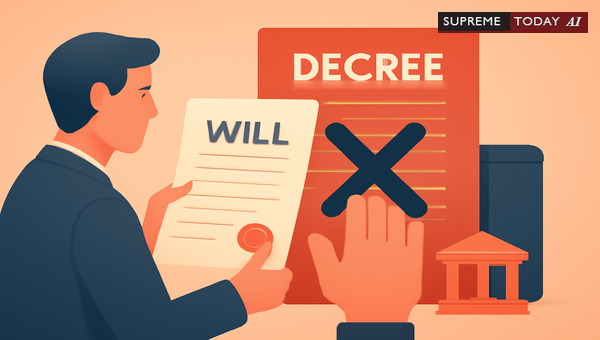
Can a Will Be Revoked by ? A Comprehensive Legal Guide
Wills are cornerstones of estate planning, outlining how a person's assets should be distributed after death. But what happens when family disputes arise, leading parties to consider a ? A common question arises: Can a will be revoked by way of ? This query often surfaces in contentious inheritance matters, where parties seek mutual agreements to avoid prolonged litigation.
In this post, we delve into the legal framework surrounding will revocation, the role of compromises, and insights from relevant case law. While this provides general information, it is not a substitute for professional legal advice—consult an attorney for your specific situation.
Legal Framework for Compromises
A is a mutual agreement between parties to settle a dispute, often involving concessions from both sides. This principle is well-established in various legal contexts, including arbitration and civil suits. 2004 5 Supreme 702
For a to hold validity:- It must be lawful and compliant with applicable laws.- If deemed unlawful, it can be challenged in court. Courts typically treat applications to set aside a decree as requests to review the underlying judgment. 2007 0 Supreme(MP) 21 2007 0 Supreme(MP) 26
Compromises are powerful tools for dispute resolution but have limits, especially when personal documents like wills are involved.
Standard Methods for Revoking a Will
Under the , a (the will-maker) can revoke a will at any time before death through specific means:- Executing a new will or .- Destroying the existing will by burning, tearing, or other acts of destruction.- Writing a , which must be executed like an unprivileged will under —signed by the and attested by at least two witnesses. 2007 0 Supreme(Kar) 192
The lies on the party claiming it. As observed in , For proving that the will had been revoked, it had to be shown that the had made another will or or by some writing declared his intention to revoke the will. 2016 0 Supreme(Mad) 3573
A must also meet strict standards: the must be of , and must be dispelled. Failure to prove under renders it invalid. In one case, courts set aside concurrent findings upholding a cancellation deed because evidence showed the was in a coma, ignoring requirements under the Indian Succession Act and . 2007 0 Supreme(Kar) 192
Can Serve as Revocation?
Directly addressing the question: A will cannot typically be revoked simply by way of . Wills embody the 's personal intentions, which cannot be altered post-death by heirs without legal authority.
Compromises generally apply to ongoing disputes or proceedings, not unilateral revocation. For instance:- Once is granted, it remains valid against all until revoked—even if based on a . Therefore, as it is categorically declared in various judgments that once a is granted, it is valid against everyone until the same is revoked, even it is on the basis of . 2021 Supreme(Online)(MAD) 38262
Parties to a (often heirs) lack authority to override the 's wishes unless the aligns with formal revocation processes executed by the themselves.
Implications in Practice
- Pre-Death Compromises: If the is alive and participates, a might influence a new will, but it doesn't revoke the old one automatically.
- Post-Death Disputes: Compromises can settle inheritance claims but don't retroactively revoke the will. Courts scrutinize such agreements to ensure they reflect the 's intent. 2007 0 Supreme(MP) 21 2007 0 Supreme(MP) 26
In self-acquired property cases, wills favoring certain heirs must dispel suspicions, but revocation still requires formal steps—no shortcuts via . Courts have confirmed no need to assign reasons for exclusion in wills, but cancellation demands proof. Indian Succession Act - reference in sources
Insights from Case Law
Judicial precedents reinforce these principles:- Finality: binds all until revoked formally, unaffected by informal compromises. 2021 Supreme(Online)(MAD) 38262- Burden of Proof: Objectors must provide cogent evidence of revocation acts like destruction. Under of the Act, the Will can be revoked inter alia, by burning, tearing or otherwise destroying and unless any of the circumstances has been proved by the objector by cogent evidence, the question of the revocation of the Will will naturally not arise. 2007 0 Supreme(Kar) 192- Execution Standards: A revocation deed needs attestation and soundness of mind. Misreading evidence or ignoring leads to interference by higher courts to prevent miscarriage of justice. case
Other cases highlight that unauthorized compromises (e.g., by parties lacking authority) are challengeable, as seen in society disputes under . 1989 0 Supreme(Mad) 543
While unrelated areas like evacuee property allotments show fraud-based revocations are possible with proof, wills demand stricter personal intent compliance. 1988 0 Supreme(All) 263
Challenges and Court Scrutiny
Any attempt to use for will revocation invites court review:- Authority Check: Heirs can't bind the estate without or executor consent.- Lawful Execution: Must comply with Succession Act; otherwise, voidable.- Fraud or Misrepresentation: Like in allotment cases, such elements allow revocation but not via casual agreement. 1988 0 Supreme(All) 263
Courts intervene if findings are perverse, ensuring proof. CODE OF CIVIL PROCEDURE case
Key Takeaways
- Wills require formal revocation by the —new will, destruction, or attested declaration.
- Compromises resolve disputes but do not inherently revoke wills without legal backing.
- Post-, challenges need substantial proof; compromises alone insufficient. 2021 Supreme(Online)(MAD) 38262
- Always dispel suspicions and meet evidentiary standards under Sections 63, 68, and 70.
Conclusion and Recommendations
In summary, while compromises foster amicable resolutions, they generally cannot revoke a will. The law prioritizes the 's intent through prescribed methods. Attempting revocation via risks invalidation and litigation.
Recommendations:- Consult a wills and estates specialist early.- Document intentions clearly to avoid disputes.- For disputes, explore mediation within legal bounds.
Estate planning evolves—stay informed, but seek tailored advice to safeguard your legacy. This overview draws from established precedents but isn't exhaustive legal counsel.
(Word count: approx. 1050)
#WillRevocation #EstateLaw #IndianSuccessionAct















