


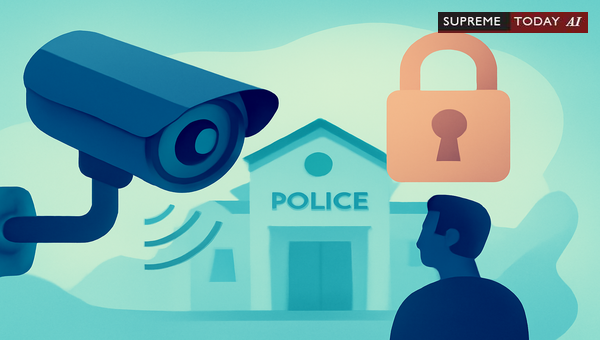
CCTV in Police Stations: Balancing Privacy Rights and Accountability
In an era where surveillance technology is ubiquitous, the question CCTV Camera and Privacy arises frequently, especially regarding installations in sensitive public spaces like police stations. While CCTV cameras enhance transparency and prevent , they must not trample on protected under of the Indian Constitution. This blog post delves into key judicial findings, legal frameworks, and practical considerations to help you understand this delicate balance.
Note: This article provides general information based on court judgments and is not legal advice. Consult a qualified lawyer for specific cases.
Main Legal Finding: Privacy Protections Apply to CCTV Surveillance
The installation and use of CCTV cameras in police stations are subject to constitutional protections of privacy under . Courts have emphasized that while such surveillance promotes accountability, it must adhere to principles of to avoid infringing individual rights. 2020 8 Supreme 354 2024 0 Supreme(AP) 1192
Key court directions mandate CCTV in police stations for transparency, but with strict safeguards. For instance, systems must include night vision, audio-visual recording, and data storage for at least 18 months (with upgrades to maximum possible duration). 2020 8 Supreme 354
Legal Framework for CCTV in Police Stations
Judicial directives have made CCTV installation in police stations not just encouraged but mandatory in critical areas to curb and ensure accountability. The Station House Officer (SHO) bears responsibility for maintenance, fault rectification, and data backups. 2020 8 Supreme 354
However, this framework intersects with privacy laws. Surveillance must be carried out in accordance with law, respecting constitutional safeguards, and should be limited to cases where there are reasonable grounds and for legitimate purposes. 2024 0 Supreme(AP) 1192
From other cases, courts recognize CCTV's role in investigations but stress procedural compliance. For example, in one matter, petitioners sought CCTV footage preservation, but access was limited to protect : The CCTV footage for the entire events from would have covered various events, which may even affect the privacy of the third parties, not connecting in this present complaint. 2024 Supreme(Online)(Mad) 62318 2023 Supreme(Online)(MAD) 8038
Right to Privacy as a Fundamental Right
enshrines the right to privacy, encompassing personal intimacies, , , and . Unwarranted CCTV surveillance invades these protections. 2020 8 Supreme 354 2024 0 Supreme(AP) 1192 1962 0 Supreme(SC) 440
The has clarified that any intrusion, including CCTV monitoring, must pass the . Excessive surveillance without legal basis is unconstitutional. 2024 0 Supreme(AP) 1192
In practice, this means CCTV footage collection for evidence generally does not violate privacy, especially in spousal or investigative contexts, if relevant and lawfully obtained. 2024 0 Supreme(AP) 1192
Limitations and Conditions for Lawful Surveillance
Permissible surveillance requires justification for public safety or security, remaining proportionate and non-excessive. Data storage is capped at necessary durations—minimum one year, ideally 18 months—to prevent misuse. 2020 8 Supreme 354
Courts often scrutinize footage admissibility under . Irrelevant footage, covering areas outside the incident or capturing unrelated individuals, may be withheld: CCTV footage was denied to the appellant on security and privacy grounds. 2021 Supreme(Online)(CIC) 1747
Disclosure balances public interest against third-party rights. They also submitted that the CCTV footage contained images of other customers doing their transactions and disclosure of that would result in unwarranted invasion of the privacy of third parties. 2022 Supreme(Online)(CIC) 4461
Data Collection, Storage, and Access Controls
CCTV footage handling demands secure preservation for investigations. Unauthorized collection or prolonged retention breaches privacy. Courts mandate adequate storage (e.g., minimum one month) and quality standards. 2020 8 Supreme 354 2022 Supreme(Online)(MAD) 607
Access is restricted: In bribery probes or crimes, footage aids fact-finding but is limited to relevant periods. CCTV footage can also provide evidence in case crimes do occur and help the law enforcement agencies. 2022 Supreme(Online)(CIC) 4461
Petitioners sometimes face hurdles obtaining footage, as seen in requests to secure recordings post-incident, highlighting delays or denials on privacy grounds. 2025 Supreme(Online)(Mad) 71990
Exceptions, Violations, and
Arbitrary or indiscriminate surveillance violates . Routine monitoring without suspicion is challengeable. 2024 0 Supreme(AP) 1192
is paramount; footage of commuters or bystanders is often redacted. Public spaces demand policies balancing security with rights: Installing CCTV cameras in public or semi-public spaces aims to enhance security but must be balanced against individual privacy rights. 2022 Supreme(Online)(MAD) 607
Police insistence on CCTV or call records pre-FIR has been critiqued: The police are insisting for CCTV footage and call details record. It is common knowledge that in most of the investigations such type of evidence may not be available. 2018 0 Supreme(Bom) 3062
Recommendations for Compliance
To navigate this landscape:- Base CCTV deployment on legal authority and legitimate needs. 2020 8 Supreme 354- Implement secure storage (up to 18 months) with strict access controls.- Conduct regular audits for proportionality.- Establish oversight to curb misuse.- Invoke privacy rights in disputes over .
In investigations, ensure footage certification and relevance to avoid evidentiary pitfalls. 2024 0 Supreme(Ker) 1342
Key Takeaways and Conclusion
CCTV in police stations is a vital tool for accountability, as affirmed in landmark directions, yet it must yield to privacy under . Courts consistently require lawful, necessary, and proportionate use, with safeguards for data and third-party rights. 2020 8 Supreme 354 2024 0 Supreme(AP) 1192
From mandating installations to limiting disclosures, the judiciary strikes a balance favoring transparency without sacrificing dignity. As technology evolves, adherence to these principles remains crucial.
References:1. 2020 8 Supreme 354 – Directions on CCTV in police stations.2. 2024 0 Supreme(AP) 1192 – Surveillance and privacy under Articles 19/21.3. 2021 Supreme(Online)(CIC) 1747, 2025 Supreme(Online)(Mad) 71990, 2024 Supreme(Online)(Mad) 62318, 2023 Supreme(Online)(MAD) 8038, 2022 Supreme(Online)(CIC) 4461, 2022 Supreme(Online)(MAD) 607, 2018 0 Supreme(Bom) 3062, 2024 0 Supreme(Ker) 1342.
In summary, while CCTV fosters trust in law enforcement, privacy reigns supreme—ensuring surveillance serves justice, not intrusion. Stay informed, and prioritize compliance in an increasingly watched world.
#CCTVPrivacy #PoliceSurveillance #RightToPrivacy












