


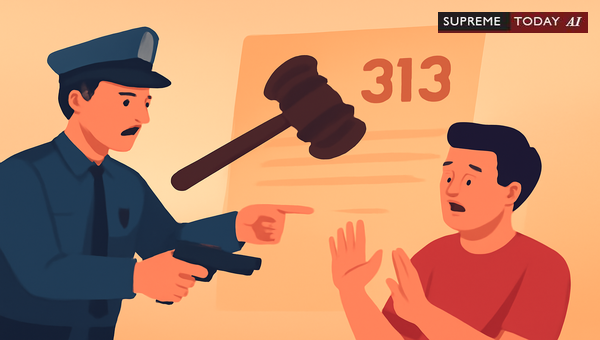
False Cases: Unjust Firing Exposed
In high-stakes encounters between law enforcement and civilians, allegations of police misconduct can shatter lives. Imagine a scenario where a police officer fabricates a story to implicate an innocent person, ignores key witnesses, and even resorts to firing shots. The question at the heart of such controversies is: Police Officer Framed a False Story against Accused and Fired on him? This blog delves into real legal analyses, court observations, and evidence from documented cases to unpack this issue, highlighting patterns of fabrication, , and potential .
While these insights draw from judicial findings, they are for informational purposes only and do not constitute legal advice. Consult a qualified attorney for your specific situation.
Understanding and Fabrication
typically involves creating or manipulating evidence to falsely implicate individuals, often due to personal vendettas, pressure, or ulterior motives like securing promotions. Courts have repeatedly flagged such conduct as a serious breach of duty. For instance, investigations described as 'one-sided' fail to record statements from independent witnesses, leading to 'manufactured' stories against the accused and their families 2011 0 Supreme(P&H) 1064.
Key indicators include:- Omission of independent witnesses: In one case, the police neglected to record the statement of witness Wasakha Singh, raising suspicions of deliberate fabrication 2011 0 Supreme(P&H) 1064.- Fabricated police reports: Documents label police narratives as 'manufactured' and 'framed,' pointing to clear misconduct 2011 0 Supreme(P&H) 1064.
This pattern extends beyond isolated incidents. In another matter, the police allegedly cooked up a false story, with a postmortem report prepared at their instance
. Similarly, to falsely implicate an applicant, a complainant engineered a story claiming the accused fired at an injured person, despite no firearm evidence 2022 Supreme(Online)(MP) 9793.
Improbable Police Narratives and Accused Denials
Police versions often crumble under scrutiny for being highly improbable. Consider claims where the accused allegedly fired 'numerous shots without hitting anyone,' while officers 'sat on the ground to save themselves'—deemed unbelievable by courts 2018 0 Supreme(Raj) 1968.
Accused persons frequently deny these stories under , alleging due to prior disputes or police pressure. One accused completely rejected the prosecution's account, citing unrelated conflicts 2023 0 Supreme(All) 1403. The failure to record the accused's statement further fuels doubts about credibility 2011 0 Supreme(P&H) 1064.
Supporting cases echo this:- A petitioner claimed the story was false, as the deceased had portrayed himself as a police official in a personal dispute 2021 0 Supreme(P&H) 459.- In a kidnapping case, the informant allegedly 'engineered this false story' after willingly sending children with the accused, who took them for a joyride 2018 0 Supreme(All) 297.
These denials, backed by inconsistent prosecution evidence, often lead courts to question the entire narrative.
Unjustified Police Firing and Use of Force
Firing at the accused is a grave escalation, frequently disputed in legal proceedings. Courts have observed exaggerated or false police accounts, suggesting the accused's actions were in or unproven as malicious 2012 0 Supreme(All) 2901 1957 0 Supreme(Bom) 140. In some instances, charges were dismissed due to false witness accounts and lack of credible evidence 1957 0 Supreme(Bom) 140.
The need for stringent evidence in police firing cases is emphasized, protecting individuals from abuse 2020 0 Supreme(MP) 332. Related examples include:- Falsity in recovery procedures under Cr.P.C. sections, where police framed the accused without following mandates like informing the SHO 2014 0 Supreme(Raj) 85.- A service personnel denying false charges of misconduct, calling them a 'made up story' involving implausible threats without evidence 2015 0 Supreme(Gau) 1392.
When police fire in disputed scenarios, courts stress accountability, often highlighting the absence of independent corroboration.
Broader Implications of Police Misconduct
Misconduct isn't limited to framing; it includes false implications to settle scores or gain promotions 2020 0 Supreme(MP) 332. In corruption probes against officers, defenses like the '' have overturned convictions when prosecution evidence falters 2020 0 Supreme(Telangana) 82. Here, the accused officer proved money was thrust upon him, with consistent witness testimony undermining the prosecution's case 2020 0 Supreme(Telangana) 82.
decisions also reflect gravity: courts deny it when evidence like audio clips supports serious allegations but scrutinize fabricated stories closely 2021 0 Supreme(P&H) 459.
Key Court Observations
- : Heavy burden on prosecution when shadow witnesses turn hostile 2020 0 Supreme(Telangana) 82.
- Credibility tests: Testimonies of 'injured witnesses' (like kidnapped children) hold weight if corroborated, but defenses must prove falsity 2018 0 Supreme(All) 297.
- Procedural lapses: Violations like not following , 165, 166 render recoveries false 2014 0 Supreme(Raj) 85.
Legal Remedies and Recommendations
If facing such allegations, options generally include:1. Challenge under Cr.P.C. 313: Deny the story and highlight inconsistencies.2. File complaints: Petition higher authorities or seek judicial inquiry into misconduct.3. Demand investigation: Probe failures like unrecorded witnesses and improbable claims.4. Seek bail or : Argue lack of credible evidence and fabrication.
Courts advise further scrutiny of police conduct, ensuring accountability for unlawful force 2020 0 Supreme(MP) 332. In appeals, consistent defenses have led to acquittals or dismissed charges.
Conclusion and Key Takeaways
Evidence from multiple cases strongly suggests patterns of false stories, one-sided probes, and potentially unjustified firing. Accused denials, , and procedural lapses often expose misconduct 2011 0 Supreme(P&H) 1064 2018 0 Supreme(Raj) 1968 2023 0 Supreme(All) 1403. While courts protect genuine cases, they vigilantly dismantle fabrications to uphold justice.
Key Takeaways:- Demand recording of all witnesses to prevent one-sided stories.- Scrutinize police firing claims for or exaggeration.- Pursue remedies like inquiries into .- Always gather counter-evidence early.
This analysis underscores the importance of robust legal safeguards. For personalized guidance, reach out to a legal professional promptly.
Word count: Approximately 1050. General information only—not legal advice.
#PoliceMisconduct #FalseFraming #LegalRights















