


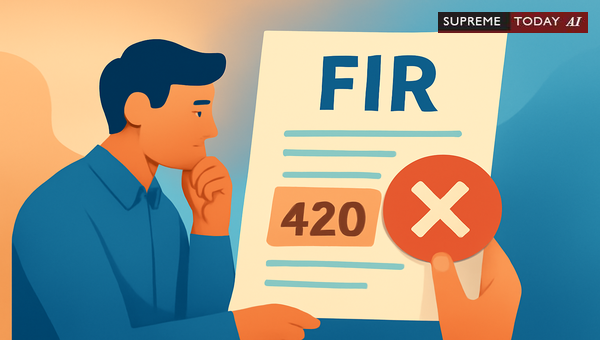
Wrong Section? Top Legal Remedies in India
Imagine discovering that the police have registered a () against you under the completely wrong section of law or act. This common procedural error can lead to unnecessary harassment, prolonged legal battles, and potential miscarriage of justice. If you're facing this situation and wondering, If Police has Entered the in Wrong Act what is the Remedy?, you're not alone. In the Indian legal system, several remedies exist to address such irregularities, ensuring fairness and adherence to the .
This article breaks down the key principles, step-by-step remedies, and insights from judicial precedents. While this provides general guidance, consult a qualified lawyer for advice tailored to your case, as outcomes depend on specific facts.
Understanding and Common Errors
An is the first step in initiating a criminal investigation for under However, errors like citing the wrong section—such as registering under a or an inapplicable special act—occur due to oversight, misinterpretation, or even .
Technical irregularities, including the wrong section, are often curable if the underlying facts support a valid offense. Courts emphasize substance over form, but prompt action is crucial to safeguard your rights. 2004 0 Supreme(Cal) 640
Key Legal Principles Governing Incorrect FIRs
Indian courts have established clear guidelines:
Erroneous Cognizance Doesn't Automatically Quash Proceedings: Even if a is filed under a wrong section, a Magistrate can take cognizance if the and reveal facts fitting a valid section. If a police officer submits a under a wrong section, the learned Magistrate can still take cognizance of the case. The proceedings cannot be quashed solely due to the erroneous section if the and reveal a different, valid section under which the offence can be established. 2004 0 Supreme(Cal) 640
Magistrate's Review Power: The Magistrate reviews the and . If investigation uncovers elements of another offense, they can correct it. 2004 0 Supreme(Cal) 640
No Second for Same Incident: Registering a second for the same cognizable offense is prohibited and can be challenged. 2018 0 Supreme(J&K) 750 2022 0 Supreme(All) 1328
Court-Directed Registration: If police refuse or err in registering an for a cognizable offense, courts can direct them. 1997 0 Supreme(P&H) 1167
These principles prevent abuse while allowing corrections.
Step-by-Step Remedies for Wrong Registration
Here are practical remedies, typically pursued through legal representation:
- Seek Correction by Magistrate:
Approach the Magistrate handling the case to review the and amend the section if evidence supports it. This is the first-line remedy for curable errors. 2004 0 Supreme(Cal) 640
File Petition to Quash under :
If the is fundamentally flawed (e.g., or no case), petition the for quashing. If the is fundamentally flawed (e.g., based on a non-cognizable offence), a petition can be filed under to quash the . 2014 0 Supreme(Raj) 1737
Challenge the :
Once filed, argue in court that no case exists under the cited section, prompting alteration or dismissal.
Judicial Review and Directions:
- Petition the for directions to police or Magistrate if inaction persists. Courts can order proper registration and investigation. 1997 0 Supreme(P&H) 1167
Act swiftly—delays may complicate remedies.
Insights from Case Law on Special Acts and Errors
Judicial precedents highlight nuances, especially with special statutes:
- Cognizance Under Special Acts: For offenses under acts like the , Magistrates cannot take cognizance on police reports alone; a complaint from an authorized officer is required. Act being cognizable offence, the Police could have registered an in this case; However, so far as taking cognizance of offence under the said Act is concerned, it can be taken by the Magistrate only on the basis of a complaint filed by an authorized officer. 2019 0 Supreme(All) 2521 2019 0 Supreme(All) 975
In one case, cognizance under the Act was quashed, but IPC sections proceeded: The Court quashed the cognizance order with respect to the offence under the , but upheld the cognizance order with respect to the offences under the . 2019 0 Supreme(All) 975
Wrong Police Station or Investigation Flaws: Errors like lodging in the wrong station raise doubts on genuineness. Statement was lodged before a wrong police station, ordinarily what was expected is that the said police would forward the information to the proper police station or if the crime is registered in a wrong police station that has to be presented to the proper police station. 2017 0 Supreme(Ker) 832
No for Overlapping Offenses: Prosecution under IPC and special acts is allowed if ingredients differ, but cognizance rules must be followed. 2019 0 Supreme(All) 2521
These cases underscore that while police can register FIRs for under special acts, trial cognizance follows statutory mandates.
Additional Considerations and Precautions
- Gather Evidence: Collect copy, excerpts, and proof of wrong section.
- Avoid Self-Help: Don't confront police directly; use legal channels.
- Timelines: Quashing petitions have no strict limit but should be filed early.
- Costs and Risks: Successful quashing may award costs against frivolous FIRs.
In forgery-related cases, courts quash if no proof exists: Charge of forgery cannot be imposed or sustained against a person against whom allegation of making false letter in question has not been established.
Conclusion and Key Takeaways
A wrong section doesn't doom your case—remedies like Magistrate correction, Cr.P.C. 482 quashing, and judicial directions offer robust protection. Key takeaways:- Prioritize Magistrate review for minor errors. 2004 0 Supreme(Cal) 640- Quash fundamentally bad FIRs via . 2014 0 Supreme(Raj) 1737- Understand special act rules to challenge invalid cognizance. 2019 0 Supreme(All) 2521- Act promptly with professional help.
References: 2004 0 Supreme(Cal) 640 2018 0 Supreme(J&K) 750 1997 0 Supreme(P&H) 1167 2014 0 Supreme(Raj) 1737 2022 0 Supreme(All) 1328 2019 0 Supreme(All) 2521 2019 0 Supreme(All) 975 2017 0 Supreme(Ker) 832
Disclaimer: This is general information based on legal precedents, not specific advice. Laws evolve, and cases vary. Always consult a lawyer for your situation.
#WrongFIRRemedies















