Searching Case Laws & Precedent on Legal Query.....!
Analysing the retrieved Case Laws
Scanned Judgements…!



Searching Case Laws & Precedent on Legal Query.....!
Analysing the retrieved Case Laws
Scanned Judgements…!
Accused's Need to Prove Financial Capacity - In cases under Section 138 of the NI Act, the primary burden initially lies with the complainant to prove the existence of a loan transaction; the accused can then challenge the complainant’s financial capacity to lend money. Once the accused admits to obtaining a loan, the presumption shifts, and the complainant is generally not required to prove financial capacity unless challenged effectively. 2025 0 Supreme(HP) 463, 2023 0 Supreme(HP) 565, 2024 0 Supreme(HP) 262, 2024 0 Supreme(Guj) 1049
Court Observations on Financial Capacity - Courts have noted that the proceedings under Section 138 are not civil suits, and the complainant need not prove his financial capacity at the outset. However, if the accused raises a probable defence questioning this capacity, the onus shifts to the complainant to establish it with evidence. Failure to do so can lead to the court’s finding of insufficient proof. 2025 0 Supreme(HP) 463, 2023 0 Supreme(HP) 565, 2023 0 Supreme(Tri) 48
Evidence and Burden of Proof - The complainant can rely on documents like income tax returns and bank statements to demonstrate financial capacity. Nonetheless, courts have sometimes found that the absence of specific documentary evidence or the non-production of account statements weakens the proof of capacity. Cross-examination that questions the complainant’s financial ability can shift the burden onto the complainant to prove capacity. 2023 0 Supreme(HP) 565,
Mandava Ramesh Vijayawada VS Boddu Kranthi Kumar Vijayawada - Crimes
, 2023 0 Supreme(Guj) 640, 2023 0 Supreme(Tri) 48Legal Precedents and Judicial Viewpoints - Supreme Court decisions clarify that when the accused challenges the complainant’s capacity, the complainant must prove his ability to lend. If the accused admits the loan transaction, the proof of capacity becomes less critical. Courts have emphasized that the standard of proof for the defence is preponderance of probabilities, and the proceedings are not civil suits requiring strict proof of financial capacity. 2025 0 Supreme(HP) 463, 2024 0 Supreme(Guj) 1049, 2023 0 Supreme(Tri) 48
Analysis and Conclusion:In Section 138 cases, the initial burden is on the complainant to prove the loan transaction, not necessarily his financial capacity. However, if the accused raises a probable defence questioning the complainant’s ability to lend, then the complainant must substantiate his financial capacity with appropriate evidence. Courts recognize that once the accused admits to receiving a loan, the proof of capacity is less stringent. Overall, the accused in Case 138 needs to demonstrate that the complainant lacked the financial capacity to lend, especially if such a defence is raised and supported by evidence.
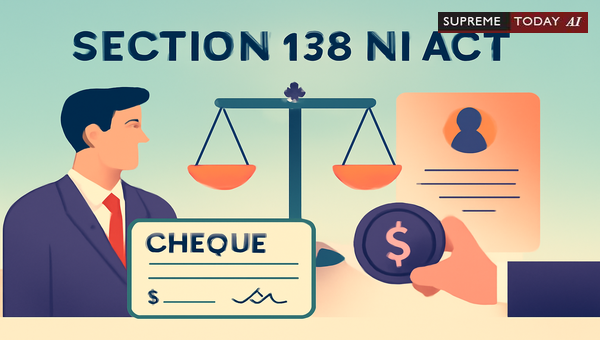
Cheque bounce cases under () are common in India, often arising from bounced cheques issued for alleged debts. A frequent defense raised by the accused revolves around the complainant's financial capacity to lend the claimed amount. But does the accused in a 138 case need to prove his financial capacity? This question lies at the heart of many such proceedings, where the can shift dynamically based on evidence.
In this comprehensive guide, we'll explore the legal principles, presumptions, and judicial insights governing financial capacity in Section 138 cases. Whether you're an accused facing a complaint or advising on such matters, understanding these nuances is crucial. Note: This article provides general information based on legal precedents and is not a substitute for professional legal advice. Consult a qualified lawyer for case-specific guidance.
Section 138 criminalizes the due to insufficient funds or other reasons, provided the cheque was issued for discharge of a . A key provision here is , which creates a that every cheque was issued for such a debt. This presumption is , allowing the accused to challenge it with evidence. 2023 0 Supreme(Mad) 1978 2022 0 Supreme(P&H) 95
Initially, the complainant bears the burden to establish the existence of the debt. However, once a is raised—such as questioning the complainant's ability to lend—the onus may shift back. Financial capacity becomes pivotal: courts scrutinize whether the complainant had the means to advance the loan amount. 2020 0 Supreme(Ker) 237 2014 5 Supreme 632
The proceedings under Section 138 are , not full civil suits, so the standard of proof is based on the . The complainant must typically prove the transaction, but financial capacity isn't always front-loaded.
Girdhari Lal Rathi VS P. T. V. Ranianujachari & another - Dishonour Of Cheque (1997)
Courts have clarified that once the accused admits obtaining a loan, cross-examining the complainant's financial capacity may be unnecessary unless a strong challenge is mounted. However, effective revealing lacks—like no bank transactions—can tip the scales. 2023 0 Supreme(Bom) 927 In one observation: Complainant had no financialcapacity and there is no evidence to show transactions between the Complainant and the Accused. 2023 0 Supreme(Bom) 927
From other precedents: However, the trial Court for non-production of Account Statement has erroneously held that complainant has failed to prove the financialcapacity to lend the money to accused. 2022 0 Supreme(Kar) 1544 This highlights how missing documents can doom the complaint.
Contrary to the notion that the accused must prove his own financial capacity, the focus is primarily on the complainant. If the complainant fails to show they could lend the amount—especially large sums—it often leads to acquittal.
Raj Kumar Goel VS State of U. P. - Dishonour Of Cheque
Additional insights affirm: Courts have noted that the proceedings under Section 138 are not civil suits, and the complainant need not prove his financial capacity at the outset. However, if the accused raises a probable defence questioning this capacity, the onus shifts. 2025 0 Supreme(HP) 463 2023 0 Supreme(HP) 565 2023 0 Supreme(Tri) 48
The accused typically doesn't prove their capacity unless admitting the transaction and countering repayment claims. Instead, they highlight complainant gaps.
Courts demand tangible proof:
Failure is fatal: In several cases, courts have acquitted the accused when the complainant failed to prove their financial capacity or the source of funds. 2020 0 Supreme(P&H) 884 2017 8 Supreme 674
Judicial precedents shape this area:
These cases underscore: Accused need not prove their capacity outright; a credible challenge suffices.
In Section 138 cases, the accused does not primarily need to prove their own financial capacity. Instead, by raising a on the complainant's capacity, the burden shifts, often leading to dismissal if unmet. The presumption under favors efficiency, but evidence rules.
Key Takeaways:- Presumption exists but is challengeable. 2023 0 Supreme(Mad) 1978- Challenge complainant's capacity via cross-exam to shift onus. 2020 0 Supreme(Ker) 237- Courts acquit on capacity failures. 2020 0 Supreme(P&H) 884- Use documents like statements for proof. 2020 0 Supreme(Kar) 1271
Stay informed, gather evidence, and seek expert counsel. Cheque bounce defenses hinge on these principles.
References: 2023 0 Supreme(Mad) 1978 2022 0 Supreme(Mad) 3643 2022 0 Supreme(P&H) 95 2020 0 Supreme(Ker) 237 2014 5 Supreme 632 2020 0 Supreme(Kar) 1271 2020 0 Supreme(P&H) 884 2017 8 Supreme 674 2008 0 Supreme(MP) 1392 2023 0 Supreme(Bom) 927 2022 0 Supreme(Kar) 1544 2025 Supreme(Online)(MP) 9434 2025 0 Supreme(Guj) 1093 2017 0 Supreme(All) 2316
Raj Kumar Goel VS State of U. P. - Dishonour Of Cheque
2025 0 Supreme(HP) 463 2023 0 Supreme(HP) 565 2024 0 Supreme(HP) 262 2024 0 Supreme(Guj) 1049 2023 0 Supreme(Tri) 482023 0 Supreme(Guj) 640 #Section138, #ChequeBounce, #NIACT


have explained his financial capacity. ... The learned Trial Court found sufficient reasons to summon the accused for the commission of an offence punishable under Section 138 of the NI Act, to which, the accused pleaded not guilty and claimed to be tried. The complainant examined himself (CW1) and Prakash Chand (CW2) to prove his case. ... The observation of the High C....

Complainant had no financial capacity and there is no evidence to show transactions between the Complainant and the Accused. 9. Mr Agha placed reliance in the case of Rohitbhai Jivanlal Patel vs. ... He then would submit that the cross examination of the Complainant about his financial capacity was absolutely unnecessary once the Accused admits of obtaining loan from th....

have explained his financial capacity. ... The Trial Court and the First Appellate Court have noted that in the case under Section 138 of the N. I. Act, the complainant need not show in the first instance that he had the capacity. The proceedings under Section 138 of the N. I. Act is not civil suit. ... He admitted that he had filed the Income Tax Return of Rs.1,70,000/-There was no docu....

It was further held that the accused has a right to demonstrate that the complainant did not have the financial capacity. It was observed:- “9. The Trial Court and the First Appellate Court have noted that in the case under Section 138 of the N. I. ... have explained his financial capacity. ... The observation of the High Court that the trial court's finding that the co....

show that he had the financial capacity. ... However, the trial Court for non-production of Account Statement has erroneously held that complainant has failed to prove the financial capacity to lend the money to accused. ... In the present case, the accused has not elicited anything worth material in the cross-examination of PW1 that he has no #HL_STAR....

evidence to show that he had the financial capacity. ... He, therefore, submitted that the trial Court committed error in shifting burden upon the complainant to prove his financial capacity, which otherwise was not a ground raised in the reply to the legal notice by the accused. He, therefore, urge this Court to grant leave to appeal. ... The Trial Court and the First Appellate Court ha....

Thus, the initial burden in respect of financial capacity to advance the aforesaid amount of Rs.4.00 lakhs to the accused has been well established by the complainant in this case. ... It is submitted by the learned counsel for the appellant/complainant that the learned Trial Court has convicted the respondent/accused, however the learned appellate court has acquitted the accused on the ....

In order to prove his financial capacity, the complainant placed reliance on Ex.P6 to Ex.P9 i.e. his Form-16 for the financial years 2009-10 to 2013-14 and Ex.P10-his bank account statement from 01.01.2009 to 31.12.2014. ... It is appropriate to mention here that the complainant has no necessity to establish his financial capacity as per the decision in M. Vidyavathi v. ... However, the ....

his financial capacity. ... We are, thus, satisfied that accused has raised a probable defence and the findings of the trial court that complainant failed to prove his financial capacity are based on evidence led by the defence. ... The observation of the High Court that trial court's finding that the complainant failed to prove his financial #HL_START....

Whether the Accused is able to show that Complainant has failed to prove his financial capacity to give loan to the Accused as alleged. B. ... It is a settled legal position as culled out from the various decisions of the Hon’ble Supreme Court that whenever accused challenges the financial capacity of the complainant then it is always incumbent upon th....
S. No. 148 of 2011 filed by the complainant for recovery of a loan of Rs. 7 lakhs given to one Balana Gouda in December 2009. Thus, there was evidence on record to indicate that in December 2009, he gave Rs. 7 lakhs in a sale agreement, in 2010, he made a payment of Rs. 4,50,000/- towards sale consideration and further, he gave a loan of Rs. 50,000/-for which complaint was filed in 2012 and further loan of Rs. 6 lakhs in November 2011. 27. There was another evidence on the record, i.e., a copy....

Vijaysinh Somsinh Chauhan has been examined as a witness, but in the examination in chief has not mentioned that he had given any amount to the complainant to give to the accused, and the father of the complainant, brother-in-law of the complainant and the father-in-law of the complainant have not been examined on oath before the learned Trial Court to prove that they had given any amounts to the applicant. As the accused has challenged the financial capacity of the applicant the bur....

But, when the case of the complainant is that he lent money to the accused by cash and that the accused issued the cheque in discharge of the liability, and if the accused challenges the financial capacity of the complainant to advance the money, despite the presumption under Section 139 of the Act, the complainant has the obligation to prove his financial capacity or the source of the money allegedly lent by him to the accused. In my view, the crux of the decisions referred ....

If the accused failed to produce the receipts in criminal proceedings, the prosecution has to succeed or fail on its own case depending upon the oral and documentary evidence on record. In this case, as the complainant failed to prove satisfactorily that he has sufficient capacity to lend the amount of Rs. 1,25,000/- and more so, by way of cheque and his failure to prove that the amount was actually drawn by the accused, the accused cannot be punished for an offence under Section 138....
If the accused failed to produce the receipts in criminal proceedings, the prosecution has to succeed or fail on its own case depending upon the oral and documentary evidence on record. In this case, as the complainant failed to prove satisfactorily that he has sufficient capacity to lend the amount of Rs. 1,25,000/- and more so, by way of cheque and his failure to prove that the amount was actually drawn by the accused, the accused cannot be punished for an offence under Section 138....


An indispensable Tool for Legal Professionals, Endorsed by Various High Court and Judicial Officers
Please visit our Training & Support
Center or Contact Us for assistance

Scan Me!
India’s Legal research and Law Firm App, Download now!


For Daily Legal Updates, Join us on :



 Back to top


