


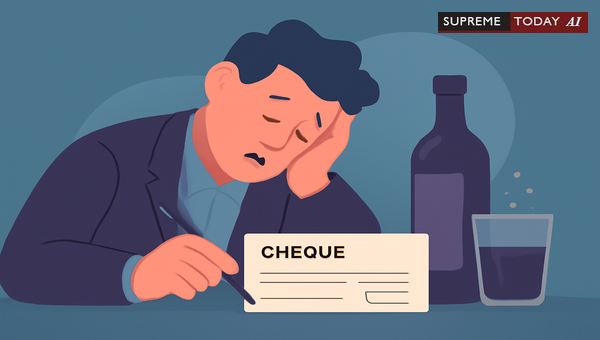
Is a Cheque Drawn While Drunk Valid Under Law?
In the fast-paced world of business transactions, cheques remain a cornerstone of financial dealings in India. But what happens when a cheque is signed after a few drinks? A common myth circulates: A cheque drawn under the influence of alcohol is not considered a and is not a legal debt. Is this true? This blog post dives deep into the legal nuances under the (), examining presumptions, validity challenges, and judicial perspectives to clarify this issue.
We'll explore whether intoxication automatically voids a cheque, the role of evidence, and practical takeaways. Note: This is general information based on legal precedents and not specific legal advice. Consult a qualified lawyer for your situation.
What Makes a Cheque a ?
Under , a cheque is defined as a —a drawn on a specified banker and payable on demand. 2001 7 Supreme 810
2001 6 Supreme 875. The law treats cheques with a strong under , meaning courts assume every was made or drawn for consideration unless proven otherwise. 2022 0 Supreme(SC) 1276 2005 0 Supreme(Ker) 357 2023 0 Supreme(All) 907.
mandates the Courts to believe :- (a) that every was made or drawn for consideration... 2024 0 Supreme(Chh) 243. This presumption shifts the focus: mere issuance implies a .
Does Intoxication Automatically Invalidate a Cheque?
No—a cheque drawn under the influence of alcohol does not automatically lose its status as a or cease to represent a legal debt. Its validity depends on the circumstances and evidence. 2022 0 Supreme(SC) 1276. Mere intoxication doesn't categorically invalidate it; the drawer must prove incapacity, , or rendered the act involuntary. 2022 0 Supreme(SC) 1276 2001 7 Supreme 810.
Courts emphasize that the presumption under holds unless rebutted. For instance, the presumption under Section 118 and 139 of the N.I. Act and the on the complainant is often misapplied; actually, once execution is admitted, the burden shifts to the accused. 2024 0 Supreme(Chh) 243. In one case, the erred by placing the burden on the complainant despite the accused's admission of debt, leading to conviction under . 2024 0 Supreme(Chh) 243.
The : Key to Challenging Validity
Once a cheque's execution is proven or admitted, presumes it was issued for a . The drawer bears the burden to rebut this with cogent evidence. 2022 0 Supreme(SC) 1276 2005 0 Supreme(Ker) 357 2023 0 Supreme(All) 907.
Intoxication might factor in as evidence of incapacity, but it must show the drawer's free will was impaired. The intoxication of the drawer might be relevant to establish incapacity, but the evidence must substantiate that the intoxication rendered the act of drawing the cheque involuntary or invalid. 2022 0 Supreme(SC) 1276.
Related precedents reinforce this:- Presumptions as to negotiable instruments - Until the contrary is proved... The presumption can be rebutted, but mere denial isn't enough; the complainant may still need to prove debt existence in some contexts. 2024 0 Supreme(Guj) 1953.- In a case involving part-payments, courts clarified that without endorsement under , a cheque might not reflect the current debt, but intoxication wasn't the issue—enforceability was. 2022 8 Supreme 240.
The , legal presumptions, and the accused's admission of debt in the issuance of the cheque are crucial in determining liability under the . 2024 0 Supreme(Chh) 243.
Judicial Approach to Intoxication and Cheque Disputes
While no provided document directly rules on alcohol-induced cheques, general principles apply. Courts examine:- Circumstances of issuance: Witness testimony, drawer's conduct, medical evidence. 2022 0 Supreme(SC) 1276.- Voluntariness: Was the act truly involuntary? Mere tipsiness rarely suffices without proof of total incapacity. 2022 0 Supreme(SC) 1276.
In broader cases:- When issuance for debt is doubtful, presumption under Section 118 may not apply. When the issuance of cheque for existing debt itself is doubtful, the presumption under Section 118 , ought not to have drawn. 2021 0 Supreme(Mad) 514 2021 0 Supreme(Mad) 1455.- No legally recoverable debt means no offense. When there is no debt or liability exists, then the said cheque amount will not become legally recoverable debt... 2020 0 Supreme(Kar) 2156.- (e.g., unauthorized date insertion) void instruments under , but intoxication isn't analogous unless proven non-consensual. 2015 0 Supreme(Guj) 2373.
These cases highlight that defenses like intoxication require , not bald assertions.
Exceptions Where Intoxication Could Matter
- Proven incapacity: If intoxication rendered the drawer unable to understand the act, validity could be challenged. 2022 0 Supreme(SC) 1276.
- or : Combined with alcohol, this strengthens rebuttal. 2001 7 Supreme 810.
- No underlying debt: Even sober, absence of consideration defeats enforcement. 2023 0 Supreme(All) 907.
However, Mere intoxication without evidence of incapacity or may not suffice to invalidate a . 2022 0 Supreme(SC) 1276. Courts presume validity unless rebutted. 2023 0 Supreme(All) 907.
Practical Recommendations for Parties Involved
- For drawers: If claiming intoxication, collect evidence promptly—witnesses, medical reports, timelines. Don't rely on self-serving statements.
- For holders: Prove execution and rely on presumptions; counter rebuttals with transaction records.
- Litigation tip: In proceedings, comply with notice requirements; courts assess holistic evidence. 2015 0 Supreme(Ker) 515.
The court emphasized the need for complainant to establish debt existence for successful prosecution under . 2024 0 Supreme(Guj) 1953. Balance presumptions with proof.
Conclusion and Key Takeaways
A cheque drawn under alcohol's influence remains a presumptively valid representing a legal debt under the . Intoxication alone doesn't invalidate it—the drawer must rebut the strong presumptions of with solid evidence of incapacity or involuntariness. Judicial trends prioritize enforceability unless defenses are substantiated.
Key Takeaways:- Presumption rules: Cheques are valid for consideration by default. 2022 0 Supreme(SC) 1276.- Burden on accused: Prove lack of debt or invalidity. 2024 0 Supreme(Chh) 243.- Evidence is king: Intoxication needs context to challenge enforceability.- Seek advice: Each case turns on facts—consult professionals.
Stay informed, transact wisely, and remember: one drink too many doesn't erase legal obligations without proof.
References (select excerpts):1. 2022 0 Supreme(SC) 1276: Presumption and burden details.2. 2001 7 Supreme 810: Cheque definition.3. 2024 0 Supreme(Chh) 243: Section 118 presumptions.4. 2024 0 Supreme(Guj) 1953: Rebuttal of presumption.
#ChequeLaw #NIAct #LegalInsights












