


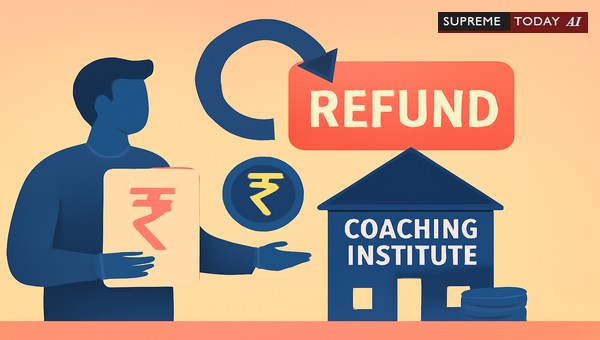
Can Coaching Institutes Charge Advance Fees Without Refund?
In the competitive world of education in India, coaching institutes play a pivotal role in preparing students for exams like JEE, NEET, and UPSC. However, disputes often arise over advance fees—especially when students discontinue or institutes fail to deliver promised services. A common question parents and students ask is: Can coaching institutes take advance fees without refund?
This blog post dives into the legal landscape under Indian consumer protection laws, analyzing key judgments and principles. We'll explore whether such practices are lawful, what courts have ruled, and practical recommendations. Note: This is general information based on precedents; consult a lawyer for specific advice.
Legal Framework: Consumer Rights in Coaching Services
Coaching institutes fall under the (and its predecessor, the ), treating students as consumers and institutes as service providers. Charging fees upfront is not inherently illegal, but retaining them without delivering services can amount to a or .
Principles of fair trade imply that fees must correspond to services rendered. Courts have consistently held that demanding full advance fees for extended periods without refunds for unutilized portions violates consumer rights. For instance, the judgment in
FIIT JEE LTD. VS MINATHI RATH - Consumer ()
establishes that coaching institutes must refund fees for unattended periods if they collect advance payments.The court held that demanding full advance fees and not refunding for unattended periods is unjustified and violates consumer rights.
FIIT JEE LTD. VS MINATHI RATH - Consumer ()
Key Court Rulings on Advance Fees and Refunds
Obligation to Refund Unutilized Fees
When a student discontinues or does not attend, institutes are generally required to refund the unused portion of fees, particularly if paid in advance. The ruling in
FIIT JEE LTD. VS MINATHI RATH - Consumer ()
clarifies:Coaching institutes must refund the unutilized portion of fees if the student discontinues or does not attend the coaching.
Terms like no refund clauses are scrutinized and often deemed unfair if they contravene consumer laws
. Courts prioritize equity over rigid contract terms.
Advance Fees as
Several cases reinforce this. In
, referencing :
Charging fees in advance beyond the current semester/year would certainly amount to and the same cannot be countenanced... should only be asked to pay fees for a semester/year to begin with.
Here, the commission criticized institutes for collecting multi-year fees upfront without refunding balances, directing refunds for excess amounts taken.
Similarly,
echoes this, noting:
Charging fees in advance beyond the current semester/year would certainly amount to ... The appellant – Institute is not only a structure made up of bricks and cement where the students go and get coaching after paying hefty fees.
These precedents highlight that advance fees for future periods are problematic unless tied to actual service delivery.
Specific Instances of Refunds Ordered
In 2024 Supreme(Online)(NCDRC) 840, a complaint sought refund of Rs.26,986/- paid for advance squash coaching fees after the complainant stopped attending. The ordered a refund, emphasizing service obligations. This aligns with broader coaching disputes where partial attendance triggers .
When Can Institutes Retain Advance Fees?
Institutes may retain fees for:- Services already rendered: Proportionate to classes attended.- Reasonable administrative costs: But not the entire amount unilaterally.
However, blanket non-refund policies are vulnerable. As per
, such clauses may be challenged if they deny refunds without justification.
Terms and conditions that specify no refunds may be subject to scrutiny; courts have found such clauses unfair if they contravene consumer protection principles.
Practical Implications for Students and Institutes
For Students and Parents
- Document everything: Keep receipts, enrollment forms, and attendance records.
- Demand : Cite consumer laws when requesting refunds for unutilized periods.
- File complaints: Approach if denied; no court fee for claims under Rs. 5 lakhs.
- Negotiate upfront: Insist on clear refund clauses in agreements.
For Coaching Institutes
- Adopt fair policies: Charge semester-wise or offer .
- Transparent agreements: Include refund terms compliant with consumer laws.
- Avoid excess advances: Limit to current session to prevent claims.
Recommendations from legal analysis include ensuring clear refund terms in admission agreements and adhering to fair practices
FIIT JEE LTD. VS MINATHI RATH - Consumer ()
.Broader Context: Evolving Regulations
The education sector sees growing scrutiny. While the law doesn't prohibit advance fees outright, it mandates refunds if services aren't fully provided. Charging without delivering coaching can lead to legal action for
FIIT JEE LTD. VS MINATHI RATH - Consumer ()
.Recent NCDRC trends, as in
and
, push for semester-based payments, protecting economically weaker students who can't afford hefty upfront sums.
Key Takeaways
- Upfront fees are allowed, but only if services are delivered as promised.
- Refunds mandatory for unutilized portions upon discontinuation
FIIT JEE LTD. VS MINATHI RATH - Consumer ()
. - No-refund clauses often unfair and challengeable
.
- if charging multi-year advances without refunds
.
- Act promptly: Use consumer forums for quick redressal.
In summary, while coaching institutes can take advance fees, they cannot retain them arbitrarily without refunds. This balances business needs with student rights under Indian law.
Disclaimer: This post provides general insights based on judgments like
FIIT JEE LTD. VS MINATHI RATH - Consumer ()
,,
, 2024 Supreme(Online)(NCDRC) 840, and
. Laws evolve, and outcomes depend on facts. Seek personalized legal advice for your situation. #CoachingFeesRefund #ConsumerRightsIndia #LegalIndia















