


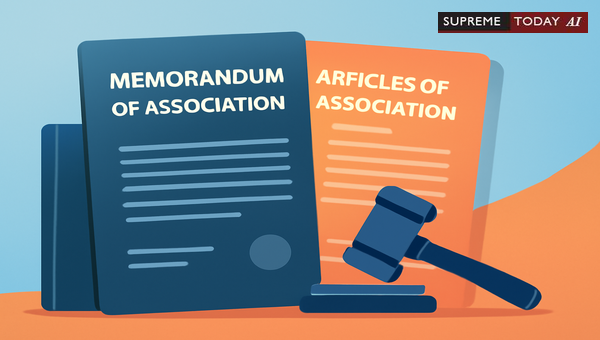
: Does Companies Act 1956 Compliance Hold Under 2013?
In the evolving landscape of Indian corporate law, companies formed under the , often grapple with ensuring their foundational documents align with the more stringent . A key question arises: Companies Act 1956 Compliance with Companies Act 2013—does the (MoA) or (AoA) drafted under the old regime automatically comply with the new Act, or do statutory provisions override any inconsistencies? This is crucial for business owners, directors, and legal professionals navigating transitions and amendments.
This post delves into the legal principles of , judicial interpretations, and practical recommendations. While the MoA outlines a company's objectives and AoA governs internal management, both are subordinate to the governing statute. Let's break it down.
The Nature of MoA and AoA in Indian Company Law
The defines a company's scope of activities, while the serve as internal regulations governing management, shares, meetings, and member rights. Under the , these were key constitutional documents, but the 2013 Act introduced reforms emphasizing flexibility and compliance.
The AoA acts as a between the company and its members, and among members themselves
. However, it is merely an internal framework and cannot override . Similarly, the MoA's conditions must align with the Act; any conflict triggers statutory precedence.
As noted in judicial precedents, in case of conflict between the provisions of the Companies Act and the or , it is, as laid down by , the provisions, contained in the Companies Act, which would prevail 2009 0 Supreme(Gau) 854. , 2013, explicitly reinforces this hierarchy: the Act overrides the MoA and AoA where inconsistencies arise.
: Act Prevails Over MoA and AoA
A fundamental principle is that statutory law trumps company documents. Provisions in the AoA or MoA attempting to fetter statutory powers—such as altering articles or exercising rights—are invalid if they conflict with mandatory requirements
.
For instance, under (analogous to Indian provisions), the MoA and AoA impose contractual obligations but remain subject to the Act
. Courts have consistently held that inconsistent AoA clauses, like Governing Power provisions limiting statutory rights, are subordinate or void
.
Transitioning from the 1956 Act to 2013, companies must review their MoA for compliance. The 2013 Act simplified the MoA by entrenching objects clauses into the AoA ( vs. ), but legacy MoA provisions conflicting with new rules—e.g., on share capital or director qualifications—yield to the statute.
Judicial Approach to Conflicts
Courts prioritize statutory compliance. In cases involving amendments, resolutions under , for deleting or altering AoA articles (e.g., Article 57) must adhere to statutory procedures 2012 0 Supreme(Bom) 2376. Failure to do so renders changes ineffective.
Another example: Challenges to security deposits under , for elections were upheld as rational for orderly conduct, aligning AoA provisions with the Act 2017 0 Supreme(Del) 1139. The court noted, the condition for pre-deposit of Rs.1 lakh under for contesting elections was held to be formulated to ensure orderly conduct of the elections and was found to .... 2017 0 Supreme(Del) 1139
In shareholder disputes, decisions to sell shares or assets, even if backed by AoA, cannot prejudice statutory interests. A minority shareholder's must not override company decisions unless invoking under (now ) 2009 0 Supreme(Gau) 854.
Malaysian precedents offer analogous insights: AoA provisions cannot contravene the , mirroring India's Section 9
.
Key Exceptions and Limitations
While rare, exceptions exist if the Act expressly permits deviations. For example:- AoA may include provisions allowed by law, but mandatory rules (e.g., director independence under 2013 Act) cannot be bypassed.- Amendments require and filing (), subject to Registrar scrutiny.
Courts scrutinize clauses fettering powers: The courts will scrutinize any AoA provisions that seek to fetter statutory powers or rights, and such provisions are likely to be invalid if they conflict with mandatory statutory requirements
.
In government companies, even shareholder directions (e.g., Governor under ) are limited to policy, not day-to-day operations 1995 0 Supreme(Pat) 334. The Governor's power to issue directions under Article 123 of the Nigam's is limited to broad policy matters and not day-to-day administration 1995 0 Supreme(Pat) 334.
Bonus share issuances from revaluation reserves, permitted where law allows (), must comply with AoA interpretations favoring statutory permission 2005 5 Supreme 631.
Practical Recommendations for Compliance
To ensure MoA/AoA under 1956 complies with 2013:- Review and Amend: Conduct a clause-by-clause audit against (MoA/AoA) of the 2013 Act. Delete inconsistent provisions, like outdated objects clauses.- : Pass resolutions per , file Form INC-2/INC-7.- Seek Approvals: For changes affecting creditors or public interest, notify stakeholders.- Professional Advice: Engage company secretaries to align with , norms if applicable.- In Conflicts: Rely on Section 9—statute prevails, avoiding litigation.
Legacy companies have until specified transitions (e.g., via MCA notifications) but proactive compliance prevents penalties.
Conclusion and Key Takeaways
In summary, the under , does not automatically fully comply with the 2013 Act; statutory provisions prevail over any inconsistent MoA or AoA clauses. The are internal regulations that must conform to the statutory provisions of the Companies Act and other relevant laws. In cases of conflict, the law prevails
Key Takeaways:- Statute > MoA/AoA in conflicts (Section 9, 2013 Act).- Amend proactively to avoid invalidity.- Courts enforce compliance, protecting stakeholders.
This post provides general insights based on legal precedents and is not specific legal advice. Consult a qualified lawyer for your company's situation.
References
: Primacy of statutory law over AoA.
: AoA as subordinate internal regulations.
: Validity under statutory sections.
- 2009 0 Supreme(Gau) 854: Section 9 supremacy.
- 2017 0 Supreme(Del) 1139: Section 160 compliance.
- 2012 0 Supreme(Bom) 2376: AoA amendments.
- 1995 0 Supreme(Pat) 334: Limits on directions.
- 2005 5 Supreme 631: Bonus shares and reserves.















