


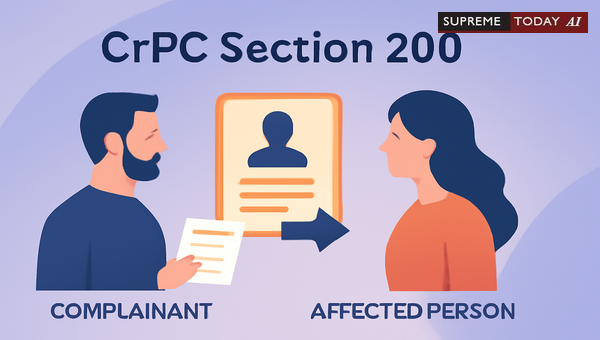
When Isn't the Affected Person in CrPC Cases
In criminal proceedings under the , a common misconception is that the must always be the person directly harmed by the offense. But what happens when the is not an affected person? This question arises frequently in cases involving third-party filings, corporate complaints, or public interest matters. Understanding this distinction is crucial for lawyers, businesses, and individuals navigating India's criminal justice system.
This blog post breaks down the legal framework, drawing from statutory provisions and judicial precedents. Note that this is general information based on established principles and should not be taken as specific legal advice—consult a qualified attorney for your situation.
Defining the Under CrPC
The CrPC, whether the old version or the new , does not explicitly define '.' However, it generally refers to the person who initiates the complaint and is examined under 1998 1 Supreme 116 1997 0 Supreme(Raj) 926 1997 0 Supreme(Raj) 924.
- Key Procedural Step: Examination under Section 200 is pivotal. The magistrate records the 's statement on oath, marking them as the official 2001 3 Supreme 343 1991 0 Supreme(Raj) 732.
- Broad Scope: This role isn't limited to natural persons. A , like a company, qualifies as a 'person' under (adopted by new CrPC ) and can file complaints 1998 1 Supreme 116 1997 0 Supreme(Raj) 926 1997 0 Supreme(Raj) 924.
This procedural lens separates the 's role from substantive victimhood.
Affected Person vs. : The Core Distinction
The need not be the affected person or victim. Courts have clarified that:
- No Prerequisite of Harm: A person without direct grievance can be the if they file the complaint and undergo . Personal injury isn't required 2001 3 Supreme 343.
- Filing is Key: Only the filer examined under Section 200 holds status, even if indirectly interested 2001 3 Supreme 343 1991 0 Supreme(Raj) 732.
- Reverse Scenario: An affected party who doesn't file or get examined isn't the 2001 3 Supreme 343.
For instance, in defamation cases, third parties might initiate proceedings if procedurally compliant, though specific offenses like defamation under often require the 's direct involvement 2000 0 Supreme(Raj) 66 2024 0 Supreme(Mad) 2291. In one case, a lacked standing: A defamation complaint must be filed by the directly, as a lacks standing under 2024 0 Supreme(Mad) 2291. This highlights offense-specific nuances but reinforces CrPC's general flexibility.
Juristic Persons as Complainants
Companies and other entities frequently act as complainants in , cheating, or fraud cases. As long as they authorize a representative for , their juristic status suffices 1998 1 Supreme 116 1997 0 Supreme(Raj) 926 1997 0 Supreme(Raj) 924.
This broadens access to justice, allowing regulatory bodies or organizations to prosecute without a 'victim' in the traditional sense.
Practical Implications and Examples
The rule has real-world applications:
- Third-Party Complaints: In or societal harms, any motivated individual can complain without personal loss 2001 3 Supreme 343.
- Defamation and Others: A third party not directly defamed might file if examined, though courts scrutinize 2000 0 Supreme(Raj) 66.
- Corporate Scenarios: Businesses report crimes affecting operations, positioning themselves as complainants regardless of direct 'affected' status.
Recommendations for Practitioners:- Emphasize procedural compliance (filing + Section 200 exam) over personal injury when arguing status.- For juristic entities, ensure proper authorization to avoid challenges.
Insights from Related Legal Contexts
While CrPC governs criminal complaints, parallels in consumer and other laws illustrate the -affected divide:
- Consumer Protection: A must typically be a 'consumer,' excluding pure commercial users unless for livelihood. A consumer is one who hires or avails of services but does not include a person who avails of any facility for commercial purpose
. In real estate delays, non-consumers lack , mirroring CrPC's procedural focus
.
- Domestic Violence (): The 'aggrieved person' must prove shared household ties; transient visits don't qualify 2022 0 Supreme(Del) 1603.
- Project Affected Persons: Strict definitions exclude extended family like 'grand daughter-in-law' unless dependent 2022 0 Supreme(Bom) 716. We find this submission to be fallacious... Chandrashekhar, would also become an affected person which is not permissible as she would be the great grand daughter-in-law of the affected person 2022 0 Supreme(Bom) 716.
- Agriculture Subsidy Case: A farmer with damaged crops on his land had despite joint project: There was annatto crop planted in the field of the which was found damaged... the had suffered loss
.
These cases underscore that while CrPC is permissive, domain-specific laws impose stricter 'affected' requirements.
In banking, loss of documents compromised title, affirming standing for service deficiencies
.
Key Takeaways and Conclusion
- Primary Criterion: status hinges on filing and examination, not being affected 2001 3 Supreme 343.
- Juristic Flexibility: Companies can initiate without human victims 1998 1 Supreme 116.
- Caveats: Offense-specific rules (e.g., defamation) may demand direct aggrievement 2024 0 Supreme(Mad) 2291.
In summary, CrPC empowers broader participation in criminal justice, distinguishing procedural complainants from substantive victims. This facilitates efficient prosecutions but requires careful navigation of exceptions. For tailored guidance, seek professional legal counsel.
This post aligns with principles from cited judgments and statutes, offering general insights only.
#CrPC #CriminalLaw #ComplainantRights















