Searching Case Laws & Precedent on Legal Query.....!
Analysing the retrieved Case Laws
Scanned Judgements…!



Searching Case Laws & Precedent on Legal Query.....!
Analysing the retrieved Case Laws
Scanned Judgements…!
Signature does not amount to relinquishment unless there is an express clause - A consenting signature or witness agreement signifies awareness and non-objection but does not constitute a relinquishment of share unless explicitly stated in a clause. Courts emphasize that mere signature without an express clause cannot be deemed as giving up one's share ["2025 Supreme(Online)(Kar) 438824"].
Relinquishment deeds require proper proof and registration - Several sources highlight that relinquishment deeds must be registered to be admissible in evidence. Unregistered deeds or vague proof, such as unidentified signatures or lack of proper identification, weaken the claim of relinquishment. For example, the relinquishment deed itself is not produced at all nor it is the case of defendant that it was the registered one ["2023 0 Supreme(Bom) 1807"], and relinquishment deed requires to be registered otherwise it is not admissible in evidence ["2023 0 Supreme(Bom) 1807"].
Relinquishment can be inferred from conduct, such as accepting consideration and executing receipts - Courts have recognized that relinquishment of shares can be inferred from circumstances like receipt of consideration and execution of receipts, even without a registered deed. For instance, relinquishment of his share by accepting amount and executing a receipt for the same is sufficient to infer relinquishment ["2025 0 Supreme(Telangana) 112"], ["2025 Supreme(Online)(Tel) 52883"].
Mere signing without knowledge or explicit agreement does not constitute relinquishment - When signatures are obtained without the signatory’s knowledge or understanding, especially in cases involving illiterate or blind persons, such signatures do not amount to valid relinquishment. Mere putting of signature on a document without knowing its content by a blind, illiterate widow will amount to execution of the document? ["2025 0 Supreme(Ker) 2193"].
Relinquishment does not necessarily alter the nature of joint or coparcenary property - Relinquishment of a coparcener's share in joint family property does not amount to alienation but results in the extinction of his interest. Relinquishment by one coparcener of his interest in favour of the others does not amount to alienation; it merely amounts to extinction of his interest ["2022 Supreme(Online)(MAD) 18127"], ["2024 0 Supreme(Guj) 2085"].
Relinquishment deeds are often mistaken for gift deeds and require careful legal classification - Some documents labeled as relinquishment deeds are treated as gift deeds by authorities, especially if not properly executed or registered. The relinquishment deed was treated as a gift deed by the Director of Stamps ["2022 0 Supreme(Guj) 1485"].
Legal effect of relinquishment depends on registration and proper execution - Without registration, relinquishment deeds are invalid and do not affect the rights of other co-sharers. Admittedly the relinquishment deed is not a registered document and thus, it was not admitted in evidence ["2003 0 Supreme(Kar) 724"].
Express clauses or explicit provisions are necessary for relinquishment to be effective - Courts stress that relinquishment must be explicitly stipulated; otherwise, signatures or conduct alone do not suffice to prove a transfer or waiver of rights ["2025 Supreme(Online)(Kar) 438824"].
Analysis and Conclusion:The consensus across the sources is that a consenting signature or deed does not automatically amount to relinquishment of share unless there is an explicit clause or properly registered document indicating such intent. Mere signatures, especially when not understood or obtained without knowledge, are insufficient. Relinquishment can be inferred from conduct, such as accepting consideration and executing receipts, but formal registration remains crucial for legal validity. Therefore, unless an express clause or proper legal documentation exists, a signatory's consent alone does not constitute relinquishment of share rights ["2025 Supreme(Online)(Kar) 438824"], ["2023 0 Supreme(Bom) 2068"], ["2025 0 Supreme(Telangana) 112"].
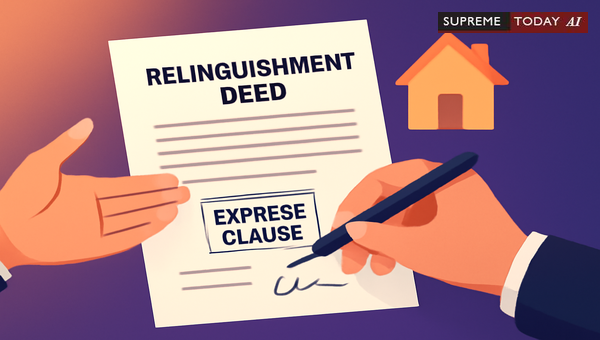
In property disputes, family settlements, and coparcenary matters, a common misconception arises: does simply signing a document with consent mean you've given up your share or interest? The legal question at the heart of this issue is clear—a consenting signature does not amount to relinquishment unless there is an giving up share. This principle protects parties from unintended consequences of ambiguous agreements. Understanding this rule is crucial for property owners, heirs, and business partners to safeguard their rights.
This blog post dives into the judicial stance, key case law, and practical advice, drawing from established precedents. Note: This is general information based on court rulings and not specific legal advice. Consult a qualified lawyer for your situation.
Courts have consistently ruled that a signature on a document, even indicating consent, does not automatically amount to relinquishment of a share or interest unless there is an explicit or clear clause expressly stating that the signatory is giving up or transferring their share2024 0 Supreme(Guj) 2085.
This principle stems from the need for certainty in legal transactions, especially in family properties or joint ownerships where interests are undivided.
Relinquishment deeds or agreements only qualify as such when they contain clear language indicating an intention to relinquish rights2024 0 Supreme(Guj) 2085. For instance, the Full Bench of the in clarified that a coparcener's relinquishment of interest in the family estate in favor of other members does not amount to but merely extinguishes their interest. Crucially, it must be clearly expressed through explicit language, without needing adjustment of rights or division of wealth 2024 0 Supreme(Guj) 2085.
A signature typically signifies agreement or consent but falls short of implying relinquishment absent specific wording. In family settlements or coparcenary contexts, courts demand clear terms for any gift or release of interest 2024 0 Supreme(Guj) 2085.
The absence of an renders a signature ineffective for relinquishment. As reiterated by the , waiver or relinquishment involves an intentional act based on clear language or conduct2017 5 Supreme 165 1981 0 Supreme(Raj) 109. Mere consent does not meet this threshold.
Drafting tip: Always include phrases like I hereby relinquish and give up my undivided share in favor of... to avoid ambiguity.
In Chella Subbanna, the court held that relinquishment in favor of remaining coparceners must be explicitly stated and does not equate to a gift to one member 2024 0 Supreme(Guj) 2085. This aligns with broader precedents where courts scrutinize document language rigorously.
Relatedly, in disputes, relinquishment deeds by co-owners do not automatically constitute requiring higher duty; evidentiary context determines classification 2025 0 Supreme(Del) 489. The stressed examining intent and evidence before impounding such documents, noting a mother's relinquishment to her son wasn't inherently a gift without proof 2025 0 Supreme(Del) 489. This underscores that signatures on relinquishment deeds need contextual clarity, not presumptions.
While conduct like accepting rent or possession might imply waiver in specific scenarios, it requires clear evidence of intent2024 0 Supreme(Guj) 2085 2017 5 Supreme 165. Purely voluntary acts, such as giving up possession, do not amount to or relinquishment unless the law explicitly provides otherwise.
For example, courts have defined dispossess as ousting by legal process or physical exclusion, ruling that voluntary giving up of possession does not amount to 2016 0 Supreme(Guj) 2086 2016 0 Supreme(Guj) 1644 2003 0 Supreme(Guj) 175. In tenancy cases under the , voluntary surrender without legal compulsion was insufficient for invoking protective provisions 2016 0 Supreme(Guj) 2086. Similarly, in , courts refuse to ignore shares without express relinquishment by parties 2010 0 Supreme(AP) 1261.
These cases highlight that even in possession or tenancy contexts, relinquishment demands more than implied consent—echoing the signature rule.
In matters, signatures must serve specific purposes, like attesting execution in witnesses' presence, reinforcing intent's role 2011 0 Supreme(Del) 102. Failure to prove such intent invalidates claims.
To ensure your documents hold up:- Include explicit clauses: Clearly state I relinquish my share/interest in... when intended.- Avoid reliance on signatures alone: Consent forms need supporting language.- Seek evidence in disputes: Courts prioritize express terms over implications 2024 0 Supreme(Guj) 2085.- Consider : Relinquishment deeds may attract different duties than gifts; verify under the 2025 0 Supreme(Del) 489.- Document conduct carefully: Voluntary acts like possession handover don't imply relinquishment without clauses 2016 0 Supreme(Guj) 2086.
In partition proceedings, trial courts may value properties and offer buyout options, but only after confirming shares via express relinquishments 2010 0 Supreme(AP) 1261.
In summary, a consenting signature does not equate to relinquishment without an giving up the share. This protects against misinterpretations in property, family, and tenancy matters. Courts demand clarity to uphold intent, as seen across precedents from to the 2024 0 Supreme(Guj) 2085 2017 5 Supreme 165 1981 0 Supreme(Raj) 109 2025 0 Supreme(Del) 489.
Key Takeaways:- Prioritize explicit language in deeds and settlements.- Understand contextual nuances, like or possession rules.- Always consult legal experts for tailored advice.
By grasping this principle, you can navigate agreements confidently and minimize litigation risks. Stay informed, document diligently, and protect your interests.
References:1. 2024 0 Supreme(Guj) 2085: Full Bench on coparcenary relinquishment.2. 2017 5 Supreme 165: Waiver as intentional relinquishment.3. 1981 0 Supreme(Raj) 109: on voluntary waiver.4. 2025 0 Supreme(Del) 489: Relinquishment vs. .5. 2016 0 Supreme(Guj) 2086, 2016 0 Supreme(Guj) 1644, 2003 0 Supreme(Guj) 175: Voluntary acts and .6. 2010 0 Supreme(AP) 1261: Express relinquishment in partitions.7. 2011 0 Supreme(Del) 102: Signature intent in wills.
#RelinquishmentDeed #PropertyLaw #LegalSignature


A consenting witness / consenting party signifies agreement to the transaction, indicating awareness and non- objection. But, a consenting signature does not amount to relinquishment unless there is an express clause giving up share. ... Per contra, learned counsel appearing for the respondent-plaintiff submits that the plaintiff is an heir entitled for 1/6th share#HL_E....

He does not identified the signature of Shrawan on relinquishment deed (however, the reason for not identifying signature is his bad vision due to old age). As such, his evidence is not sufficient to prove the relinquishment deed. ... Unless it is proved by the plaintiffs that they were the owners of remaining 5/6th share in the property, the said 5/6th share is remained with defendant No.2, himself. The ....
The defendant obtained signature of plaintiff and told that he has given share of property at Achalpur. However, possession was not handed over to the plaintiff. ... Unless there is a will deed or relinquishment deed placed on record and duly proved, the Court below ought not to have rejected relief of partition as names of both the plaintiff and defendant appearing in the land records. ... As such, relinquishment deed requires to be registered otherwise it is #HL_STA....

The signature in the receipt for payment in Document Nos.1 to 4 and relinquishment deed and No objection letter given by the private complainant are not in dispute. ... Once the entire amount is received, executed the documents, subsequently the first respondent/complainant did not have any legal right to claim the property. ... It is the further submissions of the learned counsel for the petitioners that the 1st petitioner, the 1st respondent and J.Janet Helen Bertha and Gladis Elda Glory, after receiv....

(vi) Whether mere putting of signature on a document without knowing its content by a blind, illiterate widow will amount to execution of the document ? ... Though the power-of-attorney contains a clause for ratification, whether the evidence adduced by the parties show such an express or implied ratification is a matter which will be discussed in the preceding paragraphs. ... Immediately after the said suit, the appellant in R.S.A No.226/2012 filed O.S.No.234/2008 seeking for a partition of 1/6th share#HL_END....
D. 8 the plaintiffs right in the property is not forfeited since the relinquishment is not by a registered document and also that the relinquishment mentioned in ex. P. 8 is not as a consequence of accomplished oral partition between the plaintiff and the second defendant. ... P. 8 has no legal effect in law since it is not a registered document. Therefore holds that the right and interest of the plaintiff to an extent of half share in the suit property is n....

(a) if the amount or value of the claim does not exceed Rs. 1,000The same duty as Bond (No. 15) for such amount or value as set forth in the Release(b) in any other caseOne ... In this judgment, the Supreme Court decided as to whether or not two hundies sued upon were admissible in evidence. Since this judgment is not with regard to a relinquishment deed or a release deed, the ratio of the same does not apply to the present case. ... Therefore, laying down, as an abst....

1987 (1) ALT 360 wherein it was held that the relinquishment of the share of a coparcener in the joint family property need not be evizenced by a document in writing and that it can be inferred even from the circumstances as such an act does not amount to a conveyance ... Applying the said principle to the case on hand, relinquishment of his share by the plaintiff can be inferred from the other circumstances such as accepting the amount in lieu of h....

Applying the said principle to the case on hand, relinquishment of his share by the plaintiff can be inferred from the other circumstances such as accepting the amount in lieu of his share and executing a receipt for the same. ... even from the circumstances as such an act does not amount to a conveyance of property. ... The plaintiff himself has relinquished his share by accepting amount and executed a receipt in lieu of the same. ... In the present....

According to the guidelines relied upon by respondent the word occurring in sub-clause (i) of clause 2 is a regular conveyance/gift deed. A Release Deed or Relinquishment Deed can not be said to be a Conveyance Deed. The insistence on the part of the respondent is totally untenable in law. ... One of the co-owners relinquished his share by the relinquishment deed. However, the same was impounded and was treated as a gift deed by the Director of Stamps. Director of Stamp took the view t....

Assuming that surrender was invalid and the appellant left the possession over land of his own accord, was the dispossessed as contemplated in Section 32(1B) of the Act? The dispossession should have been, therefore, either by legal process or by physical act of exclusion. Voluntary giving up of possession does not amount to dispossession unless the law provides for it. 'Dispossess' according to Black's Law Dictionary means: 'to oust from land by legal process; to eject, to exclude from reality'.
The dispossession should have been, therefore, either by legal process or by physical act of exclusion. Assuming that surrender was invalid and the appellant left the possession over land of his own accord, was he dispossessed as contemplated in 32(1-B) of the Act? Voluntary giving up of possession does not amount to dispossession unless the law provides for it. "Dispossess" according to Black's Law Dictionary means: "To oust from land by legal process; to eject, to exclude from reality."

Hence the Ld ADJ was right in holding that the drafter of the Will was not the attesting witness. Attesting means signing a document for a particular purpose and the purpose being that by putting his signature the witness testifies that the executant had signed the document in his presence. Hence the Ld ADJ was right in holding that the drafter of the Will was not the attesting witness. Further to prove the intention of the advocate that he signed it as an attesting witness, the appellant should have examined the advocate, which has not been done by the appellant. Further to prove the intent....

The plaintiff urged that she is entitled to half share in the suit schedule property and it is not necessary to allot any share to defendant Nos.2 and 3. Unless there is an express relinquishment by defendant Nos.2 and 3 as to their shares, the Court cannot ignore their rights.
Voluntary giving up of possession does not amount to dispossession unless the law provides for it. "dispossess" according to Blacks Law Dictionary means : "to oust from land by legal process; to eject, to exclude from reality". Assuming that surrender was invalid and the appellant left the possession over land of his own accord, was the dispossession as contemplated in Sec. 32 (1-B) of the Act ? The dispossession should have been, therefore, either by legal process or by physical act of exclusion.


An indispensable Tool for Legal Professionals, Endorsed by Various High Court and Judicial Officers
Please visit our Training & Support
Center or Contact Us for assistance

Scan Me!
India’s Legal research and Law Firm App, Download now!


For Daily Legal Updates, Join us on :



 Back to top


