


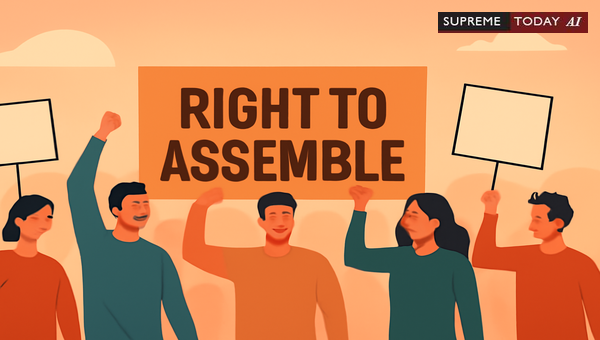
Right to Assemble in India: Key Judgments
Introduction
In a democracy like India, the freedom to gather peacefully—whether for protests, meetings, or celebrations—is more than a tradition; it's a fundamental right. But is the right to gather truly protected, and what are its limits? This question often arises amid public demonstrations or rallies. Under the Indian Constitution, the right to assemble peacefully and without arms is enshrined in . However, it's not unlimited, subject to for .
This blog post dives deep into this right, explaining its constitutional basis, key judgments, and practical implications. We'll reference landmark cases like Himat Lal K. Shah v. Commissioner of Police2025 0 Supreme(Cal) 103, drawing on judicial wisdom to clarify when and how citizens can exercise this freedom. Note: This is general information based on legal precedents and not specific legal advice. Consult a qualified lawyer for your situation.
Constitutional Foundation of the Right to Assemble
guarantees every citizen the . This right is intertwined with (freedom of speech and expression) and (freedom of movement), forming the bedrock of democratic participation 2021 0 Supreme(AP) 1013.
Key aspects include:- Essential for voicing grievances, protesting, and engaging in public discourse.- Applies to peaceful assemblies in open spaces and public streets, part of India's national tradition 2025 0 Supreme(Cal) 103.- Not absolute: and 19(3) allow in the interests of , , and .
The has emphasized that this right enables citizens to express their views, protest, and participate in democratic processes while balancing state responsibilities 2025 0 Supreme(Cal) 103.
Landmark Judgments
, especially the , have shaped the contours of this right through pivotal rulings. Let's examine the most influential cases.
2025 0 Supreme(Cal) 103
In this seminal case, the Court affirmed: the right to assemble peacefully is a constitutional right that can be restricted only under for .2025 0 Supreme(Cal) 103.
- The petitioner sought permission for a public meeting, denied due to past violence.
- Key holding: Assemblies in open spaces are protected, but the state can regulate time, place, and manner. Total bans are invalid unless justified.
- Significance: Restrictions must be reasonable and non-arbitrary, considering past conduct but favoring least restrictive measures 2025 0 Supreme(Cal) 103.
The Court noted that such rights are part of the national life and tradition, rejecting blanket prohibitions on government premises or private property without consent.
1999 0 Supreme(AP) 230
Here, the clarified: No right exists to hold meetings on government premises or private property without permission1999 0 Supreme(AP) 230.
- Assemblies are confined to public streets and open spaces.
- This ruling reinforces that while the right is fundamental, it respects property rights and public safety.
2021 0 Supreme(AP) 1013
The Court observed: The right to hold processions and public meetings flows from and the right to move freely2021 0 Supreme(AP) 1013.
- Restrictions must target and be proportionate.
- Principle: are allowed if there's a clear risk of breach, but not as a pretext to suppress dissent.
These cases collectively establish that permissions can be conditioned—e.g., for security—but outright denials require strong justification 2025 0 Supreme(Cal) 103.
Balancing Rights with :
A core judicial theme is equilibrium between assembly rights and . Courts permit:- Regulation of time, place, and manner (e.g., no blocking traffic, armed gatherings).- Imposition of conditions based on history of violence2025 0 Supreme(Cal) 103.- But prohibitions must be least restrictive and backed by evidence.
For instance, in scenarios involving prior unrest, authorities may deny permissions but must allow alternatives like designated venues. This aligns with , ensuring restrictions aren't arbitrary 2021 0 Supreme(AP) 1013.
In broader legal contexts, the concept of rights infringement underscores that any breach—like undue restrictions—requires material facts proving violation
. While not directly on assemblies, this principle applies: states must justify limits on fundamental rights.
Summary of Key Principles from Judgments
| Case | Key Holding | Significance ||------|-------------|--------------|| Himat Lal K. Shah ()2025 0 Supreme(Cal) 103 | Fundamental right; only | Defines scope and limits || 1999 0 Supreme(AP) 230 | No assemblies on govt/private property without consent | Limits locations || Babulal Parate ()2021 0 Supreme(AP) 1013 | Linked to movement; proportionate curbs | Balances with |
These precedents, including references like 2013 0 Supreme(Del) 519, highlight enduring principles:- Protected venues: Open public spaces.- State powers: Regulate, not prohibit arbitrarily.- Citizen duties: Peaceful conduct, no arms.
Practical Implications and Modern Relevance
Today, with rising protests on issues like farmers' rights or environmental concerns, these rulings guide permissions. For example, if a group has a violent history, conditions like police presence may apply—but courts intervene against bias 2025 0 Supreme(Cal) 103.
Related doctrines, such as explicit rights enforcement in other areas (e.g., permissions for land use depending on ownership rights
), echo the need for clear legal basis before restricting assemblies.
In consumer or civil disputes, timely exercise of rights is crucial, mirroring how assembly permissions must be prompt and fair 2024 Supreme(Online)(NCDRC) 4549 2024 Supreme(Online)(NCDRC) 4548. Delays or undue hurdles can infringe core freedoms.
Conclusion and Key Takeaways
The right to assemble peacefully is a pillar of Indian democracy, robustly protected yet reasonably limited for societal harmony. judgments like Himat Lal K. Shah2025 0 Supreme(Cal) 103, Railway Board1999 0 Supreme(AP) 230, and Babulal Parate2021 0 Supreme(AP) 1013 provide clarity: citizens can gather in public spaces, but states safeguard order.
Key Takeaways:- Exercise in open, public areas peacefully.- Expect reasonable regulations, challenge arbitrary bans.- Past conduct matters, but proportionality rules.
For tailored advice, reach out to legal experts. Stay informed, stay democratic!
References:- 2025 0 Supreme(Cal) 103- 2021 0 Supreme(AP) 1013- 1999 0 Supreme(AP) 230- 2013 0 Supreme(Del) 519
#RightToAssemble, #Article19, #SupremeCourtIndia














