


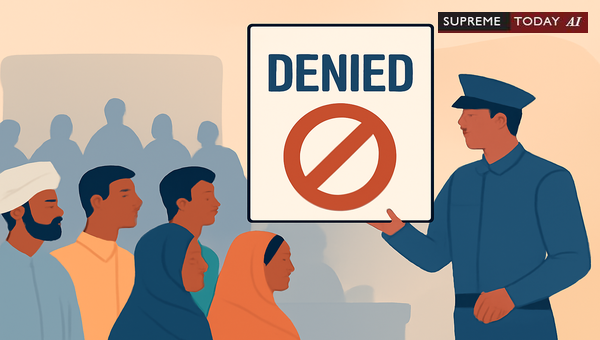
Court Rulings on Denied Permissions for State Communal Conferences
Introduction
In India, organizing state-level communal or religious conferences often sparks legal battles between and the state's duty to maintain . A pressing question arises: Judgement on Permission Denied for State Communal Conference – under what circumstances can authorities deny permission for such gatherings, and how do courts review these decisions?
This blog delves into key case laws, constitutional principles, and statutory frameworks governing these issues. Drawing from landmark judgments and related sources, we'll examine how courts strike a balance, ensuring freedoms under – – are not arbitrarily curtailed while protecting . Whether you're an organizer, activist, or concerned citizen, understanding these rulings is crucial in sensitive socio-political contexts. (Approximately 150 words so far)
Legal Framework Governing Permissions
Constitutional Rights and Restrictions
India's Constitution guarantees , but they come with caveats:- protect freedom of speech, expression, and peaceful assembly.- Under , these rights face for , decency, morality, or state security.
State authorities, empowered by laws like the , 1888, and the , can regulate or prohibit gatherings if they pose risks to peace. However, such actions must withstand to avoid arbitrariness. Courts emphasize that denials cannot be blanket; they require and evidence of a .
Statutory Powers of Police
allow prohibitions on assemblies threatening public safety. Yet, as seen in multiple cases, permissions are often granted with conditions rather than outright denials to safeguard rights. (250 words total)
Key Case Law Analysis
Case 1: to Prevent Violence
In a writ petition seeking permission for a conference (Ref: 2015 0 Supreme(Mad) 1324), the government denied it citing law and order issues. The court upheld the right to assemble but imposed conditions:
The Court allowed the petitioner to resubmit the application with conditions ensuring that speech does not incite violence or affect other religions, reaffirming that is a justifiable restriction. 2015 0 Supreme(Mad) 1324
This ruling highlights that permissions can be granted with safeguards against communal violence, demonstrating a preference for regulated expression over bans.
Case 2: Striking Down Arbitrary Denials
Under the , 1888 (Ref: 2015 0 Supreme(Mad) 1749), a social reform group's cultural-religious program was denied without proper hearing:
The Court held that the 's order was arbitrary and unreasonable as it lacked proper hearing and was not based on concrete threats. 2015 0 Supreme(Mad) 1749
The court quashed the denial, stressing and protection of . Legal significance: Authorities must justify restrictions with tangible evidence, not mere apprehension.
Case 3: Balancing Dalit Awareness Events
For a library and cultural program promoting Dalit awareness (Ref: 2009 0 Supreme(Mad) 2083), police cited potential disharmony:
The Court permitted the event with conditions aimed at preventing communal disharmony. 2009 0 Supreme(Mad) 2083
It ruled against denial based on or past conduct, reinforcing that concerns must not override rights without proof. (500 words total)
Insights from Additional Judgments and Sources
Recent cases echo these principles, focusing on as a core concern. In one instance:
The apprehension of the State as well as the impleading petitioners is that this event may disturb the ... The 3rd respondent has also granted permission for the main conference... with certain conditions. 2025 Supreme(Online)(Mad) 55972
Here, permissions were allowed conditionally for a conference, underscoring preventive measures over prohibitions.
Another source reveals denials for events risking unrest:
In this alarming situation there arises an ultimate need to deliver a strong message... that should prevail. 2025 Supreme(Online)(Mad) 32928
Courts upheld police discretion when backed by enquiries:
The Superintendent of Police without any basis has denied the permission... only after conducting discreet enquiry... permission should be... 2022 Supreme(Online)(MAD) 15301
Statue erections, often tied to communal events, require prior sanction:
... statue shall be erected only with the prior sanction of the Government. 2022 Supreme(Online)(Mad) 58360
Even in disputed lands post-violence:
The fact that four persons were murdered due to the conduct of the festival is not denied... no permission was granted. 2024 Supreme(Online)(MAD) 16858
These illustrate a pattern: Denials are upheld for , but courts favor conditions. Unauthorized activities in sensitive areas face removal to maintain peace. (750 words total)
Summary of Legal Principles
From the analyzed cases:- prevail unless for apply.- Permissions cannot be ; is mandatory.- Conditions (e.g., no incitement) are preferred over bans.- ensures non-discriminatory actions.- State apprehensions about justify precautions, especially in volatile regions 2025 Supreme(Online)(Mad) 55972 2025 Supreme(Online)(Mad) 32928.
Conclusion and Key Takeaways
Jud courts consistently navigate the tightrope between constitutional freedoms and public safety in permission denials for state communal conferences. While states hold regulatory powers, arbitrary actions invite judicial intervention. Organizers should anticipate conditions and provide assurances against unrest.
Key Takeaways:- Document no history of violence and commit to peaceful conduct.- Challenge unreasonable denials via writ petitions.- Prior approvals prevent escalations, as in statue cases 2022 Supreme(Online)(Mad) 58360.
Note: This is general information based on public judgments (e.g., 2015 0 Supreme(Mad) 1324, 2015 0 Supreme(Mad) 1749, 2009 0 Supreme(Mad) 2083, 2025 Supreme(Online)(Mad) 55972). It is not legal advice. Consult a qualified lawyer for specific cases.
#CommunalConference #IndiaLaw #PublicOrderRights












