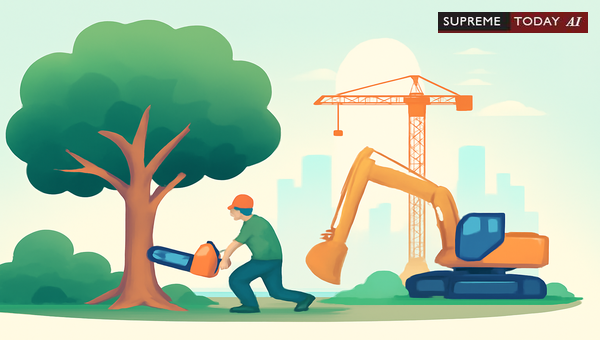
Can Trees Be Cut for Public Utilities in India?
In the balance between urban development and environmental conservation, one pressing question often arises: Trees can be Cut for Construction of Public Utilities? As cities expand and infrastructure projects like roads, metro rails, and bridges proliferate, the need to fell trees for public good clashes with preservation efforts. This blog post delves into the Indian legal framework governing tree felling for public utilities, highlighting permissions, safeguards, and judicial precedents. While this provides general insights, it is not legal advice—consult professionals for specific cases.
Legal Framework for Tree Felling in Public Interest
India's laws prioritize tree preservation but allow exceptions for public infrastructure. The Delhi Preservation of Trees Act, 1994, mandates prior permission from the Tree Officer for felling or pruning trees, with preservation as the primary goal Prof Dr Sanjeev Bagai VS Department of Environment Govt. of NCT of Delhi Through Its Principal Secretary - 2023 0 Supreme(Del) 1710. Similarly, the West Bengal Trees (Protection and Conservation in Non-Forest Areas) Act, 2006, permits felling for public projects subject to environmental assessments and compensatory planting Association for Protection of Democratic Rights VS State of West Bengal - 2018 0 Supreme(Cal) 238.
These statutes recognize that public utilities—such as highways, metro projects, and storm water drains—may necessitate tree removal when justified. Courts have upheld this, emphasizing procedural compliance. For instance, Trees are to be cut for a public purpose to facilitate expansion of the national highway. The Courts are bound to take into consideration the comparative hardship which the people at large would suffer by stalling the project of great public utility Shashwat VS State of Bihar - 2022 Supreme(Pat) 330 - 2022 0 Supreme(Pat) 330.
Permissibility for Construction of Public Utilities
Generally, trees can be felled for public utility projects provided authorities follow statutory procedures. Permissions are required from Tree Officers or Forest Departments after site inspections Prof Dr Sanjeev Bagai VS Department of Environment Govt. of NCT of Delhi Through Its Principal Secretary - 2023 0 Supreme(Del) 1710Delhi Development Authority VS Deputy Conservator Of Forests - 2022 0 Supreme(Del) 896. In Delhi, orders stress assessing necessity and transplantation options before approval Prof Dr Sanjeev Bagai VS Department of Environment Govt. of NCT of Delhi Through Its Principal Secretary - 2023 0 Supreme(Del) 1710Delhi Development Authority VS Deputy Conservator Of Forests - 2022 0 Supreme(Del) 896.
Other cases illustrate this: For metro rail projects, new trees are planted in lieu of those cut, with assistance from bodies like Bruhat Bengaluru Mahanagara Palike (BBMP) and Karnataka Forest Department. Impact on parks, lakes, water bodies and public utilities will be duly addressed SAMANVAYA VEDIKA JAYANAGAR VS BANGALORE METRO RAIL CORPORATION LTD. REP. BY ITS MANAGING DIRECTOR - 2022 Supreme(Online)(NGT) 1644 - 2022 Supreme(Online)(NGT) 1644. Similarly, permissions for cluster bus depots have allowed felling and transplantation, though violations have occurred, such as cutting 495 trees beyond permitted numbers PRAMOD TYAGI VS TRANSPORT DEPARTMENT - 2025 Supreme(Online)(NGT) 421 - 2025 Supreme(Online)(NGT) 421.
Key Conditions and Procedures
Felling trees is not indiscriminate; strict conditions apply:
Additional measures from projects include planting five times the number of trees felled, monitored via geo-tagged photos TEJASVI MINHAS VS PUBLIC WORKS DIVISION - National Green TribunalMumbai Metropolitan Region Development Authority VS Union of India, Through Ministry of Environment Forest & Climate Change - Bombay. For existing trees during construction, protective steps like circular cuts and garland drains ensure root preservation AWADHESH KUMAR PANDEY VS CHIEF SECRETARY STATE OF JHARKHAND - National Green Tribunal. Contractors bear responsibility for utility shifts, with payments for tree cutting handled by employers NHAI VS Hindustan Construction Co. Ltd. - 2017 Supreme(Del) 3613 - 2017 0 Supreme(Del) 3613NATIONAL HIGHWAYS AUTHORITY OF INDIA VS PATEL – KNR (JV) - 2018 Supreme(Del) 1317 - 2018 0 Supreme(Del) 1317.
Even in highway expansions, courts defer to expert recommendations: The Courts should not be asked to assess the environmental impact... but at the most could ensure that the recommendations of the experts have been abided by Shashwat VS State of Bihar - 2022 Supreme(Pat) 330 - 2022 0 Supreme(Pat) 330.
Court Judgments and Precedents
Judicial oversight ensures balance. The Supreme Court has upheld felling for infrastructure with compensatory plantation Association for Protection of Democratic Rights VS State of West Bengal - 2018 0 Supreme(Cal) 238. Orders direct transplantation where feasible Delhi Development Authority VS Deputy Conservator Of Forests - 2022 0 Supreme(Del) 896. However, lapses invite scrutiny: Even assuming trees have to be cut from the area for the public project, it has to be ascertained exactly how many trees are required to cut, whether some can be saved or transplanted Federation of Rainbow Warriors VS Deputy Conservator of Forests (North Goa Division) Forest Department - 2018 Supreme(Bom) 292 - 2018 0 Supreme(Bom) 292.
In metro and railway projects using cut-and-cover methods, felling is permitted with transplantation and replanting per norms People United For Better Living In Calcutta (PUBLIC) VS State of West Bengal - Calcutta. Violations on public land, like excess cutting, have led to repercussions PRAMOD TYAGI VS TRANSPORT DEPARTMENT - 2025 Supreme(Online)(NGT) 421 - 2025 Supreme(Online)(NGT) 421.
Limitations and Counterarguments
Not all felling is approved:
Concerns persist over illicit felling, requiring permissions State Of H. P. VS Krishan Lal Pardhan - 1987 0 Supreme(SC) 139. Projects must minimize impact on greenery, replacing dead trees Mumbai Metropolitan Region Development Authority VS Union of India, Through Ministry of Environment Forest & Climate Change - BombayMumbai Metropolitan Region Development Authority VS Union of India - Bombay.
Recommendations for Compliance
To navigate this:
- Obtain prior permissions from competent authorities.
- Conduct EIAs and prioritize transplantation.
- Implement compensatory afforestation.
- Follow procedures to avoid violations.
- Seek judicial review if needed.
Authorities must supervise contractors strictly Federation of Rainbow Warriors VS Deputy Conservator of Forests (North Goa Division) Forest Department - 2018 Supreme(Bom) 292 - 2018 0 Supreme(Bom) 292.
Conclusion and Key Takeaways
Trees may generally be cut for public utilities in India when complying with laws, permits, and safeguards like compensatory afforestation. This balances infrastructure needs with conservation, as upheld by courts Association for Protection of Democratic Rights VS State of West Bengal - 2018 0 Supreme(Cal) 238Prof Dr Sanjeev Bagai VS Department of Environment Govt. of NCT of Delhi Through Its Principal Secretary - 2023 0 Supreme(Del) 1710Delhi Development Authority VS Deputy Conservator Of Forests - 2022 0 Supreme(Del) 896. Developers should plan meticulously, integrating protective measures to minimize ecological harm.
Key Takeaways:- Permissions and assessments are mandatory.- Compensatory planting offsets losses.- Courts prioritize public interest with due process.- Violations invite penalties.
Stay informed on evolving regulations for sustainable development. For tailored advice, consult legal experts.
#TreeFellingLaws #PublicUtilitiesIndia #EnvironmentalLaw