


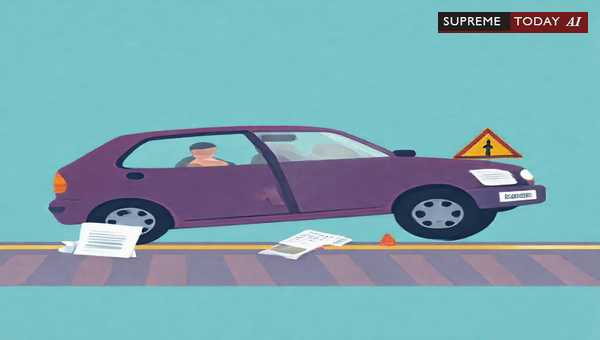
When a Person Dies in an Uninsured Vehicle After a Rash Driving Accident, Can the Insurer of the Offending Vehicle Be Made to Pay?
One of the most emotionally and legally complicated questions in motor accident litigation arises when the deceased was not driving at all, but was merely sitting in a vehicle that had no insurance cover. A common version of this situation is a collision where a private car or two-wheeler carrying a passenger is hit by a bus, truck, or other insured vehicle driven rashly and negligently. The family of the deceased then asks: if the vehicle that caused the accident is fully insured, does the death of a person who was travelling in an uninsured vehicle still entitle them to compensation from that insurer? The answer, as Indian courts have consistently held, is generally yes — but with important qualifications that depend on who was at fault and how the deceased was travelling.
Why Fault of the Offending Vehicle Matters More Than the Victim's Insurance Status
Motor accident compensation under the is built on the principle that victims of accidents caused by the negligence of another driver must be protected. A claim under rests on , meaning the claimant must establish that the accident occurred because of the rash or negligent driving of another vehicle 2026 0 Supreme(Guj) 924. The insurance status of the vehicle in which the victim was travelling is not, by itself, a bar to recovery.
In a typical case, the claimants plead that the accident was due to the of the offending vehicle, while the insurer of that vehicle contests negligence 1997 0 Supreme(Mad) 1065. Tribunals routinely decide these disputes on evidence, and where the rash driving of the insured vehicle is established, the insurer of that vehicle is fastened with liability to pay compensation to the victims, including passengers of the other vehicle 2026 Supreme(Online)(Mad) 50965. In one matter, the Tribunal concluded that the accident had taken place only due to the of the offending vehicle, and compensation followed accordingly 2026 Supreme(Online)(Mad) 50965.
So, a person who died while sitting in an uninsured vehicle is typically treated as a vis-à-vis the insured offending vehicle, because they were not an occupant of the insured vehicle itself and did not share its policy.
The Crucial Distinction: Occupant of the Insured Vehicle Versus Occupant of the Other Vehicle
The analysis changes completely depending on which vehicle the deceased was in:
Occupant of the insured (offending) vehicle: Courts have generally held that a person travelling in the insured vehicle itself — including in an uninsured trailer attached to an insured tractor — is not a for the purposes of the policy. As one decision put it, when a tractor and trailer are involved, both are required to be insured, and where the claimant was travelling in the trailer which was not insured, liability on the insurance company cannot be fastened 2014 0 Supreme(Del) 2370. The insurer's liability under , titled Insurance of Motor Vehicles against risks, is to cover third parties and not occupants of the insured vehicle 2007 3 Supreme 136.
Occupant of the other (uninsured) vehicle: Where the deceased was a passenger in a vehicle struck by the insured vehicle, the victim is a with respect to the insured vehicle's policy. The fact that the vehicle they were sitting in was uninsured does not extinguish their claim against the insurer of the negligent vehicle.
Co-passenger in the offending vehicle: A person who was only sitting as a co-passenger in the offending vehicle, and was not driving it, has been held entitled to compensation, since the negligence was that of the driver, not the passenger 2026 Supreme(Online)(Chh) 15992.
Situations Where the Insurer May Still Escape Liability
Even when the victim is a , insurers have recognised defences:
: An insurer is not liable to pay compensation to a passenger in a vehicle that is being used for in violation of the terms of the policy. In one case, the deceased had paid the driver to travel in a jeep whose policy specifically excluded use for , and the court held the insurer not liable, making the owner and driver alone responsible for the compensation.
No negligence by the insured driver: If the accident was caused solely by the negligence of the driver of the vehicle in which the deceased was travelling, the insurer of the other vehicle cannot be made liable. A claim under requires proof of another party's negligence; where the deceased driver caused the accident through their own fault, the insurance company is not liable 2026 0 Supreme(Guj) 924. In such cases, tribunals may apply and apportion liability — for example, where a claimant contributed by driving in an intoxicated condition, a percentage deduction was applied 2017 Supreme(Online)(KER) 36371. However, a finding of requires clear proof; without adequate evidence, deductions may be unjustified 2017 Supreme(Online)(KER) 36371.
Licence and coverage issues: Where an accident took place without fault on the part of the driver, the question of whether the driver held a valid licence becomes redundant, and the insurer's liability on the insured vehicle may stand 2016 0 Supreme(All) 273.
How Compensation Is Calculated in These Claims
Once liability is established, the quantum of compensation follows the standard framework under — income of the deceased, deductions for personal expenses, and multiplicands applicable to the dependents. Claimants should note that tribunals scrutinise income proof carefully: a single year's income tax return, produced close to the date of the accident without supporting returns from earlier years, may be deemed unreliable for determining the deceased's income 2026 Supreme(Online)(Mad) 50965.
Practical Steps for Families of Victims in Uninsured Vehicles
- File a claim against the insured offending vehicle: Join the owner, driver, and insurer of the vehicle that caused the accident as respondents before the Motor Accident Claims Tribunal.
- Prove : Collect FIR, spot report, witness statements, and mechanical evidence linking the accident to the offending vehicle's driver.
- Clarify the deceased's role: Establish that the deceased was a passenger, not the driver responsible for the collision — this is decisive for shifting liability to the insurer 2026 Supreme(Online)(Chh) 15992.
- Check the policy conditions: Examine whether the offending vehicle's policy covers the use in question, since exclusions (such as ) can defeat the insurer's liability.
- Anticipate pleas: Be prepared with evidence to rebut allegations that the deceased's vehicle or driver contributed to the accident.
Key Takeaways
The insurance status of the vehicle in which a victim was travelling does not, in itself, prevent recovery of compensation from the insurer of the vehicle that caused the accident through . The victim is a vis-à-vis that policy. The position reverses only where the deceased was an occupant of the insured vehicle itself, was a passenger carried in , or where the deceased's own driver was solely at fault. Because outcomes turn on the specific facts, policy terms, and evidence of negligence, families should assess their claim with a qualified advocate before the appropriate tribunal.
#MotorVehiclesAct #AccidentClaims #InsuranceLiability #ThirdPartyInsurance #MACT









