


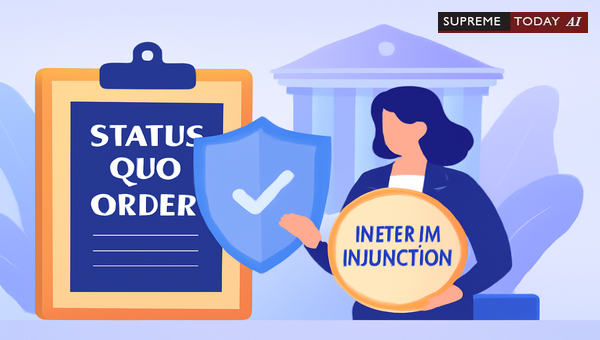
When Status Quo Orders Should Not Be Granted
In legal proceedings, particularly in civil litigation, a (also known as an ) is a powerful tool courts use to maintain the existing state of affairs between parties until the main dispute is resolved. However, these orders are not indefinite or automatic. Courts exercise caution, granting them only under specific conditions like , , and . But when should a not be granted? This question arises frequently in appeals, revisions, and enforcement scenarios.
This blog post delves into key legal principles, landmark cases, and practical scenarios where courts have refused or vacated status quo orders. Drawing from judicial precedents, we'll outline circumstances where such relief is typically denied. Note: This is general information based on case law and not specific legal advice. Consult a qualified lawyer for your situation.
Core Legal Principles for Denying Status Quo Orders
Status quo orders are interim in nature and must adhere to strict procedural and substantive standards. Here's a breakdown of situations where they should not be granted or maintained:
1. Lack of Continuation or Validity of the Original Order
If a from a higher court, such as the , is limited to a specific date and not extended, it automatically lapses. The party claiming its continuance must produce extension orders; otherwise, it ceases to operate. For instance, If a granted by a higher court (e.g., ) is only until a specific date and is not extended further, it ceases to have effect thereafter 2015 0 Supreme(Bom) 1966.
Without proof of extension, courts will not perpetuate a defunct order, preventing abuse of judicial process.
2. Absence of Clarification or Application for Extension
Parties cannot presume an order's indefinite validity. Failing to seek clarification or extension from the issuing court undermines the claim. When a party fails to seek clarification or extension of a from the court or the , the order cannot be presumed to be in force indefinitely 2015 0 Supreme(Bom) 1966. Timely action is crucial; inaction weakens the basis for enforcement.
3. Previous Orders in Force but Challenged Without Extension
Where an order remains operative because the opposing party hasn't vacated it effectively, it persists. However, if challenged and no stay or extension follows, arbitrary continuation is unwarranted. If the order is challenged and no further stay or extension is granted, it should not be continued arbitrarily 2013 0 Supreme(Bom) 1811.
4. Interim Orders Not Surviving Final Disposition
Post-disposal of the main case or appeal, interim orders do not survive unless explicitly extended. After the disposal of the main case or appeal, interim or status quo orders do not automatically survive unless explicitly continued or extended 2021 0 Supreme(Bom) 745. Continuing irrelevant orders post-judgment is inappropriate.
5. Risk of Irreparable Harm or Obstruction of Justice
Orders causing significant obstruction, such as halting lawful progress or inflicting irreparable harm—especially if provisional—should be denied. A should not be granted if it causes significant obstruction, such as preventing lawful progress or causing irreparable harm 1999 5 Supreme 60. Courts balance equities to avoid injustice.
6. Orders Lacking Substantive Grounds or Jurisdiction
orders without hearing the other side or issued sans jurisdiction lack perpetuity. If the order is issued without proper jurisdiction or lacks a sound legal basis... it might be subject to challenge and not be perpetuated 1999 5 Supreme 60.
Additional Scenarios from Judicial Precedents
Beyond core principles, various cases highlight contextual denials:
Violation of : Punitive actions like revoking permits without a hearing are invalid. Punitive actions, such as revoking permits, should not be granted without following principles of
. The revocation of a building permit was quashed for lacking a fair opportunity to be heard.
Illegality of Underlying Schemes: Benefits under schemes declared , like , cannot be granted. Schemes like , once declared and illegal by courts, should not be granted relief or benefits under them 2022 Supreme(Online)(CAT) 1441. Perpetuating illegality is impermissible.
Improper Penalty Imposition: Penalties without are unsustainable. Penalty should not be imposed under ... The appellant’s submission is that the denial of was not subject matter of 2023 Supreme(Online)(CESTAT) 631. Procedural flaws invalidate such actions.
Expiry of Limitation Periods: Relief post-statutory limits is barred. Actions revising cases after extended periods should not proceed 2024 Supreme(Online)(MP) 4919.
Pre-Existing Conditions in Service Claims: Disability benefits denied if conditions noted at enlistment negate presumption of soundness 2025 Supreme(US)(cafc) 18.
Execution and Payment Disputes: Even satisfactory work doesn't guarantee payments if delayed justifiably, though courts urge promptness. It is not disputed by the respondents that the petitioner has executed the work allotted to him to the satisfaction of the respondents
; yet, undue delays warrant scrutiny
.
Biased Arbitration Processes: Arbitrator appointments from prejudiced panels compromise neutrality and should not be granted 2025 Supreme(Online)(Kar) 21845.
Lack of Standing or Jurisdiction: Speculative injuries or improper parties bar relief. Big Shoulders asserts that Sandton’s injury is speculative and not concrete 2021 Supreme(US)(ca7) 388; standing must be concrete 2024 Supreme(US)(ca7) 401.
These precedents underscore that status quo isn't a blanket remedy; it demands legal rigor.
Practical Recommendations for Litigants
To navigate these issues:- Verify Order Status: Always check for extensions or vacaturs before relying on an order.- File Timely Applications: Seek clarifications or extensions promptly.- Assess Impacts: Evaluate if the order obstructs justice or causes hardship.- Follow Procedures: Adhere to and jurisdictional norms.
Verify whether the original order has been extended or vacated. Ensure proper application or request for continuation if needed 2015 0 Supreme(Bom) 1966.
Conclusion and Key Takeaways
Status quo orders are vital for preserving rights but fragile without proper maintenance. They should not be granted or upheld if temporary without extension, procedurally flawed, jurisdictionally weak, or harmful 2013 0 Supreme(Bom) 1811 2021 0 Supreme(Bom) 745. Courts prioritize fairness, legality, and public interest, as seen in diverse cases from penalty impositions to permit revocations.
Key Takeaways:- Temporary orders lapse without explicit renewal.- Procedural lapses (e.g., no hearing) invite denial.- Balance irreparable harm against obstruction.- Illegality or expired limits bar relief.
By understanding these boundaries, litigants can avoid futile claims and strategize effectively. For tailored advice, engage legal experts.
(Word count: 1028. References drawn exclusively from provided materials.)
#StatusQuoOrder, #LegalInsights, #CourtInjunctions
















