


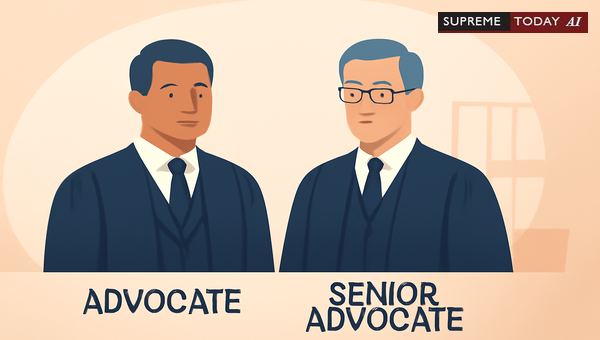
Advocate vs Senior Advocate: Key Differences Under the
Introduction
In India's legal landscape, advocates are the backbone of justice delivery, representing clients in courts and tribunals across the country. However, not all advocates are the same. A common query among law students, aspiring lawyers, and the general public is: What is the difference between Advocate and Senior Advocate according to the Advocates Act?
This distinction is governed primarily by the , which regulates the legal profession in India. Understanding these differences is crucial for anyone navigating legal proceedings, whether as a litigant, practitioner, or observer. This post breaks down the definitions, designation process, rights, restrictions, and practical implications, drawing from judicial interpretations and statutory provisions. Note that this is general information and not specific legal advice—consult a qualified lawyer for your situation.
Who is an Advocate?
An Advocate is a qualified legal professional entitled to practice law in India. According to established norms, Every person who has passed L.L.B. and enrolled with concerned, becomes an Advocate and this does not require any recognition by Court 2019 0 Supreme(All) 2520.
Key Qualifications and Enrollment
- Completion of an LL.B. degree from a recognized university.
- Enrollment with the under .
- Payment of enrollment fees and adherence to the 's standards of professional conduct.
Once enrolled, an advocate gains the right to practice before any court or in India, as enshrined in . This includes filing (power of attorney), drafting pleadings, acting on behalf of clients, and arguing cases.
Advocates form the majority of the legal fraternity and handle a wide range of matters, from civil disputes to criminal trials.
Who is a Senior Advocate?
A Senior Advocate, on the other hand, is an elite designation conferred upon an existing advocate by a or the . It is a recognition by Court to the legal knowledge, high degree of Advocacy, manner of presentation in Court and other relevant considerations which are cumulatively considered to confer the status of 'Senior Advocate' upon an Advocate 2019 0 Supreme(All) 2520.
Designation Process Under Section 16
The , particularly Section 16, empowers the Full Court of a or the to designate an advocate as a Senior Advocate. Key points:- Not a Matter of Right: Conferment of status of 'Senior Advocate' to an 'Advocate' is not a matter of right 2019 0 Supreme(All) 2520.- Criteria include standing at the Bar for at least 10 years (typically), exceptional legal acumen, contributions to law, and peer recommendations.- The court may act on its own motion or upon recommendation from the Attorney General or existing Senior Advocates.- High Courts frame rules under Section 34, and the under Section 49, to regulate this (e.g., Rule 210 in some High Courts) 2013 0 Supreme(Jhk) 213.
Importantly, The and particularly Section 49, nowhere provides for giving power to the to give status of senior advocate 2013 0 Supreme(Jhk) 213—this power rests solely with the judiciary.
Key Differences: Advocate vs Senior Advocate
Here's a comparative overview:
| Aspect | Advocate | Senior Advocate ||-------------------------|---------------------------------------|------------------------------------------|| Enrollment | (Section 24) | Designated by HC/SC (Section 16) || Qualification | LL.B. + Enrollment | Existing Advocate + Merit Recognition || Right to Designation| Automatic upon enrollment | Not a right; discretionary 2019 0 Supreme(All) 2520 || Practice Scope | Full: File, act, plead, argue | Primarily argue; restrictions apply || Vakalatnama | Can file | Cannot file 2015 0 Supreme(Ker) 1334 || Remuneration | Fixed or negotiated fees | Higher fees, often briefed by juniors || Privileges | Standard right to practice (Sec 30) | Precedence in hearing, gown with band |
These differences ensure Senior Advocates focus on high-level advocacy while juniors handle procedural aspects.
Rights and Restrictions of Senior Advocates
While Senior Advocates enjoy prestige and priority in court listings, they face specific curbs to maintain focus on :- Prohibitions: From the Rules framed by the as noted above, what is prohibited to a Senior Advocate is 'the Senior Advocate shall not file any Vakalathnama or act in any court' 2015 0 Supreme(Ker) 1334. The term act typically means not taking instructions directly from clients or handling pleadings.- They must work through junior advocates for filing documents and client interactions.- Right to Practice: Like regular advocates, they retain the fundamental right under Section 30 to appear before courts and tribunals.
Practical Implications in Tribunals: Example from Senior Citizens Act
The Advocates Act's provisions extend to tribunals. A pertinent example is proceedings under the . Section 17 of that Act initially prohibited legal representation: no party to a proceeding before the or shall be represented by a 2023 0 Supreme(Kar) 268.
However, courts have declared this Section 30 of the Advocates Act, rendering it unenforceable. Thus, parties, including senior citizens, have the right to advocate representation 2023 0 Supreme(Kar) 268. In one case, a allowed representation by an advocate before the Deputy Commissioner 2023 0 Supreme(Kar) 268. Similarly, in eviction-related matters under the Act, courts upheld a daughter-in-law's right to present her case through an advocate 2017 0 Supreme(P&H) 2133.
This applies to both advocates and Senior Advocates, reinforcing the supremacy of the Advocates Act. Note that the Senior Citizens Act focuses on welfare, not property disputes or eviction, which must be pursued separately 2022 0 Supreme(Del) 2210 2023 0 Supreme(Bom) 2118. Appeals are limited to senior citizens or parents 2018 0 Supreme(Kar) 888.
Judicial Interpretations and Case Law
- Designation and Recognition: Courts emphasize merit over entitlement 2019 0 Supreme(All) 2520.
- Representation Rights: Section 17 of Senior Citizens Act held unenforceable, permitting advocates 2023 0 Supreme(Kar) 268.
- Eviction Limitations: Tribunals under the Act cannot order eviction via advocates; it's welfare-focused
2024 0 Supreme(P&H) 901.
These rulings underscore that Advocates Act rights prevail, benefiting both categories of advocates.
How to Become a Senior Advocate?
Aspiring advocates should:- Build a strong practice record (10+ years).- Secure recommendations.- Excel in complex cases.
The process is rigorous, with only a fraction elevated annually.
Conclusion and Key Takeaways
The primary difference lies in stature and practice style: regular advocates handle comprehensive representation, while Senior Advocates are apex advocates with procedural limits but immense influence. Governed by the , these distinctions promote specialization and efficiency.
Key Takeaways:- Enrollment makes you an Advocate; court designation makes you Senior.- Seniors cannot file but retain practice rights 2015 0 Supreme(Ker) 1334.- In specialized tribunals like Senior Citizens Act, representation is allowed despite contrary provisions 2023 0 Supreme(Kar) 268.- Always prioritize welfare in senior citizen matters 2022 0 Supreme(Del) 2210.
For personalized guidance, approach a local advocate. Stay informed on evolving jurisprudence.
References (Inline citations used; key documents: 2023 0 Supreme(Kar) 268 2022 0 Supreme(Del) 2210 2017 0 Supreme(P&H) 2133 2019 0 Supreme(All) 2520 2015 0 Supreme(Ker) 1334 2013 0 Supreme(Jhk) 213 2018 0 Supreme(Kar) 888 2023 0 Supreme(Bom) 2118)
#AdvocatesAct #SeniorAdvocate #LegalIndia















